
Self-host QMReader
v1.0.12RSS workbench with AI translation and Chinese rewriting
- Stars
- 261
- Port
- 8080 (HTTP server)
- Requires
- Node.js, SQLite
What is QMReader?
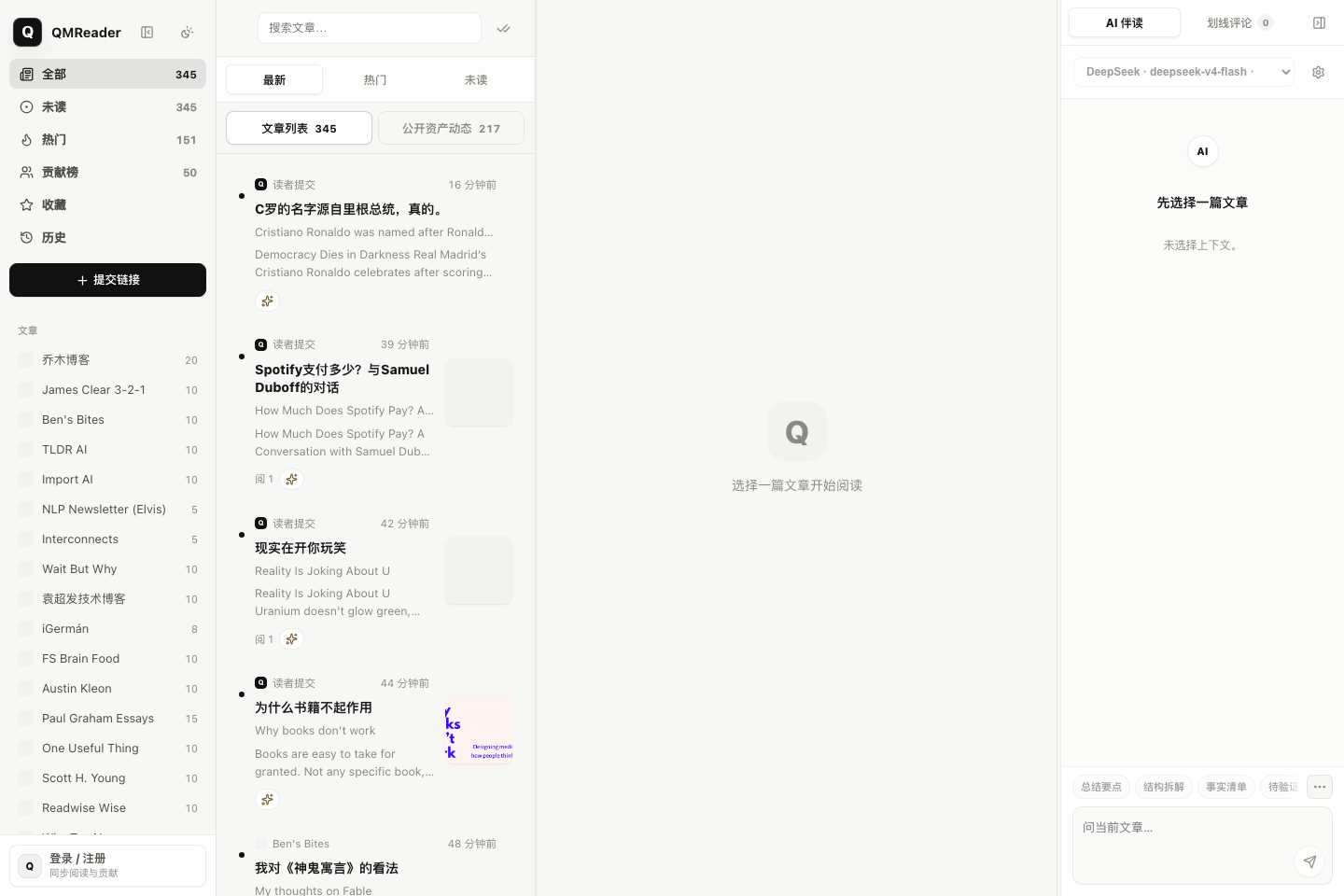
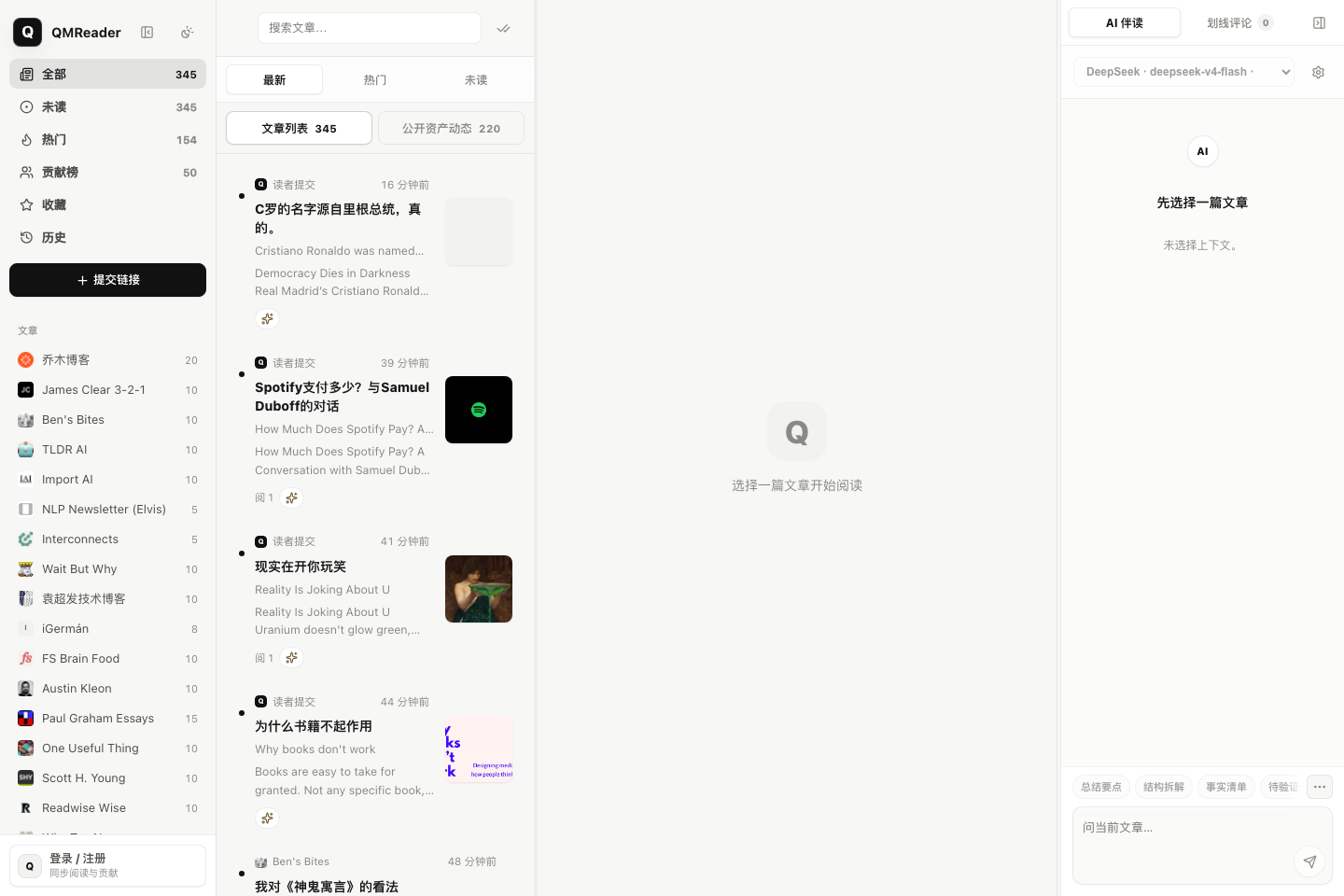
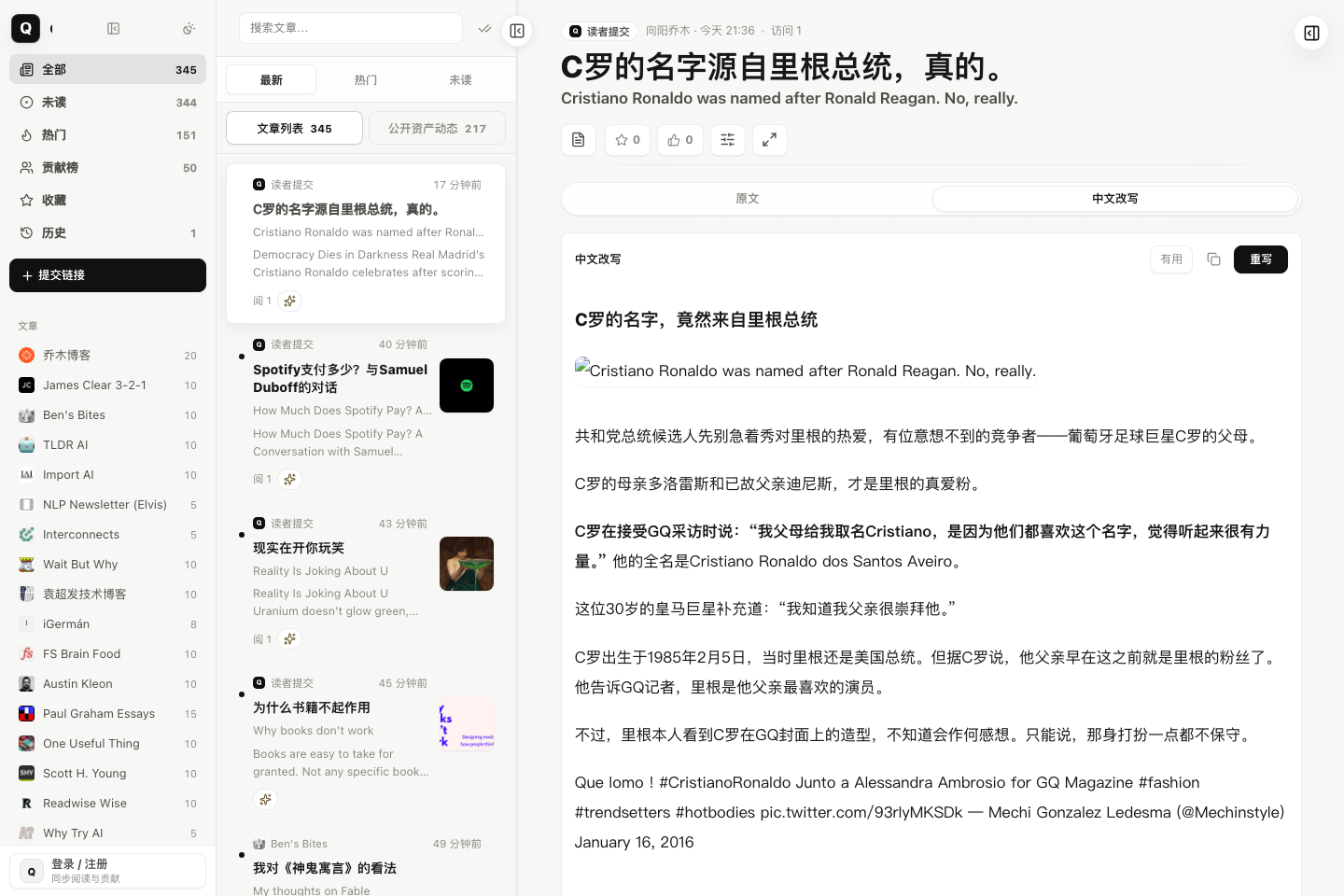
This self-hosted RSS workbench pulls feeds from RSSHub, direct RSS, sitemaps, and several technical sources. It separates fast RSS fetching from slower AI processing so new entries appear immediately while translation and rewriting run in the background. Readers see original articles alongside bilingual translations and Qiaomu-style rewrites, can add annotations and comments, and chat with an article-context AI agent. All generated content becomes public reading assets with stable deep links, contributor pages, and RSS feeds. The stack is Node.js (Express) with SQLite, deployable via Docker Compose or systemd. Server-side AI uses DeepSeek or any OpenAI-compatible API; users may also provide their own browser-side API keys stored locally. The project is MIT-licensed and maintained by 向阳乔木.
Should you self-host QMReader?
QMReader scores 47/100 on selfhost.directory (how scoring works) and ranks #41 of 85 in Feed Reader. It has 261 GitHub stars.
It shipped 10 stable releases in the past year. The latest, v1.0.12, came out on 28 October 2026.
Setup is moderate: expect some configuration beyond a single command. It is MIT-licensed and written mostly in JavaScript.
Its closest alternative on selfhost.directory is RSSHub (85/100, 46 702 stars). It scores higher overall, so compare the two before you pick. See QMReader vs RSSHub side by side.
Features
- Admin Dashboard
- Article annotations
- Article-context AI chat
- Bilingual reading
- Chinese article rewriting
- Contributor system
- Hacker News enhanced feeds
- Immersive reading mode
- Multi-source RSS aggregation
- Podcast episode support
- Public reading assets
- Reader link submission
- REST API
- Split refresh pipeline
- User-provided AI keys
QMReader README
More in Self-hosting
 quillnote-serverSelf-hosted Go server emulating Nextcloud Notes API for Quillnote/Quillpad app sync with SQLite storage.
 rainstormRainstorm is a self-hosted home server platform for Raspberry Pi to deploy services like Plex and Pi-hole via a web dashboard with zero terminal commands.
 Ride The Lightning (Core Lightning)Self-hosted web UI for managing Lightning nodes (LND, Core Lightning, Eclair) with dashboards, channel management, submarine swaps, multi-node support, 2FA, and SSO.
 RSSman XRSSman X is a self-hosted Docker Compose stack bundling Tiny Tiny RSS and RSSHub with optional Mercury, OpenCC, Huginn, and Watchtower in three editions.
 seedboxSeedbox is a self-hosted, open-source Docker Compose stack for a personal seedbox and media server with Plex, Sonarr, Radarr, Deluge, managed via Traefik with auto HTTPS.
 Self Host BlocksSelfHostBlocks is an opinionated NixOS server management system with modular blocks for self-hosting services with unified config, LDAP/SSO, backup, and monitoring.
 SimpleRelayA self-hosted multi-tenant SMTP relay routing email through upstream providers with a web dashboard for DNS validation and access control.
 SmallwebSmallweb is a self-hosted personal cloud mapping subdomains to folders for instant app deployment. Runs as a single Go binary with Deno, no build step, sandboxed apps.
 smsSelf-hosted vector tile server serving OSM data from MBTiles with hiking/cycling routing, SAC ratings, and MCP for LLM agents to plan tours.
 StartOSOpen-source, self-hosted Linux server OS: run services in isolated containers from a web UI with a marketplace, local HTTPS, Tor and encrypted backups.
 supabase-ai-starter-kitSelf-hosted open-source starter kit bundling Supabase, n8n workflows, and Ollama LLMs in one Docker Compose stack with seeded AI agents for RAG and chat.
 SyncloudSyncloud is a self-hosted, open-source platform turning your hardware into a personal app server with one-click installs for 50+ apps.
0 comments