
Self-host OxMgr
v0.6.0Lightweight cross-platform process manager in Rust
- Stars
- 294
What is OxMgr?
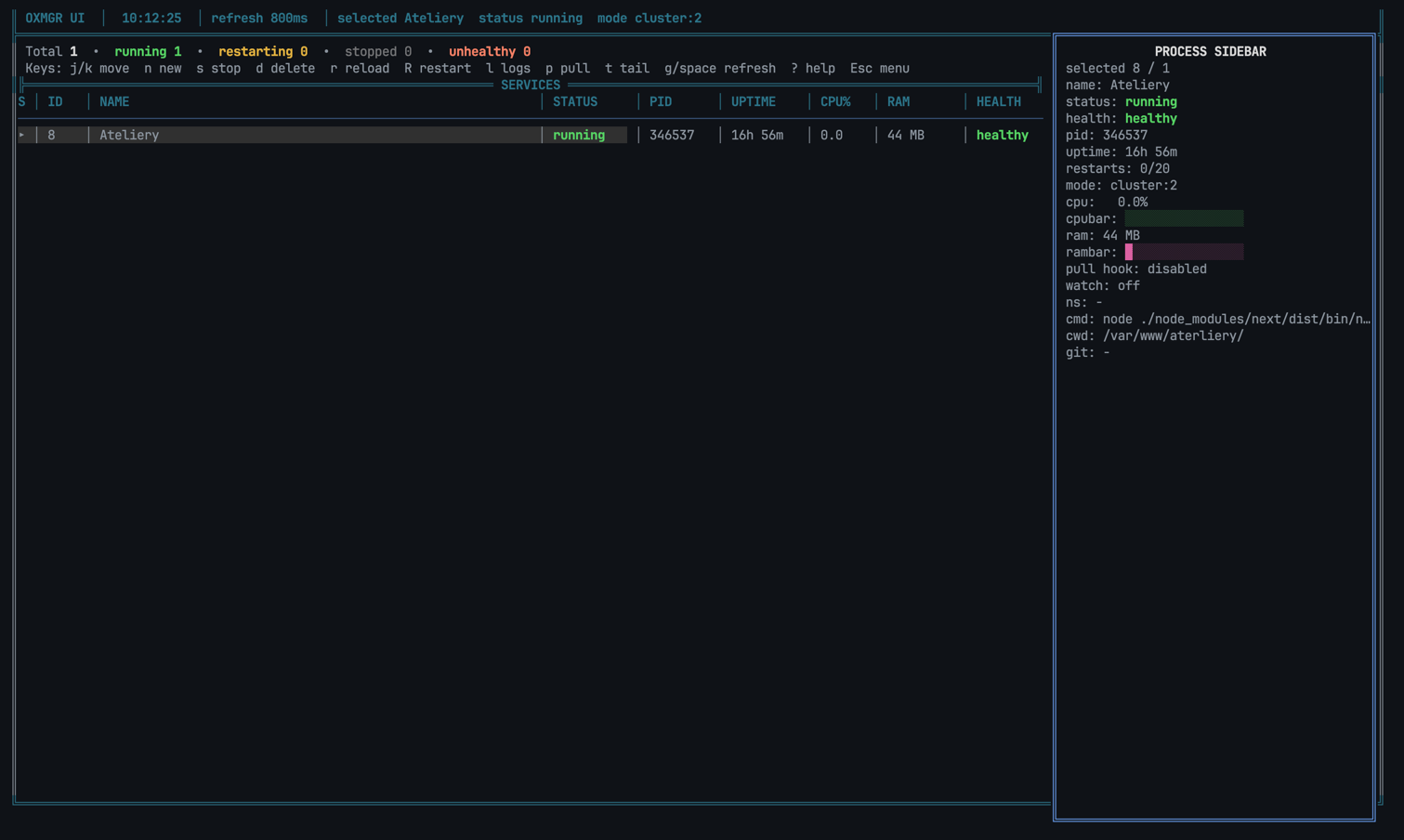
Oxmgr is a modern process manager written in Rust that manages any long-running executable — Node.js, Python, Go, Rust binaries, shell scripts — across Linux, macOS, and Windows. It provides a PM2-compatible workflow with a declarative TOML configuration (oxfile.toml) that supports idempotent apply operations, per-process health checks with automatic restart, CPU and memory limits via cgroup v2, crash-loop protection, file-watch auto-restart, Git pull and webhook-driven deployments, and an interactive terminal UI showing live CPU/RAM metrics. It runs as a lightweight daemon with persistent local state, and offers a foreground runtime mode (oxmgr runtime) for containers and Kubernetes that forwards logs to stdout/stderr. The project is MIT-licensed with no telemetry.
Should you self-host OxMgr?
OxMgr scores 49/100 on selfhost.directory (how scoring works) and ranks #6 of 20 in Application Management. It has 294 GitHub stars.
It shipped 12 stable releases in the past year. The latest, v0.6.0, came out on 27 October 2026. New versions land roughly every 5 days.
Setup is easy: most people get it running in one sitting. It is MIT-licensed and written mostly in Rust.
Its closest alternative on selfhost.directory is hot-updater (62/100, 1 797 stars). It scores higher overall, so compare the two before you pick. See OxMgr vs hot-updater side by side.
Features
- Container runtime mode
- Crash-Loop Protection
- Cross-platform
- Declarative Configuration
- File Watch & Auto-Restart
- Git Pull & Webhook Deploys
- Health Checks & Auto-Restart
- Log Management
- PM2 compatibility
- Process management
- Prometheus Metrics
- Resource LimitsLinux only
- Service Bundles
- Service Installation
- Terminal UI
OxMgr README
More in DevOps
 portabaseSelf-hosted, open-source database backup tool where agents dump PostgreSQL, MySQL, MongoDB and more on a cron, with GFS retention, S3/SFTP storage and restores.
 prom-alertmanagerOpen-source Prometheus alert hub: deduplicates, groups, routes and silences alerts to Slack, PagerDuty, email or webhooks; self-hosted with a Docker image or binaries.
 ptah-serverSelf-hosted Fair Source PaaS replacing Heroku/Vercel, using Docker Swarm for apps, databases, backups, and SSL. Archived, development paused.
 PulumiOpen-source infrastructure-as-code CLI and engine for AWS, Azure, GCP and Kubernetes in TypeScript, Python or Go, with self-hosted state in S3 or PostgreSQL.
 rackOpen-source, self-hosted PaaS that runs your apps on a Kubernetes cluster inside your cloud account, adding autoscaling, instant rollbacks, and a Heroku-like CLI.
 Red Hat QuaySelf-hosted, open-source container image registry that stores OCI artifacts, scans with Clair, and runs standalone on Podman or on Kubernetes via the Quay Operator.
- RhodeCodeRhodeCode is an open-source, self-hosted platform for unified repository management, supporting Git, Mercurial, and Subversion. It provides enterprise-grade security, code review, workflow automation, and permission management for teams.
 roterote is a self-hosted, open-source CLI cron replacement that captures stdout/stderr, records exit codes and timing, and provides a live terminal dashboard.
 RundeckEnable Self-Service Operations: Give specific users access to your existing tools, services, and scripts
 scanopyNetwork diagrams that update themselves
 sensu-goSelf-hosted, open-source monitoring with auto-discovery for cloud environments, using service checks and an observability pipeline to collect and transform telemetry.
 skyfloDeprecated open-source AI agent that runs in your Kubernetes cluster to automate infrastructure via a deterministic approval-gated control loop.
0 comments