
Self-host nanotdb
v1.4.0Single-binary TSDB with built-in dashboard for edge devices
- Stars
- 141
- Port
- 8428 (HTTP server (dashboard, API, ingest))
What is nanotdb?
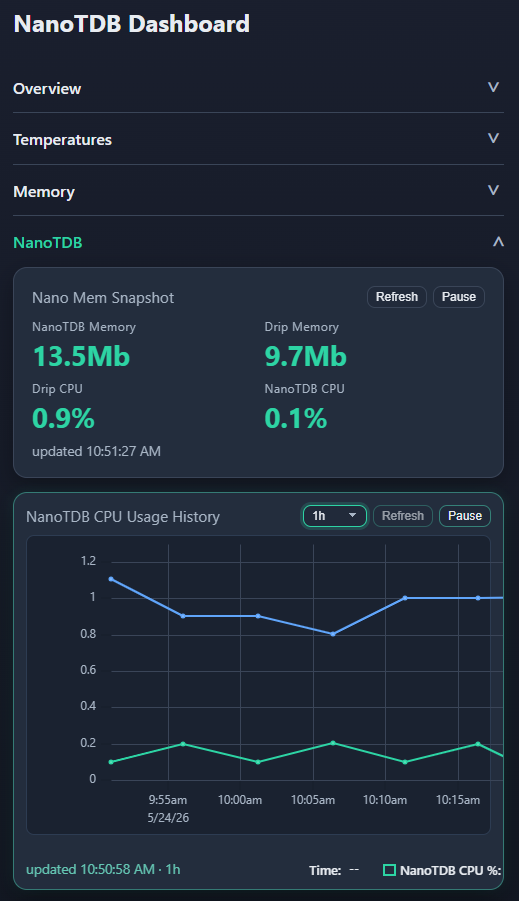
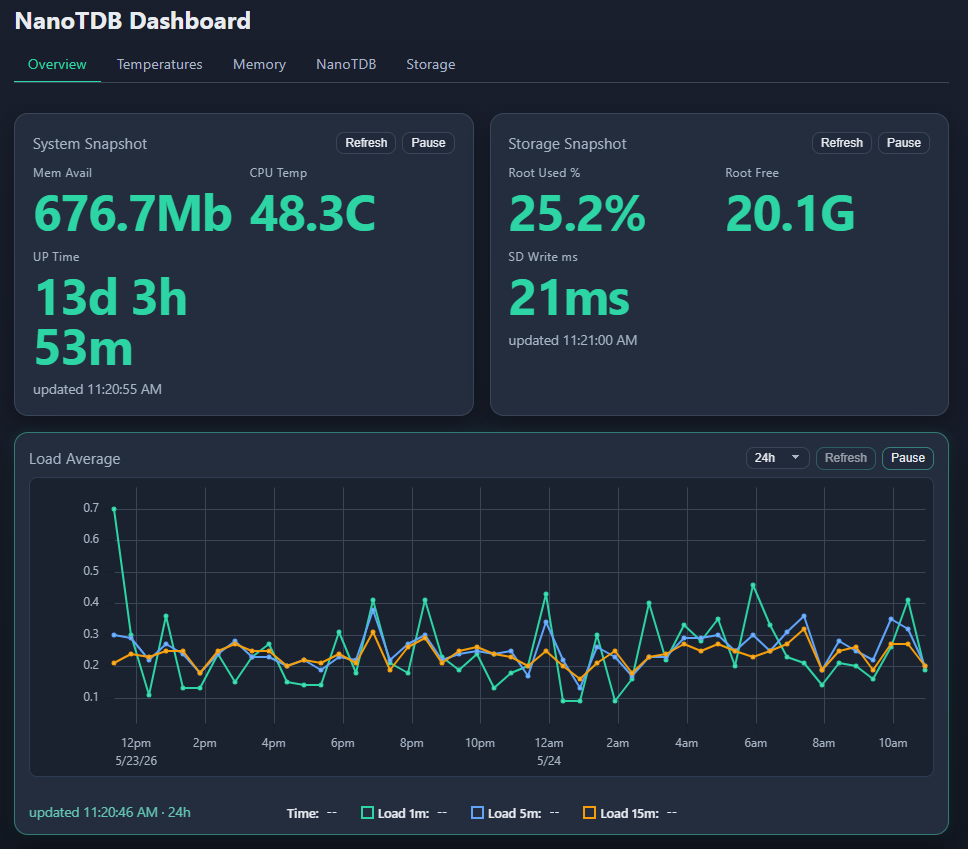
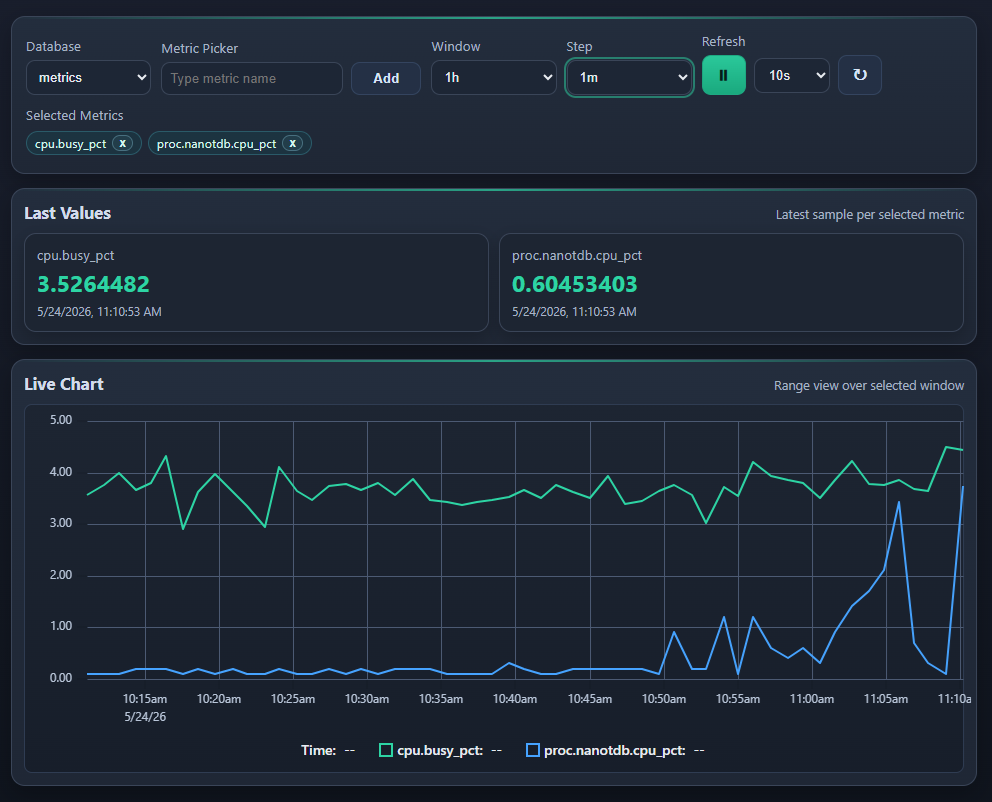
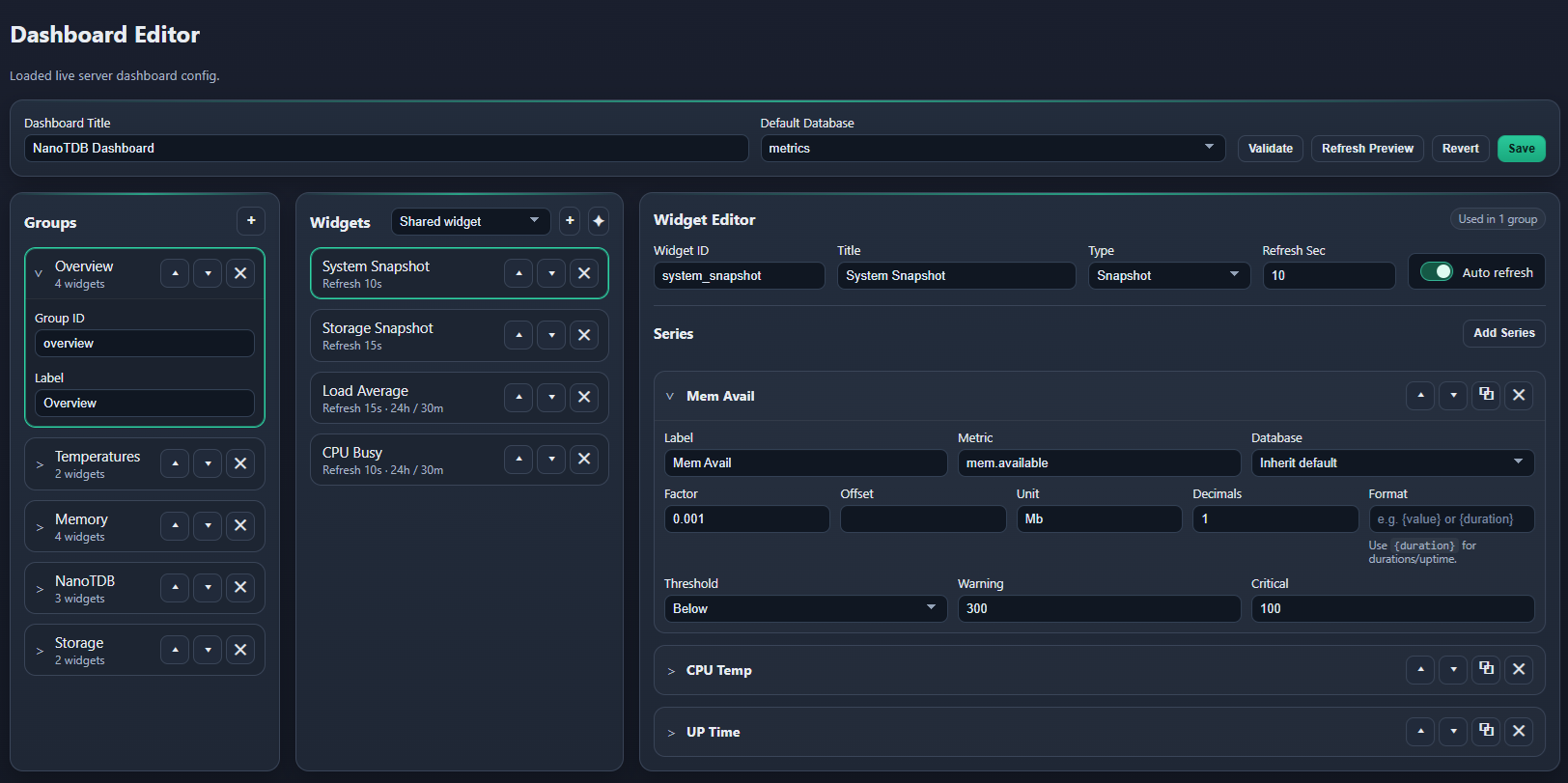
NanoTDB packages a time-series database, browser dashboard, visual editor, ad-hoc explorer, and offline command-line tool into one Go binary. It ingests metrics via line protocol, supports range and aggregate queries, handles downsampling through built-in rollups, and retains data by deleting partition files. The storage engine uses append-only, S2-compressed pages with a write-ahead log that replays on restart after crashes or power loss — a design tuned for SD-card longevity on Raspberry Pi and similar edge hardware. An optional sidecar collector named drip can push host-level metrics (CPU, memory, disk, network, load, temperature) into the database. The HTTP API matches the VictoriaMetrics wire format for instant and range queries. All configuration lives in TOML files (engine.toml for global settings, manifest.toml per database). No external database, cache, or message broker is required.
Should you self-host nanotdb?
nanotdb scores 44/100 on selfhost.directory (how scoring works) and ranks #6 of 7 in Databases & storage. It has 141 GitHub stars.
It shipped 6 stable releases in the past year. The latest, v1.4.0, came out on 28 May 2026. New versions land roughly every 1 days.
Setup is easy: most people get it running in one sitting. It is MIT-licensed and written mostly in Go.
Its closest alternative on selfhost.directory is pgvector (76/100, 23 516 stars). It scores higher overall, so compare the two before you pick. See nanotdb vs pgvector side by side.
Features
- Aggregate queries
- Built-in Dashboard
- Crash Recovery
- Dashboard editor
- Embedded engine
- Explore view
- Line protocol ingest
- MQTT ingest
- Offline CLI (nanocli)
- Prometheus-compatible import
- Retention
- Rollups
- VictoriaMetrics-compatible query API
nanotdb README
More in Databases & storage
 NornicDBSelf-hosted, open-source graph database speaking Neo4j Bolt/Cypher and Qdrant-style gRPC, uniting HNSW vector search, hybrid retrieval, and MVCC historical reads.
 OpenVikingOpenViking gives AI agents one self-hosted, browsable viking:// filesystem for memory, knowledge RAG and skills; open-source (AGPL-3.0), deployed via Docker or pip.
 Percona Server for MySQLOpen-source, self-hosted drop-in replacement for MySQL adding enterprise-style high availability, online backups, encryption and performance tooling under GPLv2.
 pgvectorOpen-source vector similarity search for Postgres
 tdengineSelf-hosted open-source time-series database for IoT and industrial data, offering clustering, stream processing, subscriptions, TDgpt AI and Grafana or Kafka links.
 TimescaleDBA time-series database for high-performance real-time analytics packaged as a Postgres extension
 VitessVitess enables unlimited horizontal scaling through generalized sharding while maintaining MySQL compatibility.
 Zenko CloudServerZenko CloudServer, an open-source Node.js implementation of the Amazon S3 protocol on the front-end and backend storage capabilities to multiple clouds, including Azure and Google.
 ZincSearchSelf-hosted, open-source full-text search engine written in Go; a lightweight Elasticsearch alternative with an embedded web UI, ES-compatible APIs and a single binary.
 Apache PinotOpen-source distributed OLAP database for user-facing apps and AI agents. Provides sub-second queries on fresh streaming data with high concurrency.
 Apache SolrA self-hosted, open-source search platform offering full-text, vector, and geospatial search used by major organizations worldwide.
 Docker Distribution RegistrySelf-hosted, open-source container registry implementing the OCI Distribution Specification for managing container images and artifacts.
0 comments