selfhost.directory

The index of self-hostable projects — ranked, categorized and served with live updates.
Own your data and stop giving it to big tech.

GitHub
MuckScraper logo

Self-host MuckScraper

v1.0.2

News aggregator grouping articles into stories with AI bias

ReleaseOpen SourceMIT
Updated7 hours ago
LanguagePython
Setup difficultyAdvanced
ThemeDark mode
Stars
159
CPU
2 CPU cores
RAM
8 GB RAM
Storage
10 GB disk for images + ~1 GB for 120k articles over 6 months
Port
5000 (Web UI)
Requires
Meilisearch, Nomic-embed-text embedding model, Ollama, PostgreSQL with pgvector
Install with Docker Compose
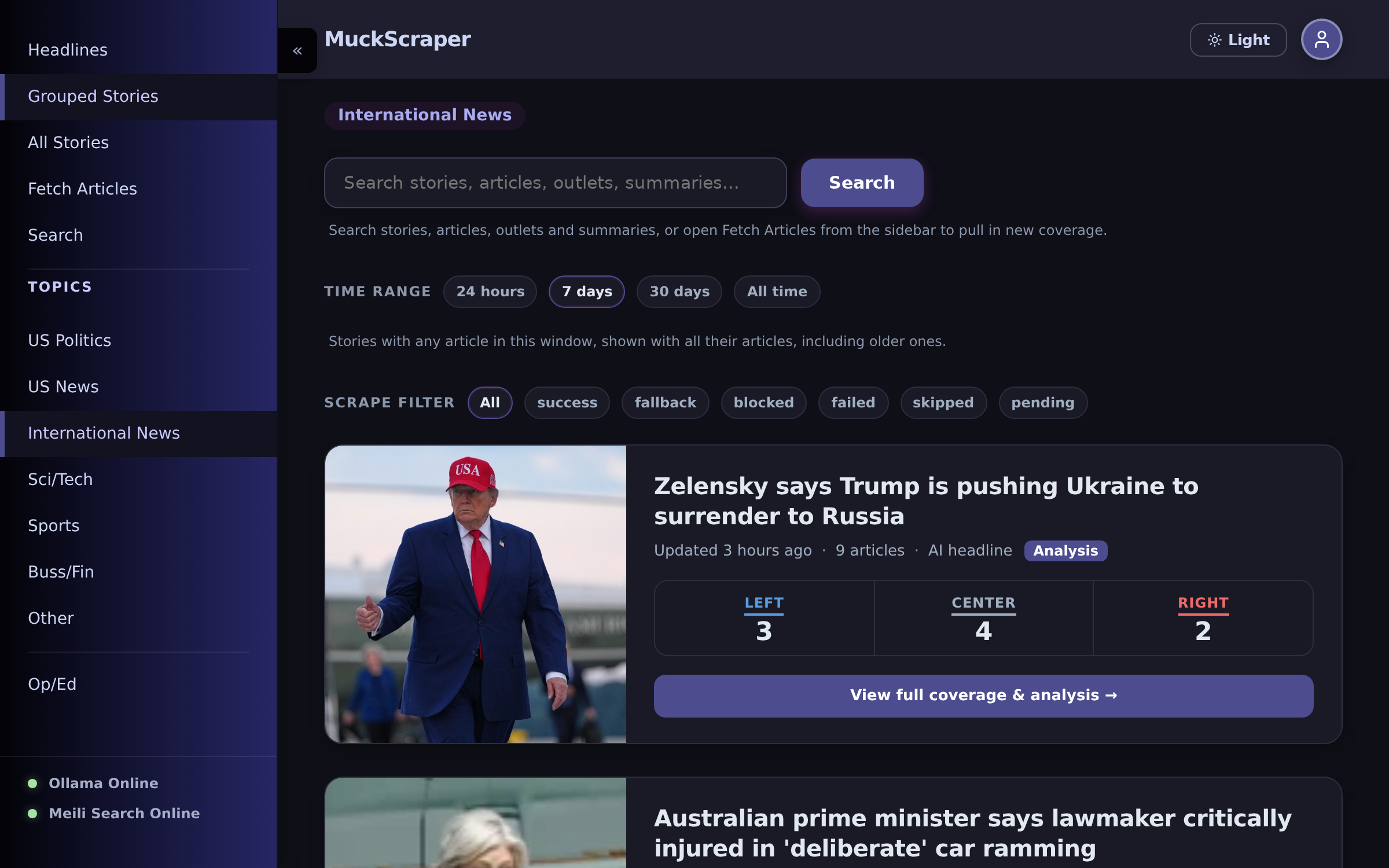
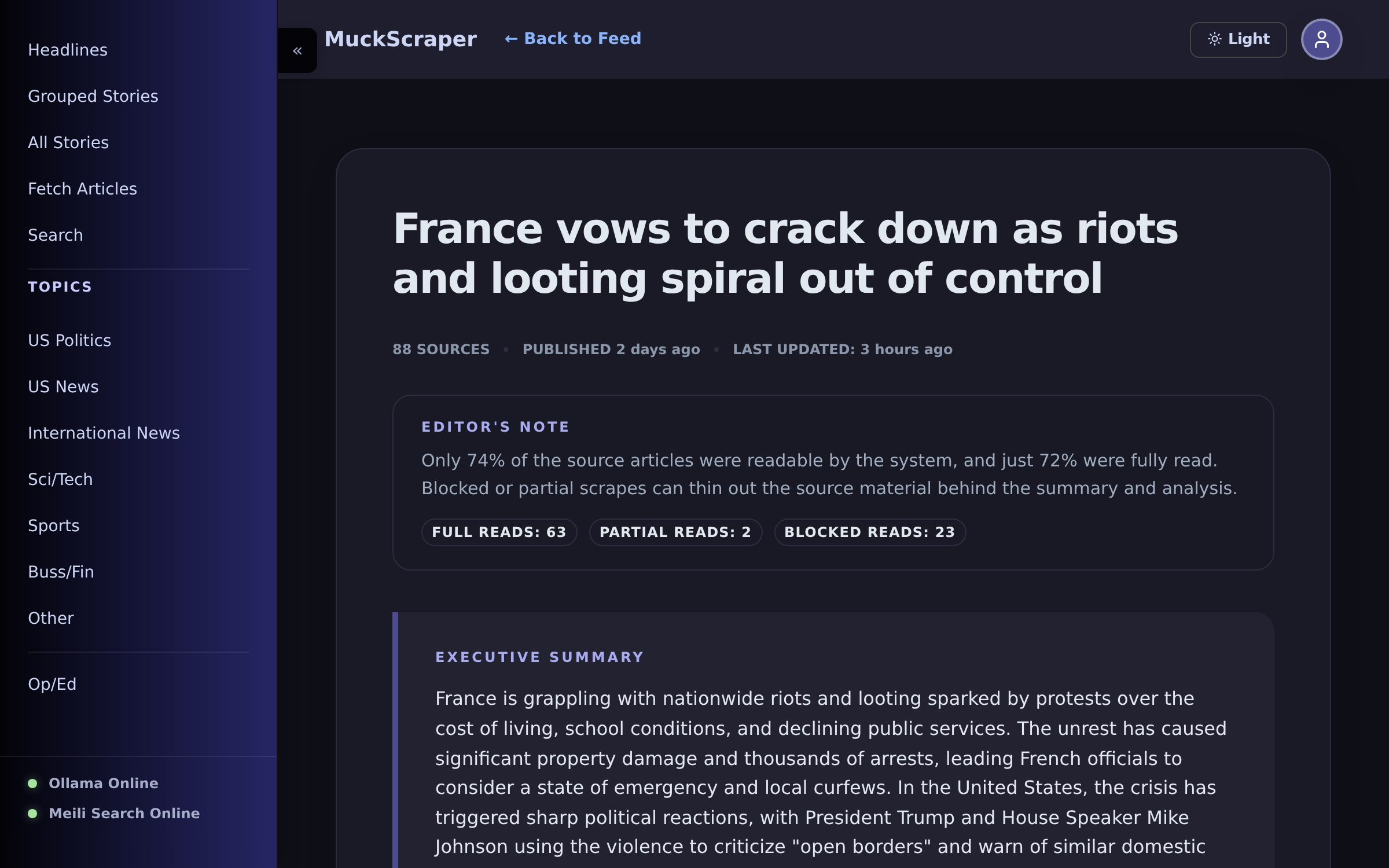
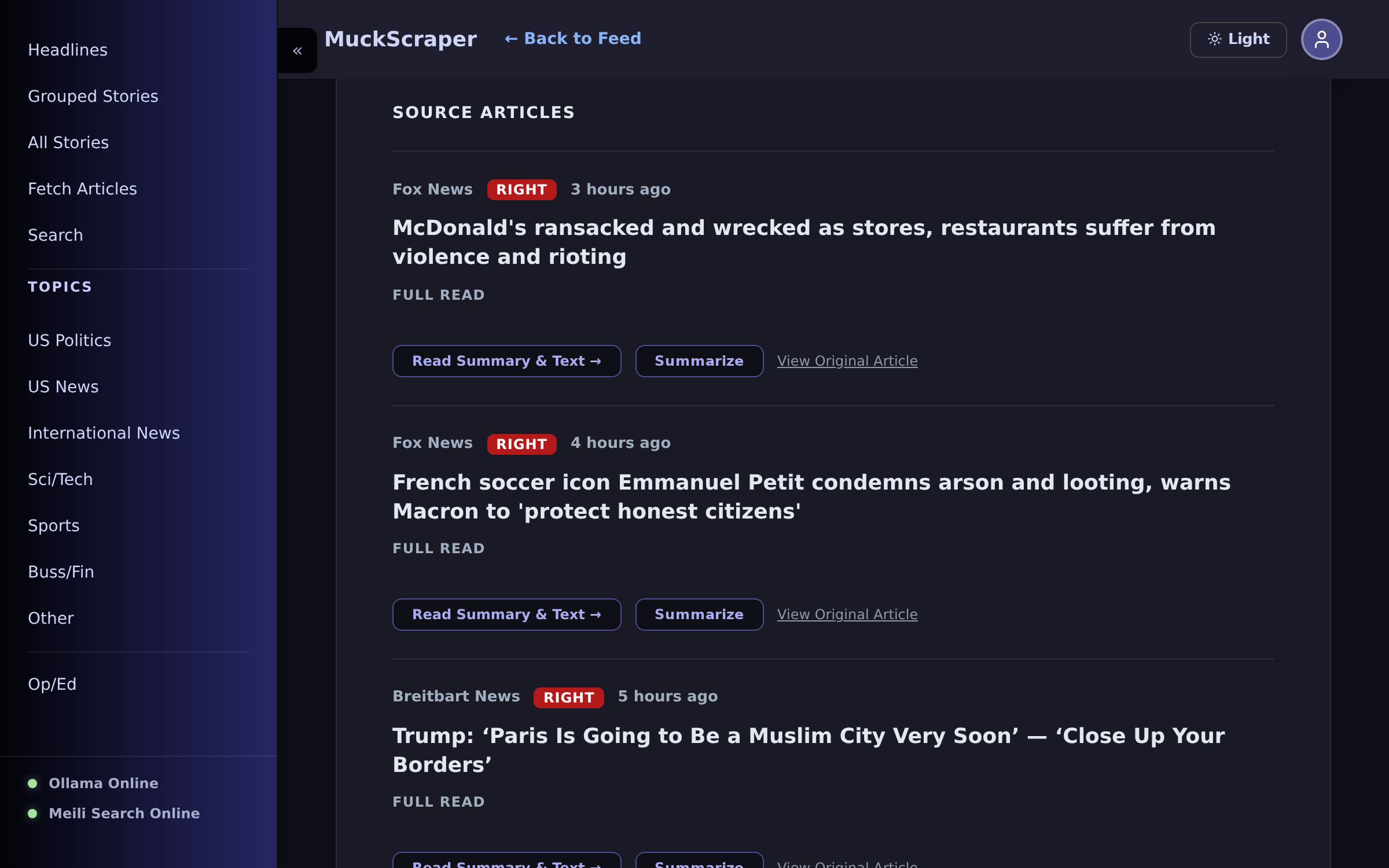
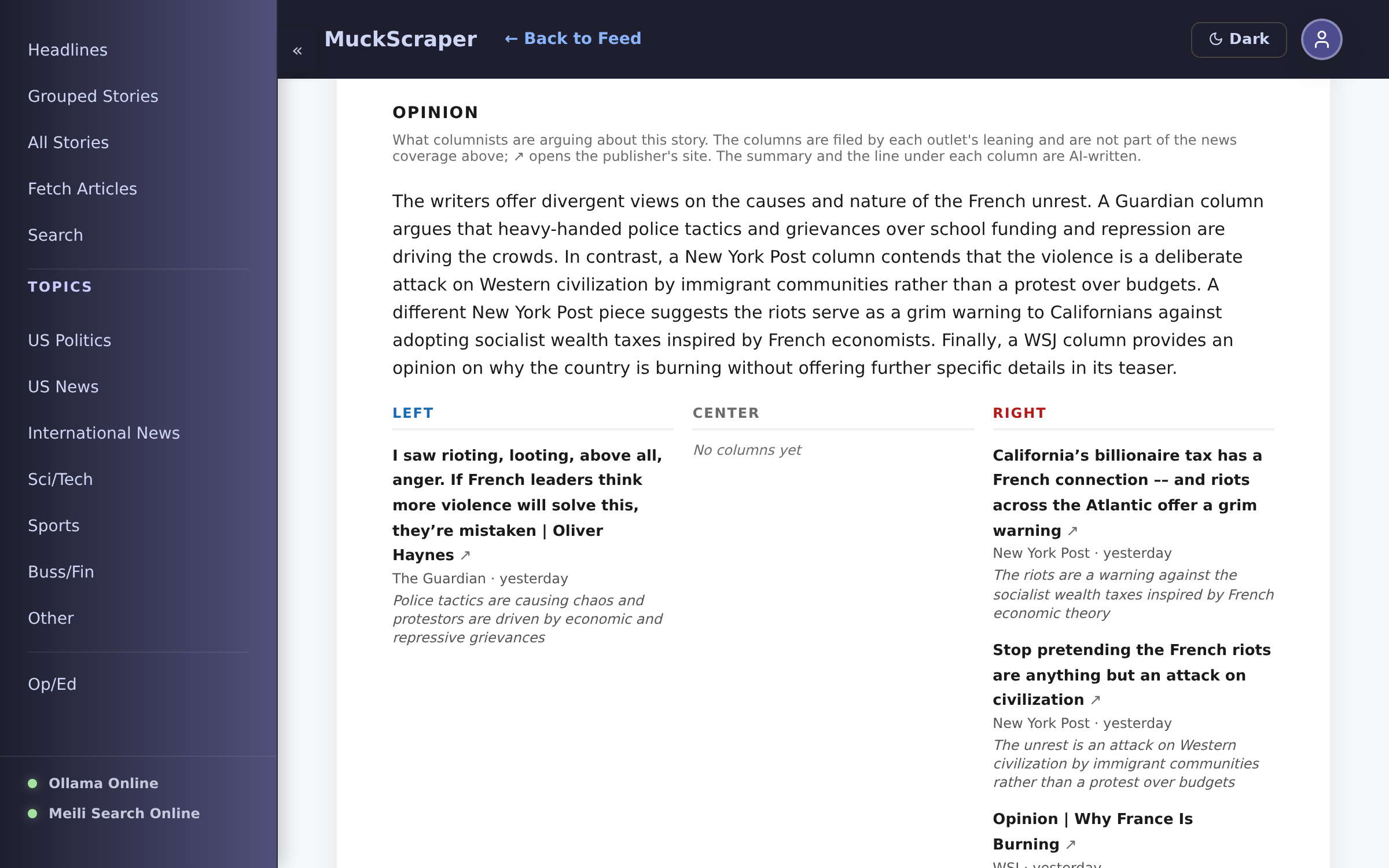
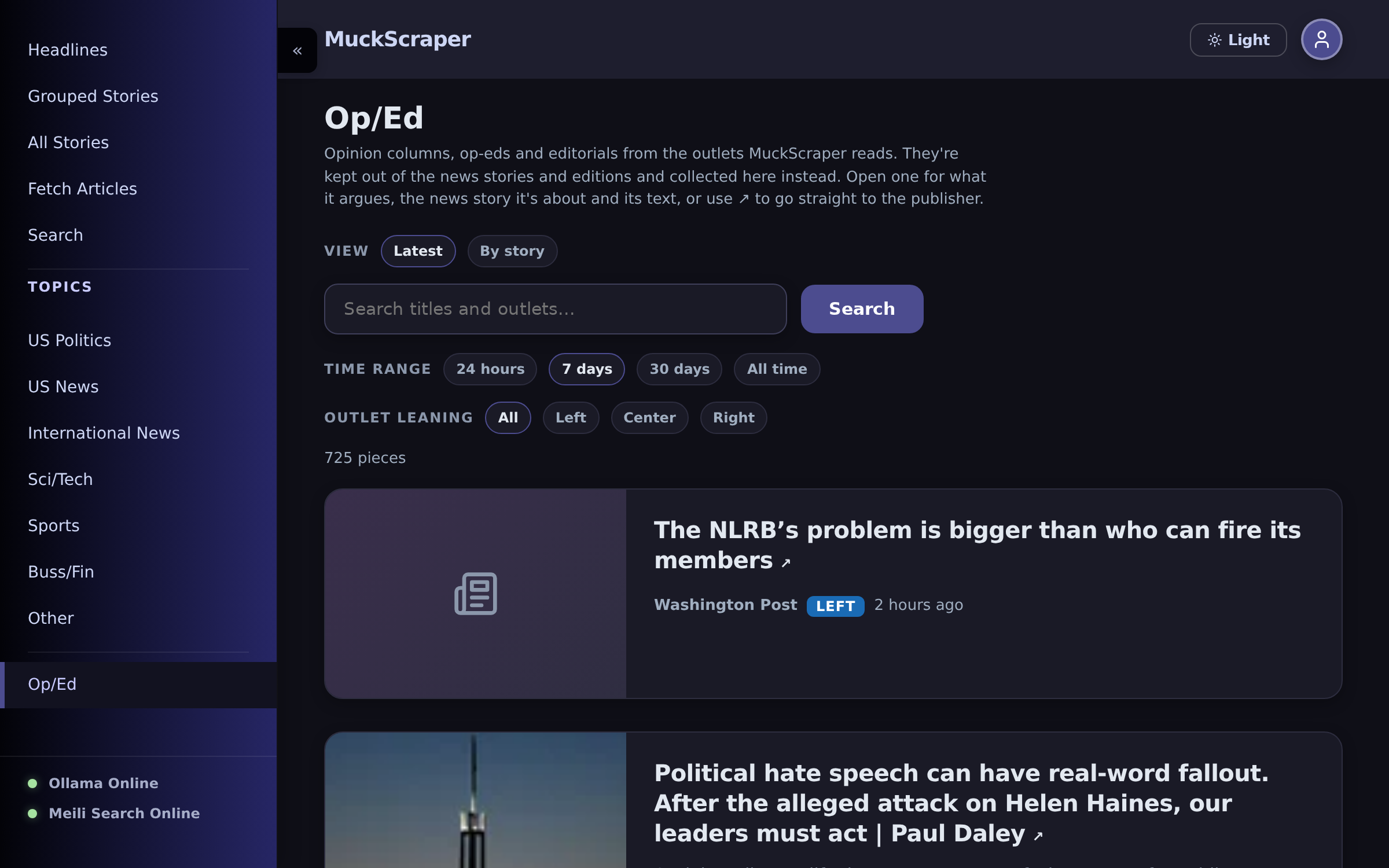
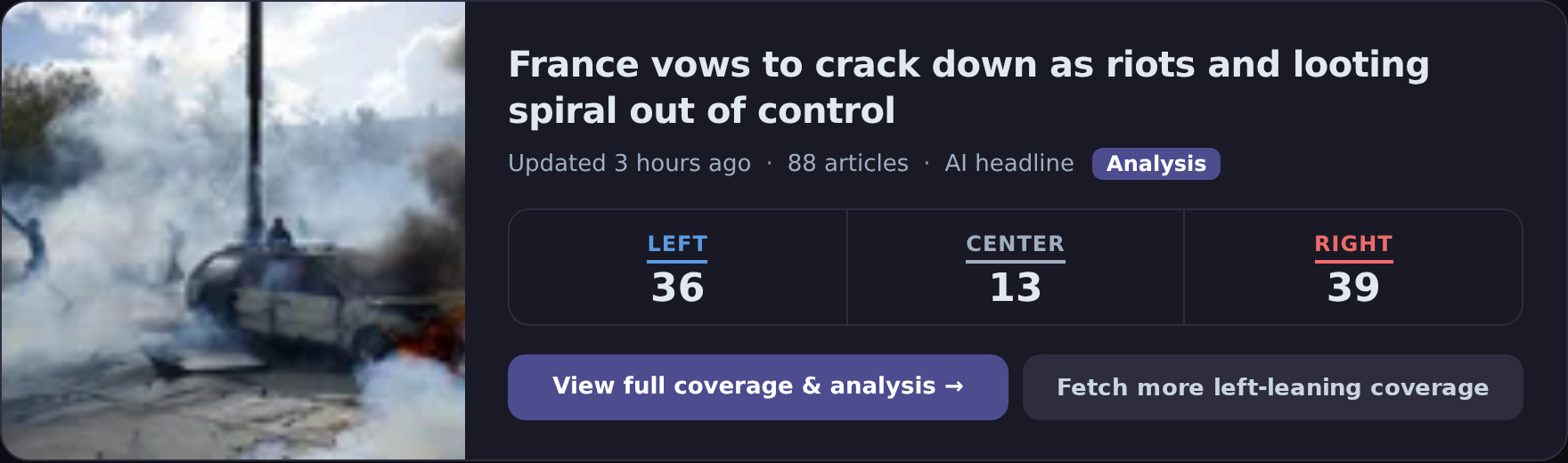
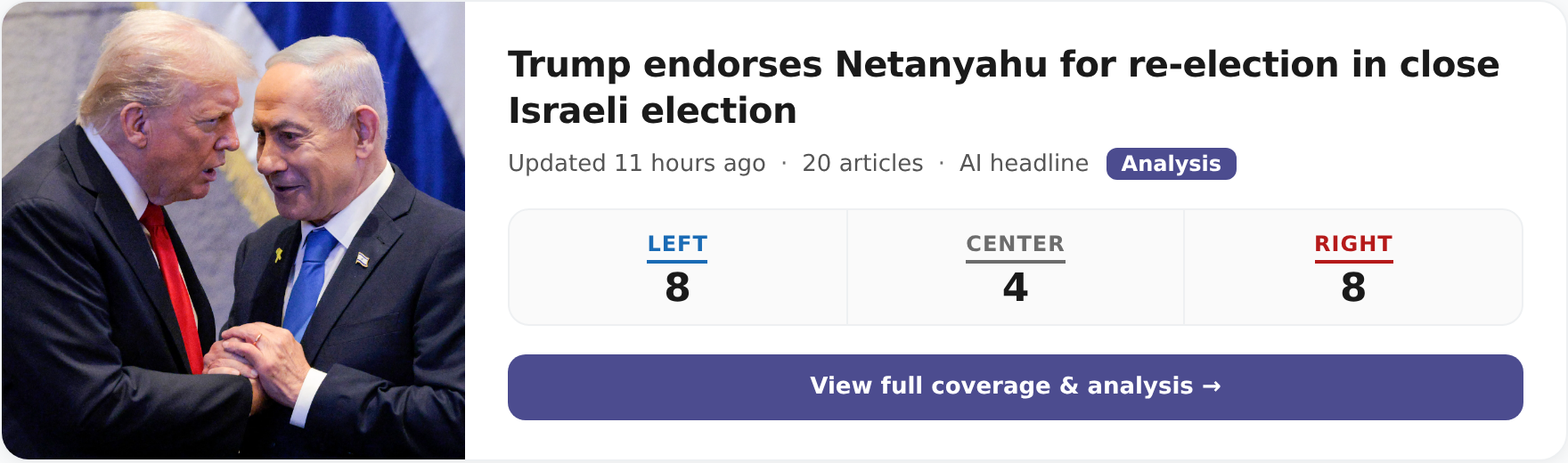
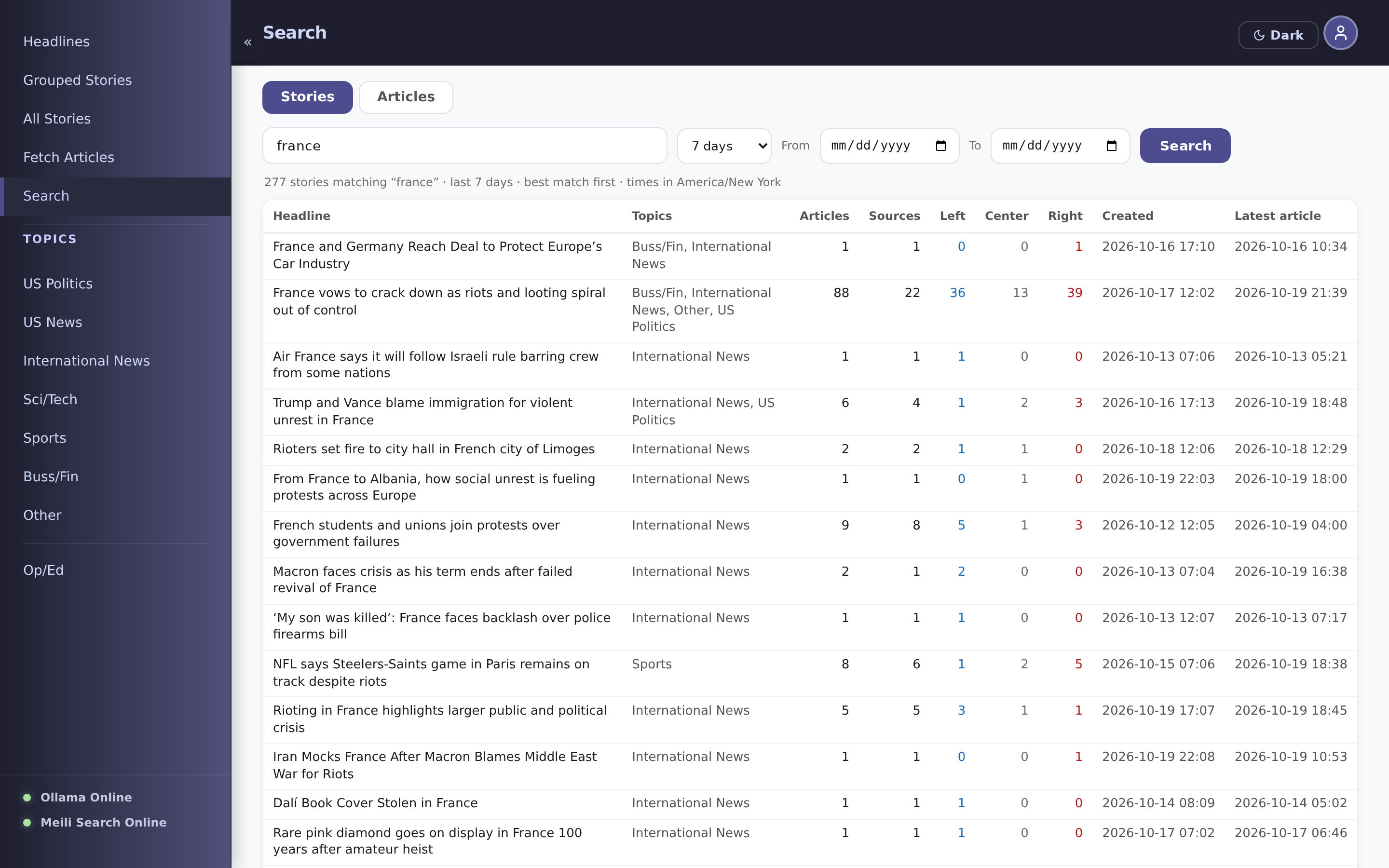
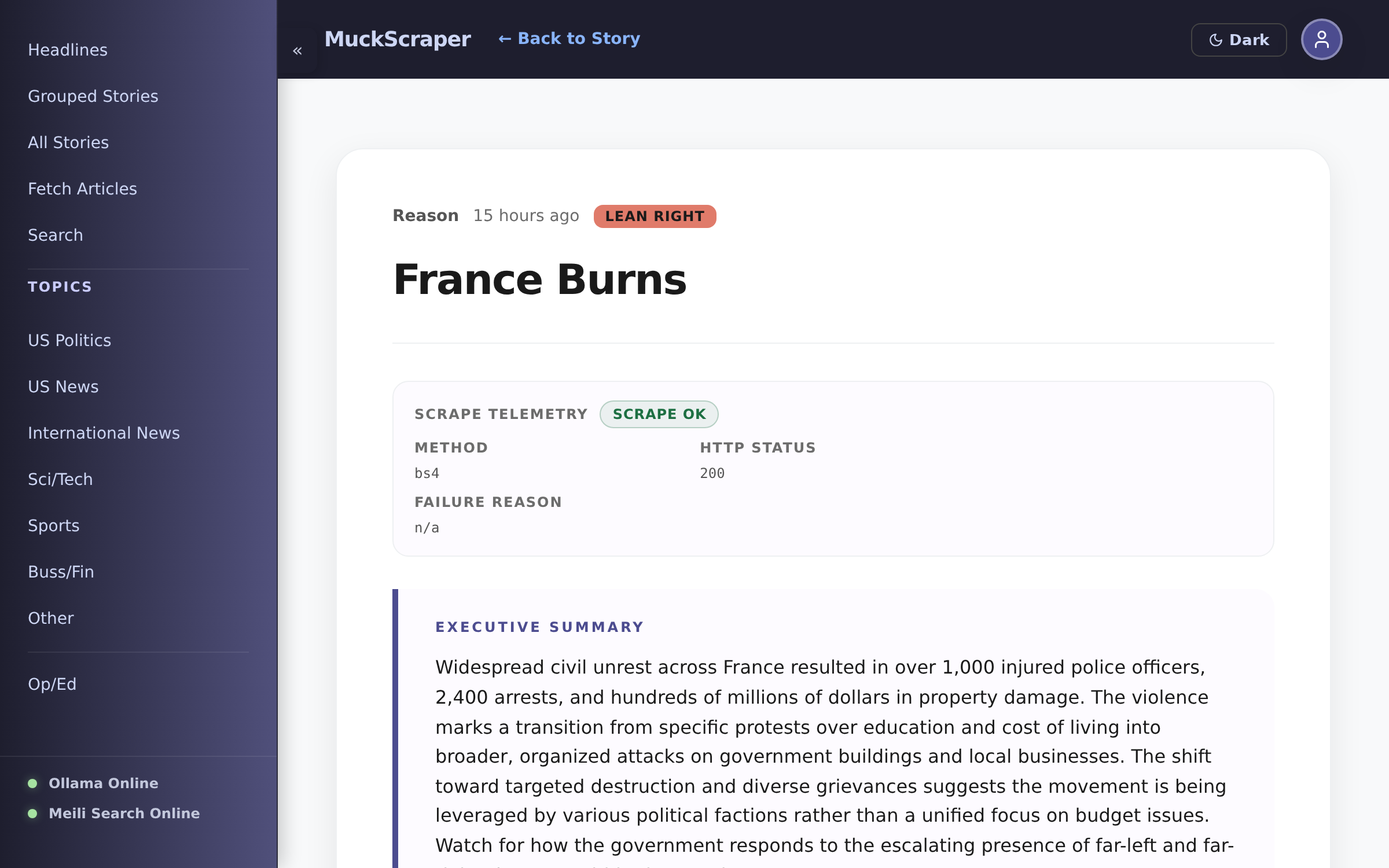
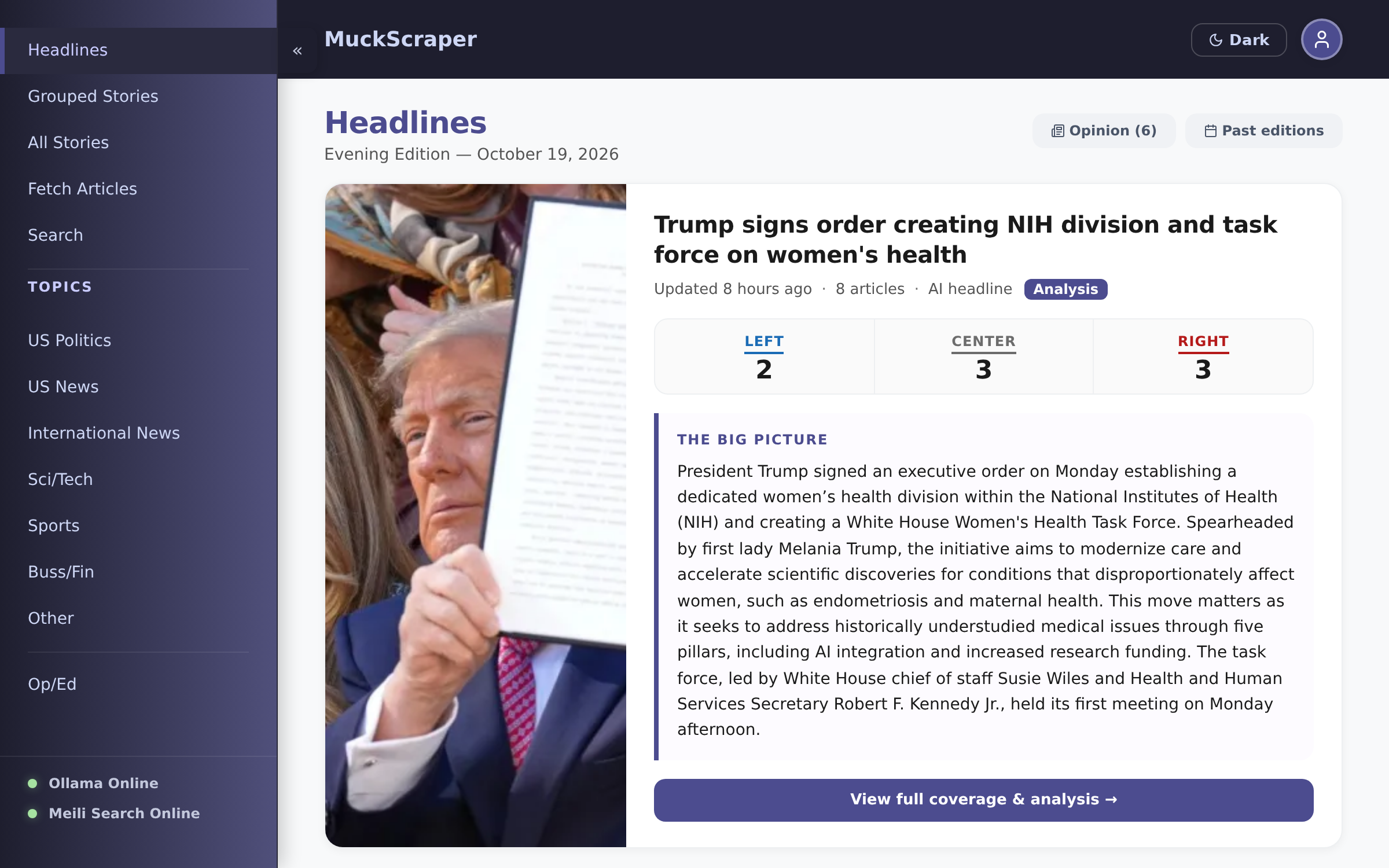
Headlines view in light mode showing latest edition with left/center/right coverage counts and summariesGrouped stories view in dark modeMulti-source story view showing summary and 88 articles from 22 outletsStory sources list with outlet leaningsOpinion columns linked to a story, filed by outlet leaning with stance and roundupOp/Ed page with opinion columns across the political spectrumBias tags showing left/center/right outlet counts with fetch-more button for underrepresented sideBias tags detail viewSearch page with sortable stories and articles tables, time window filters, and bias countsArticle reader view showing full article text

What is MuckScraper?

MuckScraper is a self-hosted news aggregator that pulls articles from RSS feeds and news APIs, then uses local language models to group related coverage into unified stories. Each story displays the count of left, center, and right outlets that reported on it, with a button to fetch more from underrepresented sides. Opinion columns are kept separate from news coverage. The system publishes curated editions twice daily and keeps past editions. It runs via Docker Compose with PostgreSQL for embeddings, Meilisearch for search, and an optional MCP server for AI assistants. The web interface offers light and dark themes, role-based access, and optional public read-only mode. Setup is automated through install.sh which handles secrets, migrations, and admin creation.

Should you self-host MuckScraper?

MuckScraper scores 46/100 on selfhost.directory (how scoring works) and ranks #4 of 6 in Feed Aggregator. It has 159 GitHub stars.

It shipped 3 stable releases in the past year. The latest, v1.0.2, came out on 26 October 2026. New versions land roughly every 3 days.

Setup is advanced: plan for several services and some ongoing maintenance. It is MIT-licensed and written mostly in Python.

Its closest alternative on selfhost.directory is Nextcloud News (61/100, 1 012 stars). It scores higher overall, so compare the two before you pick. See MuckScraper vs Nextcloud News side by side.

Features

  • Admin Dashboard
  • AI-generated summaries
  • Article scraping
  • Balanced editions
  • Full-Text Search
  • MCP Server Integration
  • Multiple LLM provider support
  • Multi-source story grouping
  • Opinion separation
  • Political bias scoring
  • Role-based Access Control
  • RSS feed ingestion
  • Topic classification
  • Wire copy detection

MuckScraper README

How to install MuckScraper

Install MuckScraper with Docker Compose

Environment variables
OLLAMA_HOST, OLLAMA_MODEL, EMBEDDING_MODEL, ADMIN_PASSWORD, POSTGRES_PASSWORD, NEWS_API_KEY, GNEWS_API_KEY, SECRET_KEY, MEILI_MASTER_KEY, DISPLAY_TIMEZONE, PUBLIC_READ_ACCESS, LLM_PROVIDER, EMBEDDING_PROVIDER, GEMINI_API_KEY, GROQ_API_KEY, OPENROUTER_HOST, OLLAMA_FAST_MODEL, OLLAMA_THINK, MCP_TOKEN, N8N_WEBHOOK_URL, LANGFUSE_PUBLIC_KEY, LANGFUSE_SECRET_KEY, LANGFUSE_HOST

git clone https://github.com/grregis/muckscraper.git cd muckscraper ./install.sh

Automated setup via install.sh: creates .env from .env.sample, generates secrets, builds images, runs migrations, creates admin user, starts scheduler

How to configure MuckScraper

  • ADMIN_EMAIL
  • ADMIN_PASSWORD
  • ADMIN_USERNAMEadmin
  • DISPLAY_TIMEZONEUTCTime zone the aggregator shows times in. Use an IANA name for where you are, e.g. America/New_York, Europe/London, Australia/Sydney (full list: https://en.wikipedia.org/wiki/List_of_tz_database_time_zones). Defaults to UTC.

    Time zone the aggregator shows times in. Use an IANA name for where you are, e.g. America/New_York, Europe/London, Australia/Sydney (full list: https://en.wikipedia.org/wiki/List_of_tz_database_time_zones). Defaults to UTC.

  • EMBEDDING_MODEL
  • EMBEDDING_PROVIDERollama
  • GEMINI_API_KEYRequired only when LLM_PROVIDER or EMBEDDING_PROVIDER is "gemini":

    Required only when LLM_PROVIDER or EMBEDDING_PROVIDER is "gemini":

  • GEMINI_EMBEDDING_MODELgemini-embedding-001
  • GEMINI_MODELgemini-2.5-flash-lite
  • GNEWS_API_KEY
  • GROQ_API_KEYRequired only when LLM_PROVIDER is "groq". GROQ_MODEL has no default -- Groq retires models periodically, so a baked-in name goes stale and 404s on every call. Check `curl -H "Authorization: Bearer $GROQ_API_KEY" \ https://api.groq.com/openai/v1/models` for what is currently served; openai/gpt-oss-20b was a reasonable general-purpose choice as of 2026-08.

    Required only when LLM_PROVIDER is "groq". GROQ_MODEL has no default -- Groq retires models periodically, so a baked-in name goes stale and 404s on every call. Check `curl -H "Authorization: Bearer $GROQ_API_KEY" \ https://api.groq.com/openai/v1/models` for what is currently served; openai/gpt-oss-20b was a reasonable general-purpose choice as of 2026-08.

  • GROQ_MODEL
  • GUNICORN_WORKERS2Number of gunicorn worker processes for the admin app (default 2). Each is a separate process, so a long-running admin action in one worker doesn't freeze requests being served by the others.

    Number of gunicorn worker processes for the admin app (default 2). Each is a separate process, so a long-running admin action in one worker doesn't freeze requests being served by the others.

  • LLM_FAST_PROVIDEROptional: send the fast tier to a different provider than LLM_PROVIDER. A run makes ~1,140 fast calls (story grouping, topic classification, outlet bias) against ~65 quality ones (summaries, deep reports), so this is how you run heavy summarization in the cloud while keeping the high-volume mechanical work on a local box: LLM_PROVIDER=openrouter <- summaries and deep reports LLM_FAST_PROVIDER

    Optional: send the fast tier to a different provider than LLM_PROVIDER. A run makes ~1,140 fast calls (story grouping, topic classification, outlet bias) against ~65 quality ones (summaries, deep reports), so this is how you run heavy summarization in the cloud while keeping the high-volume mechanical work on a local box: LLM_PROVIDER=openrouter <- summaries and deep reports LLM_FAST_PROVIDER

  • LLM_PROVIDERProvider toggle: "ollama" (default, home machine), "gemini", "groq", or "openrouter" (e.g. running on a VPS while Ollama is unreachable). Flip both back to "ollama" once Ollama is reachable again -- no code changes needed. EMBEDDING_PROVIDER can only be "ollama" or "gemini". Groq serves no embedding models and OpenRouter routes chat completions only, so setting either here quietly falls back to Ol

    Provider toggle: "ollama" (default, home machine), "gemini", "groq", or "openrouter" (e.g. running on a VPS while Ollama is unreachable). Flip both back to "ollama" once Ollama is reachable again -- no code changes needed. EMBEDDING_PROVIDER can only be "ollama" or "gemini". Groq serves no embedding models and OpenRouter routes chat completions only, so setting either here quietly falls back to Ol

  • MCP_ALLOWED_HOSTS
  • MCP_BIND127.0.0.1
  • MCP_EXPECTED_OLLAMA_CONTEXTOptional: the context size your Ollama server is configured with (OLLAMA_CONTEXT_LENGTH there). ollama_health then reports when another client has loaded a model at a different size, which slows or stalls pipeline runs.

    Optional: the context size your Ollama server is configured with (OLLAMA_CONTEXT_LENGTH there). ollama_health then reports when another client has loaded a model at a different size, which slows or stalls pipeline runs.

  • MCP_PORT8765
  • MCP_TOKENOptional read-only MCP server for health checks (docs/MCP.md). Started only with `docker compose --profile mcp up -d mcp`. MCP_TOKEN is required (16+ characters), e.g. `python3 -c "import secrets; print(secrets.token_urlsafe(32))"`. MCP_BIND is the host address the port is published on: 127.0.0.1 keeps it local; 0.0.0.0 opens it to the network (then rely on the token and a firewall or reverse prox

    Optional read-only MCP server for health checks (docs/MCP.md). Started only with `docker compose --profile mcp up -d mcp`. MCP_TOKEN is required (16+ characters), e.g. `python3 -c "import secrets; print(secrets.token_urlsafe(32))"`. MCP_BIND is the host address the port is published on: 127.0.0.1 keeps it local; 0.0.0.0 opens it to the network (then rely on the token and a firewall or reverse prox

  • MEILI_MASTER_KEYProtects the search index. install.sh fills this in when it creates .env, so you only need it if you set up .env by hand (any random string of 16+ characters works): python3 -c "import secrets; print(secrets.token_hex(32))"

    Protects the search index. install.sh fills this in when it creates .env, so you only need it if you set up .env by hand (any random string of 16+ characters works): python3 -c "import secrets; print(secrets.token_hex(32))"

  • MEILI_URLhttp://meilisearch:7700
  • NEWS_API_KEYmuckscraperHeadlinesGoogleNEW/.env.sample Optional: NewsAPI (newsapi.org) and GNews (gnews.io) keys. Leave blank to skip that source; the default RSS feeds work without either.

    muckscraperHeadlinesGoogleNEW/.env.sample Optional: NewsAPI (newsapi.org) and GNews (gnews.io) keys. Leave blank to skip that source; the default RSS feeds work without either.

  • OLLAMA_FALLBACK_HOSTOptional: a second Ollama host used automatically when OLLAMA_HOST is unreachable (e.g. an always-on CPU box covering for a Wake-on-LAN GPU box). Must serve the same OLLAMA_MODEL / EMBEDDING_MODEL. Leave blank to disable.

    Optional: a second Ollama host used automatically when OLLAMA_HOST is unreachable (e.g. an always-on CPU box covering for a Wake-on-LAN GPU box). Must serve the same OLLAMA_MODEL / EMBEDDING_MODEL. Leave blank to disable.

  • OLLAMA_FAST_MODELOptional: a smaller/faster model for the pipeline's high-volume mechanical calls -- story-grouping confirmation, topic classification, headline generation, outlet bias. A full run makes ~1,100 of those against ~65 summary/deep-report calls, which stay on OLLAMA_MODEL regardless. Biggest win when OLLAMA_MODEL is too large to fit your GPU's VRAM (check `size_vram` vs `size` in /api/ps -- a partially

    Optional: a smaller/faster model for the pipeline's high-volume mechanical calls -- story-grouping confirmation, topic classification, headline generation, outlet bias. A full run makes ~1,100 of those against ~65 summary/deep-report calls, which stay on OLLAMA_MODEL regardless. Biggest win when OLLAMA_MODEL is too large to fit your GPU's VRAM (check `size_vram` vs `size` in /api/ps -- a partially

  • OLLAMA_HOST
  • OLLAMA_MACOptional: set this if Ollama is on another machine and you use wake-on-LAN.

    Optional: set this if Ollama is on another machine and you use wake-on-LAN.

  • OLLAMA_MODELThe main chat model, pulled on your Ollama box first (`ollama pull <name>`). Starting points: gemma4:e4b-it-qat (about 3 GB of VRAM) or, on a 10 GB+ GPU, gemma4:12b-it-qat with OLLAMA_THINK=false below. See README "Hardware".

    The main chat model, pulled on your Ollama box first (`ollama pull <name>`). Starting points: gemma4:e4b-it-qat (about 3 GB of VRAM) or, on a 10 GB+ GPU, gemma4:12b-it-qat with OLLAMA_THINK=false below. See README "Hardware".

  • OLLAMA_PRIMARY_RECHECK_SECONDS60Optional: seconds to serve from the fallback before re-probing the primary so it is picked back up automatically once it comes online (default 60).

    Optional: seconds to serve from the fallback before re-probing the primary so it is picked back up automatically once it comes online (default 60).

  • OLLAMA_THINKOptional: turn a thinking model's hidden reasoning off (false) or on (true). Models such as gemma4, qwen3 and deepseek-r1 think before every answer by default, which can make each call 5-50x longer. Blank leaves Ollama's default. Only set it for a model that supports thinking; Ollama rejects the flag otherwise. Check quality on your own prompts before turning it off: on gemma4 e4b it made story gr

    Optional: turn a thinking model's hidden reasoning off (false) or on (true). Models such as gemma4, qwen3 and deepseek-r1 think before every answer by default, which can make each call 5-50x longer. Blank leaves Ollama's default. Only set it for a model that supports thinking; Ollama rejects the flag otherwise. Check quality on your own prompts before turning it off: on gemma4 e4b it made story gr

  • OPENROUTER_API_KEYRequired only when LLM_PROVIDER is "openrouter". OPENROUTER_MODEL has no default -- leaving it blank reads as "not configured" rather than sending an empty model name, so set it to something like "meta-llama/llama-3.1-8b-instruct".

    Required only when LLM_PROVIDER is "openrouter". OPENROUTER_MODEL has no default -- leaving it blank reads as "not configured" rather than sending an empty model name, so set it to something like "meta-llama/llama-3.1-8b-instruct".

  • OPENROUTER_APP_NAME
  • OPENROUTER_HOSTOPENROUTER_HOST is the OpenAI-compatible base URL. Point it at any other provider speaking that API -- DeepSeek, OpenAI, Together, a local vLLM -- and the OPENROUTER_* settings drive it with no code changes.

    OPENROUTER_HOST is the OpenAI-compatible base URL. Point it at any other provider speaking that API -- DeepSeek, OpenAI, Together, a local vLLM -- and the OPENROUTER_* settings drive it with no code changes.

  • OPENROUTER_MODEL
  • OPENROUTER_SITE_URLOptional, attribution only -- OpenRouter shows these on its public leaderboards.

    Optional, attribution only -- OpenRouter shows these on its public leaderboards.

  • POSTGRES_DBaggregator
  • POSTGRES_PASSWORD
  • POSTGRES_USERpostgres
  • PUBLIC_READ_ACCESSfalseLet signed-out visitors read Headlines, story pages and article summaries (never the scraped full text, and no buttons that run anything). Off by default, so every page needs an account. Accounts are managed at /admin/users.

    Let signed-out visitors read Headlines, story pages and article summaries (never the scraped full text, and no buttons that run anything). Off by default, so every page needs an account. Accounts are managed at /admin/users.

  • SECRET_KEYSigns login sessions; keep it secret. install.sh fills this in when it creates .env, so you only need it if you set up .env by hand: python3 -c "import secrets; print(secrets.token_hex(32))"

    Signs login sessions; keep it secret. install.sh fills this in when it creates .env, so you only need it if you set up .env by hand: python3 -c "import secrets; print(secrets.token_hex(32))"

MuckScraper releases & version history

Rate this project

Click to rate — no account needed.

0 comments

Posting as guest
Loading comments…