
Self-host Lumabri
v0.8.0Distributed LLM inference across your own computers
- Stars
- 201
- Ports
- 47300 (Household tracker (TCP) and LAN discovery (UDP)), 47301 (Household services (TCP range start)), 47315 (Household services (TCP range end)), 47380 (Local API gateway (loopback default))
- Requires
- Colibri
What is Lumabri?
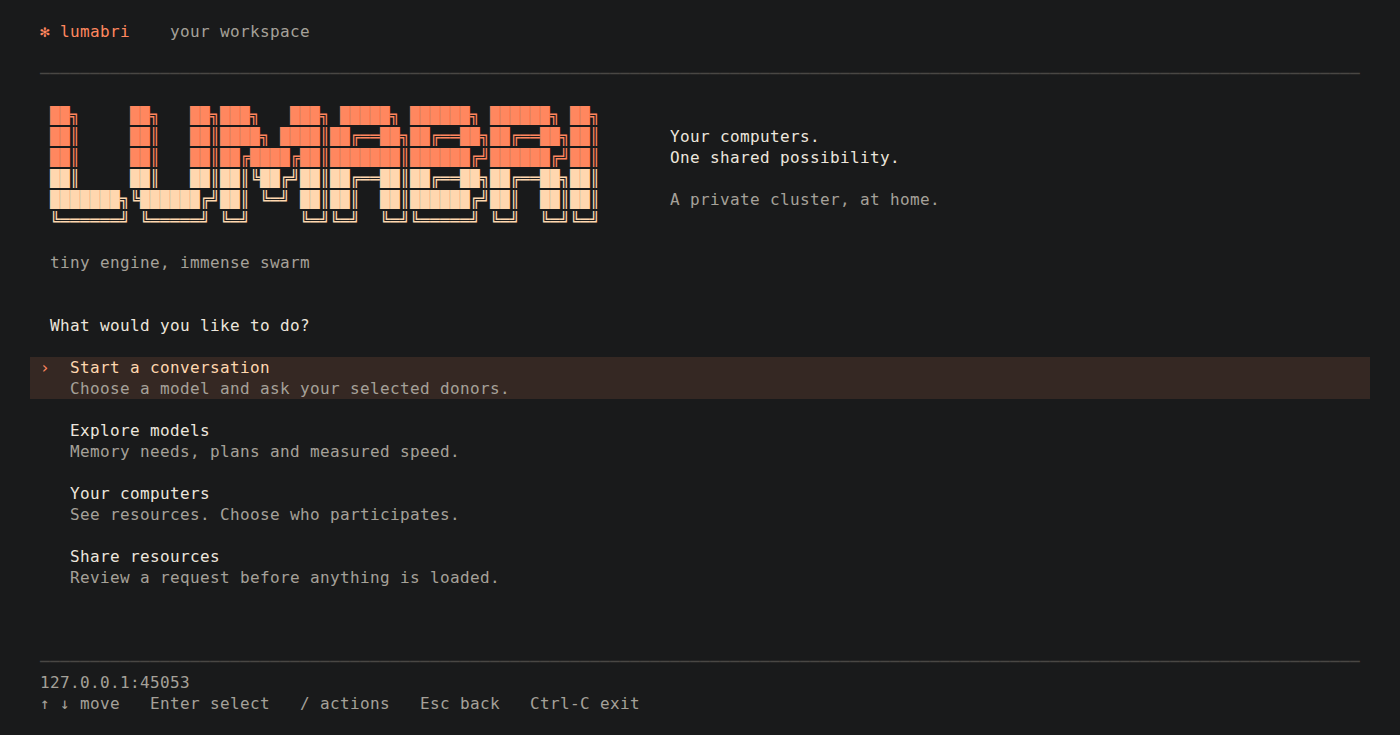
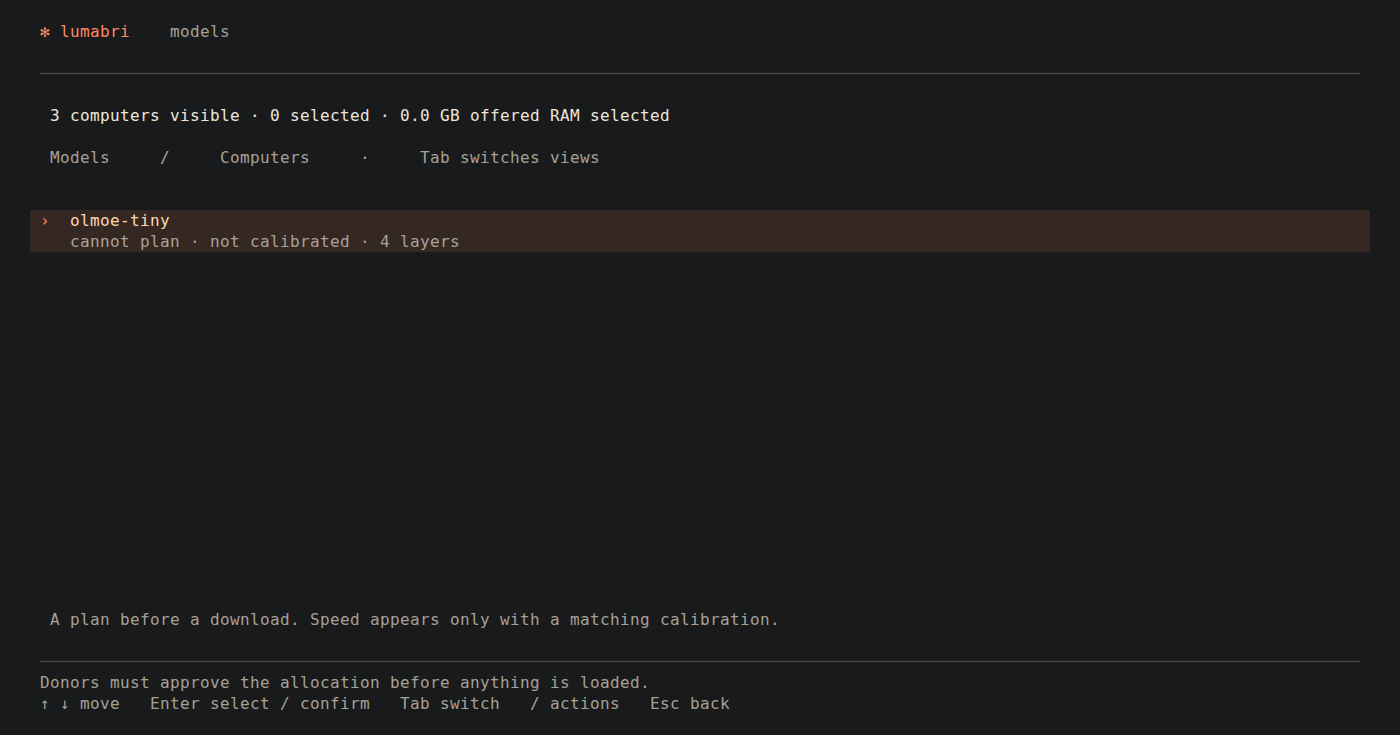
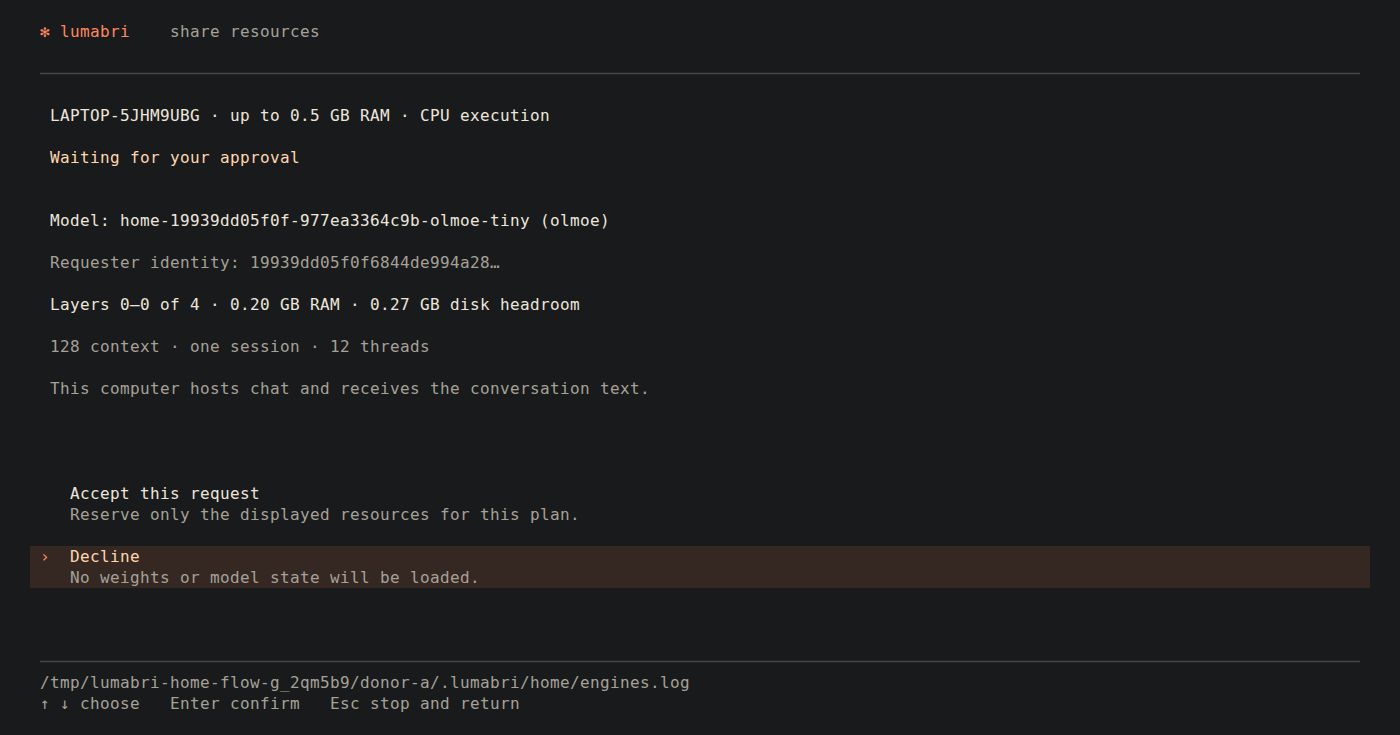
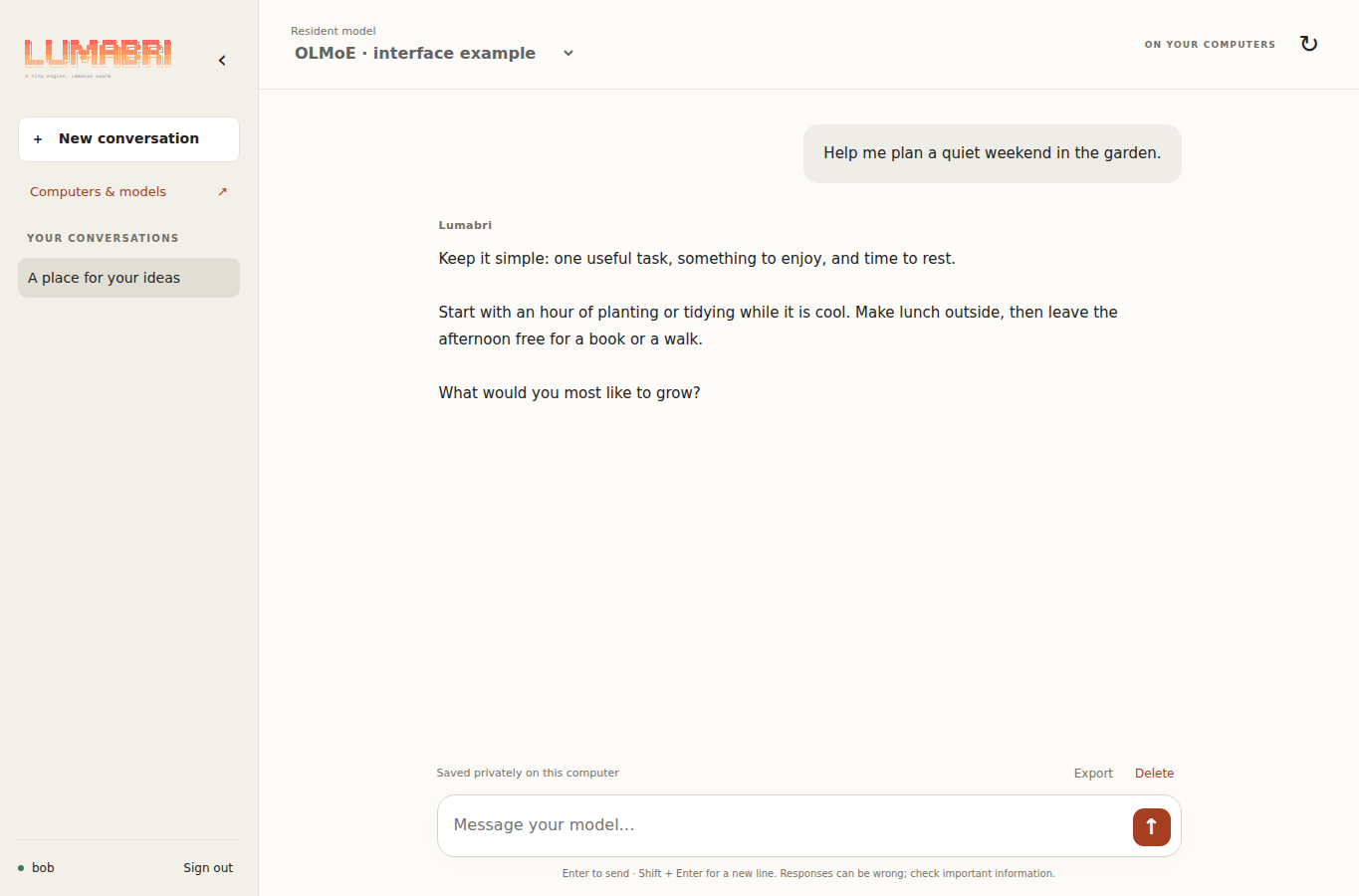
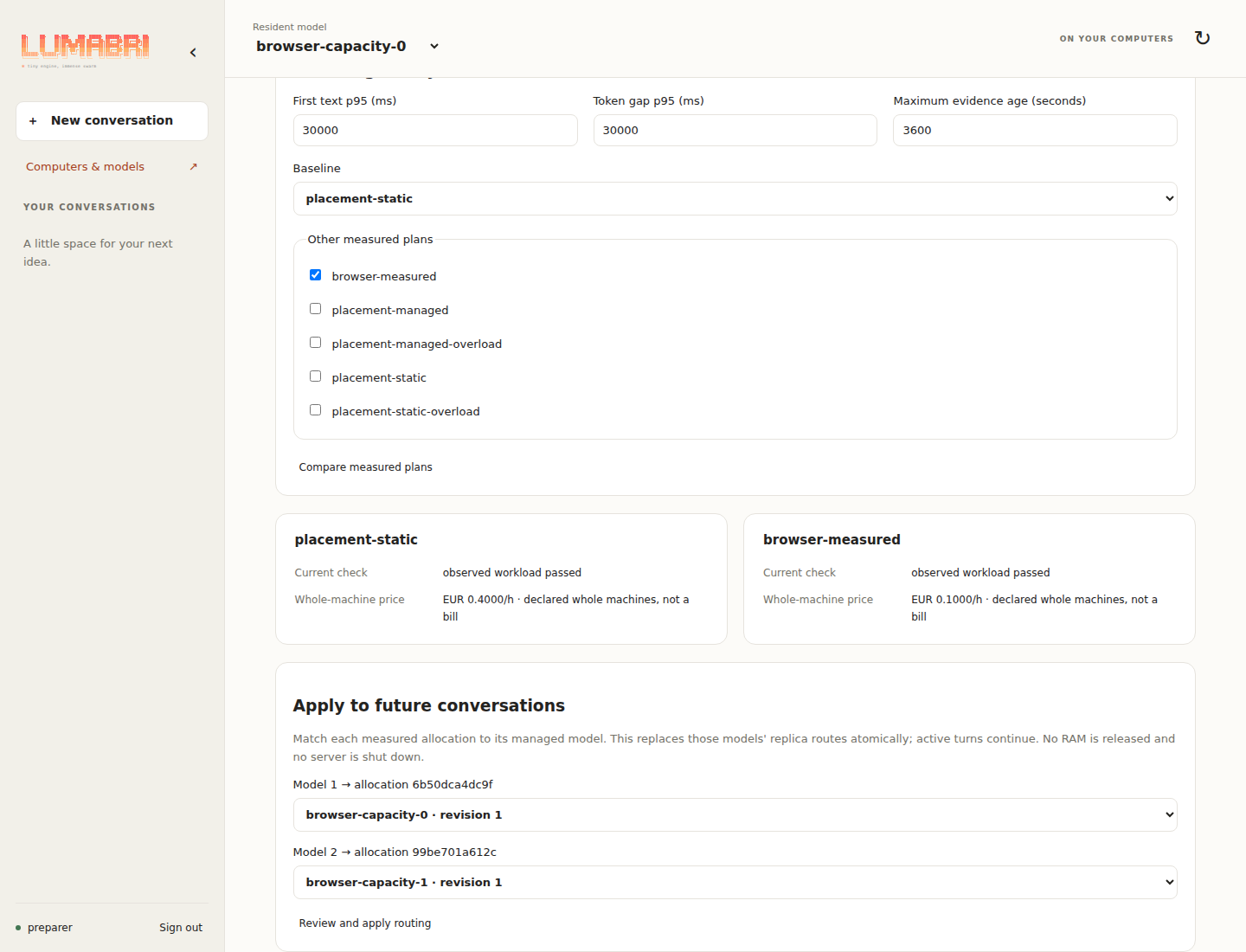
Lumabri enables running large AI models that exceed a single machine's memory by distributing the workload across multiple computers on a local network. It relies on Colibri as the inference engine and assigns contiguous layer ranges to donor machines, each loading only its designated layers into memory. A household tracker coordinates the cluster, and every model preparation step requires explicit consent from each participating donor. The software provides a terminal-based interface for configuration and chat, along with a bundled web chat served through a local authenticated API. Approved model allocations remain resident in donor memory across sessions within set memory limits. Capabilities include calibration runs to gauge performance, elastic replica policies for managed API models, and HTTPS reverse-proxy support for remote access. The codebase is written in C and compiles from source alongside a compatible Colibri checkout. It has been tested on Linux, macOS (Intel and Apple Silicon), and Windows via WSL with a firewall helper. No Docker images or pre-built binaries are distributed.
Should you self-host Lumabri?
Lumabri scores 42/100 on selfhost.directory (how scoring works) and ranks #5 of 7 in Local AI. It has 201 GitHub stars.
It shipped 3 stable releases in the past year. The latest, v0.8.0, came out on 12 August 2026. New versions land roughly every 1 days.
Setup is advanced: plan for several services and some ongoing maintenance. It is Apache-2.0-licensed and written mostly in C.
Its closest alternative on selfhost.directory is unsloth (85/100, 78 668 stars). It scores higher overall, so compare the two before you pick. See Lumabri vs unsloth side by side.
Features
- Bundled web chat
- Calibration and benchmarking
- Capacity measurement and routing
- Distributed LLM inference
- Elastic replica policies
- Encrypted household transport
- Explicit donor approval
- HTTPS reverse proxy support
- Multi-model concurrent residency
- Resident model allocations
- Terminal UI (TUI)
- Windows firewall helper
Lumabri README
More in Distributed Computing
 AI GridAI Grid is a self-hosted, open-source orchestrator that pools your computers into a single OpenAI-compatible endpoint for local LLM inference and training.
 bacalhauOpen-source orchestration framework for running Docker and WebAssembly jobs close to their data; self-hosted via one binary as client, orchestrator or compute node.
 BOINCOpen-source platform for volunteer and grid computing: run your own project server on Linux with Apache and MySQL, and let clients donate idle CPU and GPU time.
 fishnetfishnet is a self-hosted, open-source client that contributes CPU power to run distributed Stockfish chess analysis for lichess.org.
 GridcoinSelf-hosted, open-source Gridcoin node and wallet that pays GRC for BOINC volunteer computing, with staking, researcher beacons, on-chain voting and RPC control.
0 comments