
Self-host K7
v1.17.1Personal media server for movies, shows, and music
- Stars
- 344
- Port
- 7080 (HTTP web interface and API)
- Requires
- Ffmpeg, PostgreSQL
ghcr.io/kaybi-gh/k7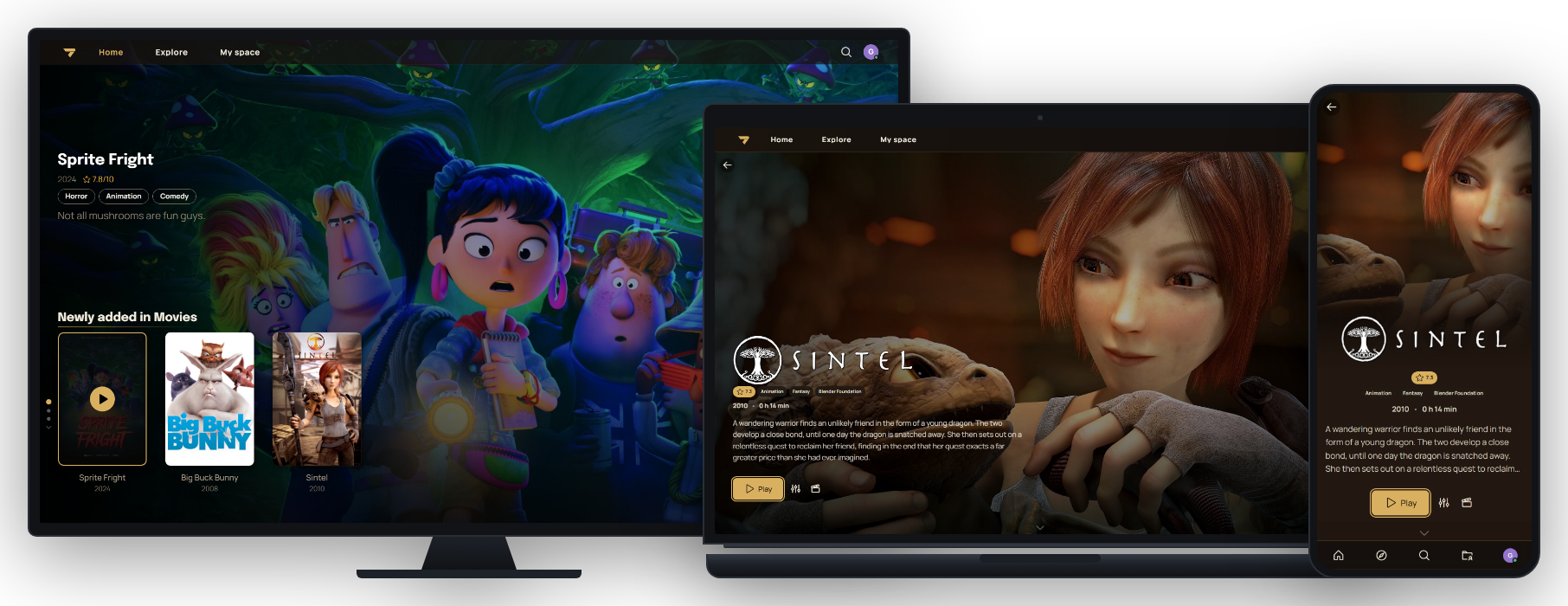
What is K7?
This media server organizes personal libraries of movies, TV series, and music, fetching metadata automatically from MusicBrainz, TMDb, and TheTVDB. It transcodes via ffmpeg and HLS so content plays on any device, and can federate with other instances to share libraries without copying files. Authentication supports local accounts with two-factor authentication, OIDC single sign-on, and optional guest access. Native clients exist for web, Android phones and TV, Windows, iOS, macOS, and Linux (GTK4), all sharing a unified Blazor and MAUI interface. Features include cross-device remote control, Chromecast casting, OpenSubsonic API for third-party players, dynamic rule-based playlists, offline downloads with sync, and optional AI-powered music discovery through a self-hosted AudioMuse instance. Administration provides a dashboard, diagnostics, webhook notifications, and import tools for Plex, Jellyfin, and Spotify. Deployment uses Docker Compose or a Helm chart on Kubernetes with PostgreSQL.
Should you self-host K7?
K7 scores 51/100 on selfhost.directory (how scoring works) and ranks #59 of 118 in Media Server. It has 344 GitHub stars.
It shipped 10 stable releases in the past year. The latest, v1.17.1, came out on 25 October 2026. New versions land roughly every 4 days.
Setup is moderate: expect some configuration beyond a single command. An official Docker image is available. It is AGPL-3.0-licensed and written mostly in C#.
Its closest alternative on selfhost.directory is Jellyfin (88/100, 58 744 stars). It scores higher overall, so compare the two before you pick. See K7 vs Jellyfin side by side.
Features
- AudioMuse AI integrationDisabled by default until you connect your AudioMuse server
- Chromecast Support
- Dynamic playlists
- Federation
- Guest Mode
- Import tool
- Local authentication with optional 2FA
- Movies, TV series, and music libraries
- Multi-platform native clientsiOS and Mac builds exist but are not tested by the maintainer
- Offline Downloads
- OIDC/SSO integration
- OpenSubsonic compatibility
- Remote Control
- Sync Play
- Transcoding (ffmpeg, HLS)
K7 README
More in Media Streaming
 lightNVRSelf-hosted, open-source NVR in C for low-memory devices. WebRTC/HLS streaming, visual detection zones, themes, external object detection.
 LinuxServer PlexSelf-hosted Docker container packaging Plex Media Server, maintained by LinuxServer.io with multi-arch support, hardware transcoding, and easy user mapping.
 LiquidsoapSelf-hosted, open-source scripting language for building audio and video streams, used by internet radios and web TVs worldwide.
 lunarr-goSelf-hosted media server for movies/TV with TMDb metadata, HLS transcoding, Chromecast/AirPlay, and native mobile apps.
 m3u-editorSelf-hosted open-source IPTV hub: import M3U/Xtream playlists, manage XMLTV or Schedules Direct EPG, and serve M3U, Xtream, HDHomeRun, or XMLTV output to any player.
 MagnetioMagnetio is a self-hosted, open-source Stremio addon scraping 22+ torrent sources with 8 debrid services, Jackett/Prowlarr, TMDB recommendations, and subtitle sync.
 MaterialiousOpen-source, self-hosted material-design frontend for YouTube and Invidious: encrypted subscriptions, SponsorBlock, DeArrow, no ads. Web, desktop & Android TV support.
 mediaMedia is a self-hosted PHP app on CakePHP 3 that indexes and streams movies, TV series, music, games, and software with TMDB metadata and web playback.
 MediaFusionMediaFusion is a self-hosted, open-source streaming platform that aggregates streams from debrid services and P2P sources for playback on Stremio, Kodi, or in a browser.
 mediastormSelf-hosted streaming platform for movies, TV, live TV with Usenet, debrid, Plex/Jellyfin, IPTV. Native apps, web UI, multi-profile, offline downloads, DVR, Iroh.
 miceMice is a self-hosted, open-source web client for Navidrome. It streams your music library with a modern UI, favorites, search, queue management, and Last.fm scrobbling.
 MikochiMikochi is a self-hosted, open-source remote file browser for servers and NAS that lets you browse, upload, download, rename, delete files, and stream media to VLC/mpv.
0 comments