
Self-host FlareMo
v0.22.2Cloudflare-native knowledge base with Memos API
- Stars
- 328
- Requires
- Cloudflare D1, Cloudflare Queues, Cloudflare R2, Cloudflare Vectorize
What is FlareMo?
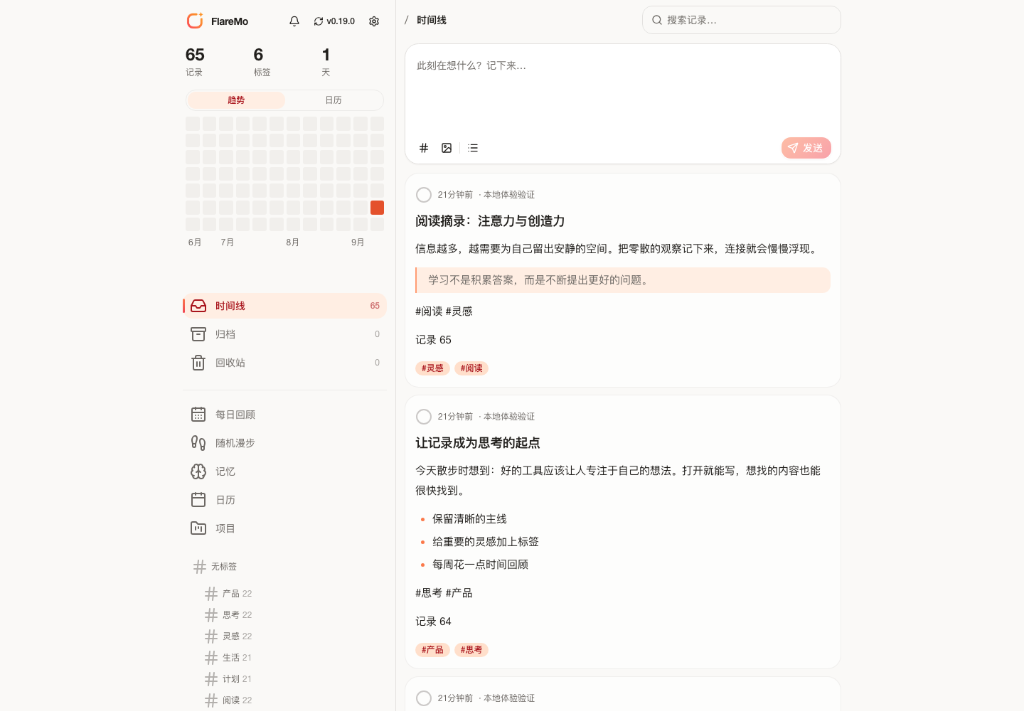
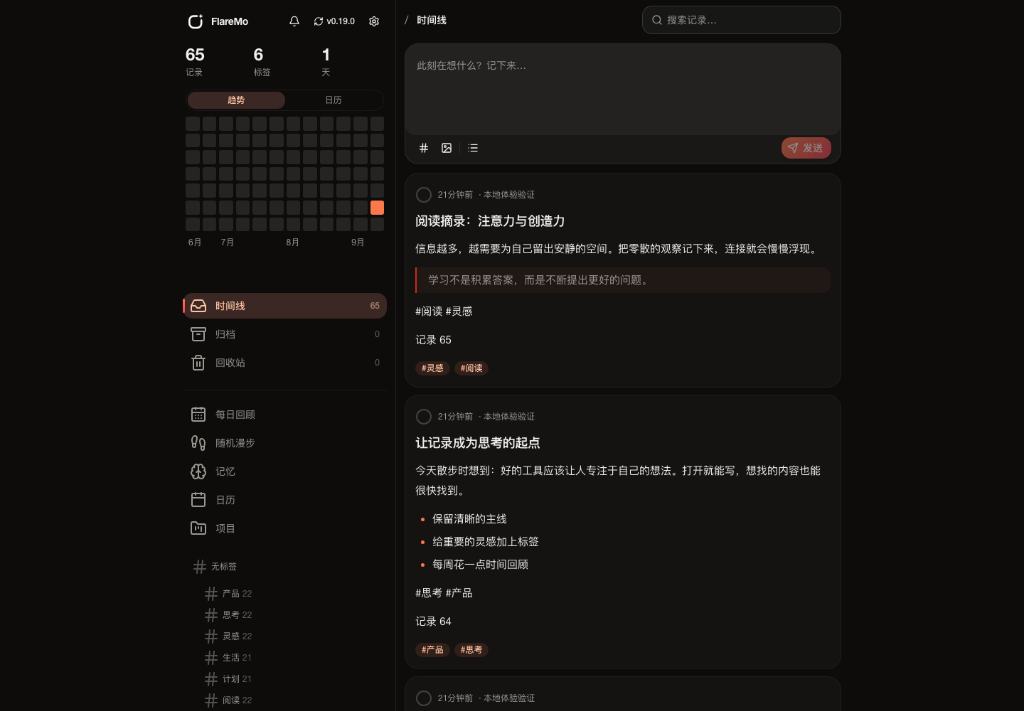
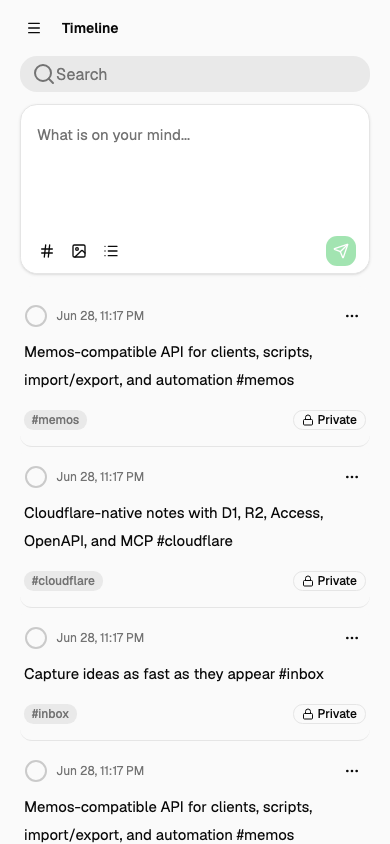
FlareMo runs entirely on Cloudflare's edge network — Workers for compute, D1 for data, R2 for files — so there are no servers to manage. It offers a Memos-compatible API, AI long-term memory through MCP endpoints, projects with kanban boards, an offline-first PWA you can install on any device, a plugin system with sandboxed cards, and team workspaces with role-based access and three visibility levels. Deployment takes minutes on a free Cloudflare account. The free tier gives 5 GB D1 (roughly 2.5 million text notes) and 10 GB R2 (about 10,000 photos) with zero egress fees.
Should you self-host FlareMo?
FlareMo scores 51/100 on selfhost.directory (how scoring works) and ranks #19 of 42 in Knowledge Management. It has 328 GitHub stars.
It shipped 10 stable releases in the past year. The latest, v0.22.2, came out on 23 October 2026. New versions land roughly every 3 days.
Setup is moderate: expect some configuration beyond a single command. It is AGPL-3.0-licensed and written mostly in Typescript.
Its closest alternative on selfhost.directory is Project N.O.M.A.D. (85/100, 41 107 stars). It scores higher overall, so compare the two before you pick. See FlareMo vs Project N.O.M.A.D. side by side.
Features
- AI long-term memory (MCP)
- Better Auth security
- Bi-directional import/export
- Daily review and random walk
- Full-text search (FTS5)
- Memos-compatible API
- Plugin system (cards)
- Project and task management
- Reader seats
- Revision History
- Semantic vector search
- Team collaboration with roles
- Voice capture (ASR)
- Web push notifications
FlareMo README
FAQ
How does single-user differ from team mode?
By default, it is a quiet single-user sanctuary. When team mode is enabled, admins invite members via one-time activation links. Memos can be private, team-visible, or public.
Do third-party apps and scripts still work?
Yes, FlareMo implements the Memos /api/v1 endpoint surface and personal access tokens (PAT). Popular iOS/Android clients like Moe Memos connect directly.
Can I migrate from Memos or flomo?
Yes, FlareMo imports ZIP or JSON export bundles from Memos and flomo, preserving timestamps, tags, and content while allowing custom conflict resolution.
How safe is my data?
Data is stored on Cloudflare's enterprise-grade distributed infrastructure with multi-region replication. FlareMo also supports one-click exports to standard Memos bundles for regular offline archiving.
Is the free tier really enough?
Yes, Cloudflare's free tier provides 5GB D1 database (~2.5 million text memos) and 10GB R2 storage (~10,000 compressed photos). Writing 100 memos daily would take 68 years to fill.
More in Knowledge Management
 flatnotesSelf-hosted, open-source note app storing every note as a plain markdown file — no database. Full-text search, tags, wikilinks, dark theme, REST API.
 fortemiHost your own AI knowledge base with hybrid search, knowledge graphs, multiple LLM backends, and multimodal ingestion. Docker deployment on regular hardware.
 frank-botFrank Bot is a self-hosted, open-source RAG chatbot using ChromaDB and Anthropic Claude. Designed for Australian workplaces with 12 industry-tuned vertical personalities.
 GititGitit is a self-hosted, open-source wiki in Haskell storing pages in Git/Darcs/Mercurial with Pandoc markup, TeX math, and syntax highlighting.
 GollumSelf-hosted, open-source wiki that keeps pages as Markdown and other markup files in a Git repo, with a built-in web editor and full revision history.
 graphitiOpen-source Python framework building temporal knowledge graphs for AI agents: hybrid semantic, keyword and graph search, facts with validity windows, episode provenance.
 GrimoireOpen-source, self-hosted local-first bookmark manager: saves and extracts pages, PDFs, and YouTube, with keyword, semantic, or hybrid search and optional AI providers.
 hAnnotate with anyone, anywhere.
 HaloSelf-hosted open-source website builder for blogs, knowledge bases, corporate sites, and online stores with plugins, themes, REST API, and multiple databases.
 HexisHexis is a self-hosted, open-source platform for managing AI-agent skills, tools and context via a Git-backed repository, accessible through MCP.
 homelableOpen-source, self-hosted homelab canvas: map network and rack layouts, scan subnets with nmap, watch live device status, and keep lab documentation in markdown.
 HumHubHumHub is a self-hosted, open-source intranet platform with user profiles, spaces, content management, and 80+ modules. Runs via Docker or LAMP stack.
0 comments