
Self-host Eneru
v6.2.2UPS monitoring and coordinated shutdown for NUT
- Stars
- 151
- Port
- 9191 (API and web dashboard)
- Requires
- Network UPS Tools (NUT)
ghcr.io/m4r1k/eneru

What is Eneru?
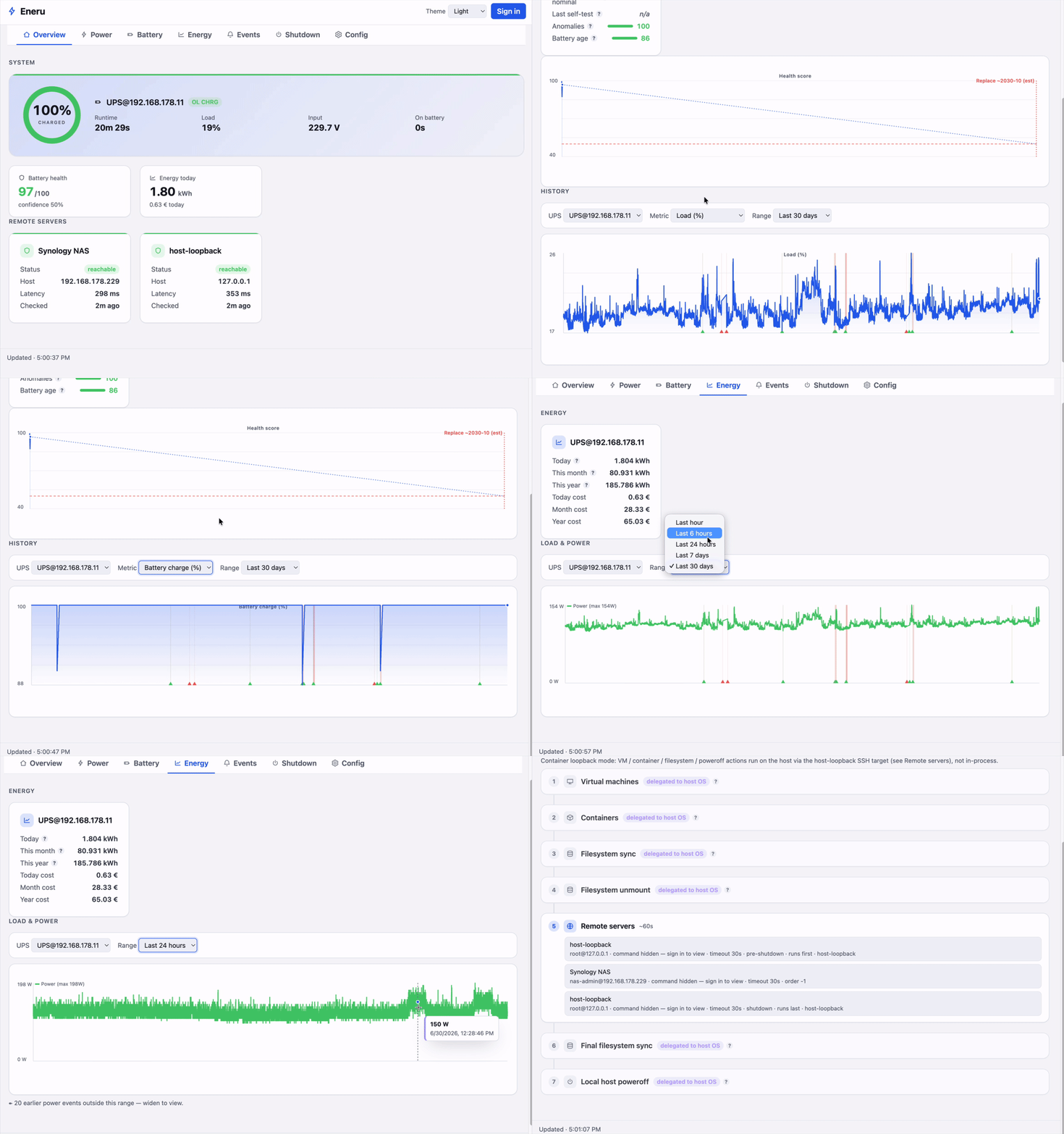
Eneru is a Python daemon for Network UPS Tools that watches one or more UPSes and coordinates orderly shutdown of virtual machines, containers, remote servers, mounted filesystems, and the local host when power fails. It ships a browser dashboard and a terminal UI, both served by an embedded API that also exposes Prometheus metrics, MQTT publishing, and a Grafana dashboard. Authentication uses local bcrypt-hashed accounts and API keys. Six trigger types drive shutdown decisions: battery percentage, remaining runtime, observed depletion rate, elapsed time on battery, the NUT forced-shutdown flag, and a connection-loss failsafe. Battery anomaly detection spots unexpected charge drops with vendor-specific filtering for major UPS brands. A guided terminal editor (eneru config) builds and validates the YAML configuration, while eneru config check runs live read-only probes against NUT, SSH, and sudo to preview the exact shutdown sequence. The project is MIT-licensed and runs via Docker/Podman, native deb/rpm packages with systemd, PyPI, or Kubernetes.
Should you self-host Eneru?
Eneru scores 51/100 on selfhost.directory (how scoring works) and ranks #58 of 104 in Monitoring & observability. It has 151 GitHub stars.
It shipped 23 stable releases in the past year. The latest, v6.2.2, came out on 8 October 2026. New versions land roughly every 2 days.
Setup is moderate: expect some configuration beyond a single command. An official Docker image is available. It is MIT-licensed and written mostly in Python.
Its closest alternative on selfhost.directory is grafana (90/100, 77 566 stars). It scores higher overall, so compare the two before you pick. See Eneru vs grafana side by side.
Features
- Authenticated API
- Battery anomaly detection
- Battery health scoring
- Browser dashboard
- Energy and cost tracking
- Grafana Dashboard
- MQTT publishing
- Multi-UPS monitoring
- Orchestrated multi-resource shutdown
- Periodic reports
- Persistent notifications
- Prometheus Metrics
- Scheduled NUT self-tests
- Six independent shutdown triggers
- TUI dashboard
Eneru README
More in Infrastructure
 ganetiGaneti is a self-hosted, open-source VM cluster manager for Xen/KVM with high availability, live migration, and automated allocation across 3-100 nodes.
 home-enterprise-labopsHELO is a self-hosted, open-source Kubernetes infrastructure for learning GitOps, service meshes, and production patterns in your homelab.
 IncusSelf-hosted, open-source system container and VM manager with unified REST API for local and remote management, scaling from single machine to clusters.
 Jitsi Video BridgeJitsi Videobridge is an open-source, self-hosted WebRTC SFU that routes video for scalable multiparty conferencing.
 LXCSelf-hosted, open-source low-level Linux container runtime for privileged and unprivileged system containers, driven by dotted lxc.* config keys and a stable C API.
 my-self-hosting-servicesSelf-hosted Docker homelab with Authentik SSO, Traefik automated SSL, Cloudflare DNS automation, and Portainer. Includes n8n, OpenClaw AI, and microservices.
 nanoclNanocl is a self-hosted, open-source orchestrator for containers and VMs using declarative Statefiles to manage workloads on your infrastructure.
 nsdNSD is an open-source, self-hosted authoritative DNS name server optimized for speed and reliability, used by root servers and TLD registries worldwide.
 os-modaA self-hosted NixOS operating system where an AI agent manages your server through structured tools, with tamper-proof audit logs and instant rollback.
 Proxmox Kubernetes EngineSelf-hosted tool to deploy HA Kubernetes clusters on Proxmox VE using Cluster API with native storage, load balancing, and CNI.
 PulumiOpen-source infrastructure-as-code CLI and engine for AWS, Azure, GCP and Kubernetes in TypeScript, Python or Go, with self-hosted state in S3 or PostgreSQL.
 RackPeekSelf-hosted web UI and CLI for home lab infrastructure documentation, tracking hardware, services, and networks in open YAML formats.
0 comments