
Self-host ctk
Browser visual editor for Docker Compose and Kubernetes
- Stars
- 302
- Port
- 9001 (Backend API server)
- Requires
- PostgreSQL
What is ctk?
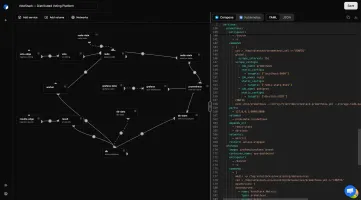
Container Tool Kit (CTK) is a browser-based visual editor for designing Docker Compose and Kubernetes configurations. Users can describe their stack in plain language and an LLM agent creates services, networks, and volumes, which can then be inspected and edited visually. The graph view stays in sync with the YAML, and manifests can be exported directly from the browser. The frontend runs locally with npm, while the optional backend stack (for project persistence and authentication) uses Docker Compose with PostgreSQL. The project is MIT-licensed and supports AI-assisted building via MCP.
Should you self-host ctk?
ctk scores 42/100 on selfhost.directory (how scoring works) and ranks #122 of 166 in Developer Tools. It has 302 GitHub stars.
There was no stable release in the past 12 months, so check the repository's recent activity before you rely on it.
Setup is moderate: expect some configuration beyond a single command. It is MIT-licensed and written mostly in Typescript.
Its closest alternative on selfhost.directory is openhands (87/100, 92 079 stars). It scores higher overall, so compare the two before you pick. See ctk vs openhands side by side.
Features
- AI-assisted manifest generation
- Browser-based, no backend required for generation
- MCP (Model Context Protocol) Support
- Project persistence with authenticationRequires backend stack with PostgreSQL
- Visual Docker Compose Builder
- Visual Kubernetes manifest builder
- YAML-graph sync
ctk README
More in Kubernetes
 DexOpen-source, self-hosted OIDC and OAuth 2.0 identity service that fronts LDAP, SAML, GitHub, Google and other IdPs, so every app just speaks OpenID Connect.
 docker-registry-proxyA self-hosted caching proxy for Docker that centralizes registry config and auth, caches layers/manifests from any registry, and helps avoid rate limits.
 dstackdstack is a self-hosted, open-source control plane for GPU compute across clouds, Kubernetes, and bare-metal. It streamlines AI development, training, and inference.
 Eclipse CheKubernetes based Cloud Development Environments for Enterprise Teams
 fluentdFluentd is a self-hosted, open-source data collector that unifies logging infrastructure with 500+ plugins for sources and destinations.
 github-actions-runner-operatorSelf-hosted Kubernetes operator that schedules GitHub Actions runner pods on demand; declare runner pools, use a GitHub App or PAT, and install with a Helm chart.
 gpustackOpen-source, self-hosted GPU cluster manager that deploys LLMs on NVIDIA, AMD or Ascend hardware via vLLM, SGLang and TensorRT-LLM behind OpenAI-compatible APIs.
 Grafana LokiGrafana Loki is a self-hosted, open-source log aggregation system that indexes metadata instead of full log text for cost-effective operation.
 HarborHarbor is an open-source, self-hosted container registry providing vulnerability scanning, image signing, and role-based access control for Kubernetes and Docker.
 home-enterprise-labopsHELO is a self-hosted, open-source Kubernetes infrastructure for learning GitOps, service meshes, and production patterns in your homelab.
 K16SSelf-hosted CKA/CKS exam simulator with real kubeadm clusters, Incus workers, timed mocks, browser terminal, and automated grading.
 KappalKappal is a self-hosted, open-source CLI that runs docker-compose.yaml on Kubernetes (K3s) using familiar Docker Compose commands — no kubectl needed.
0 comments