
Self-host Coddy Agent
1.3.60AI agent harness in one static Go binary
- Stars
- 186
- Port
- 12345 (Web UI and OpenAI-compatible HTTP API)
ghcr.io/coddy-project/coddy-agent
What is Coddy Agent?
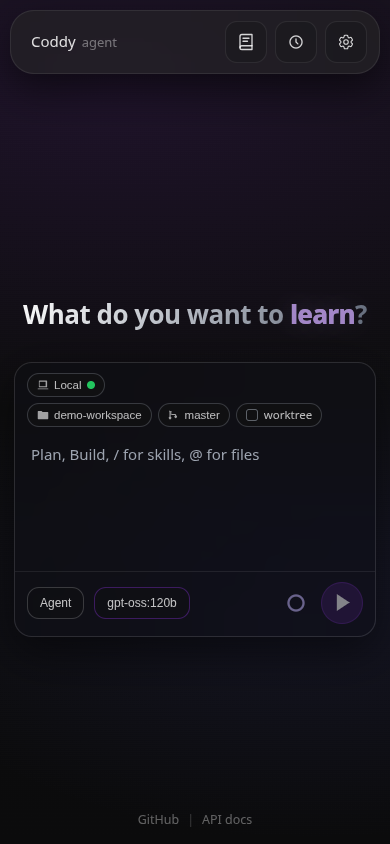
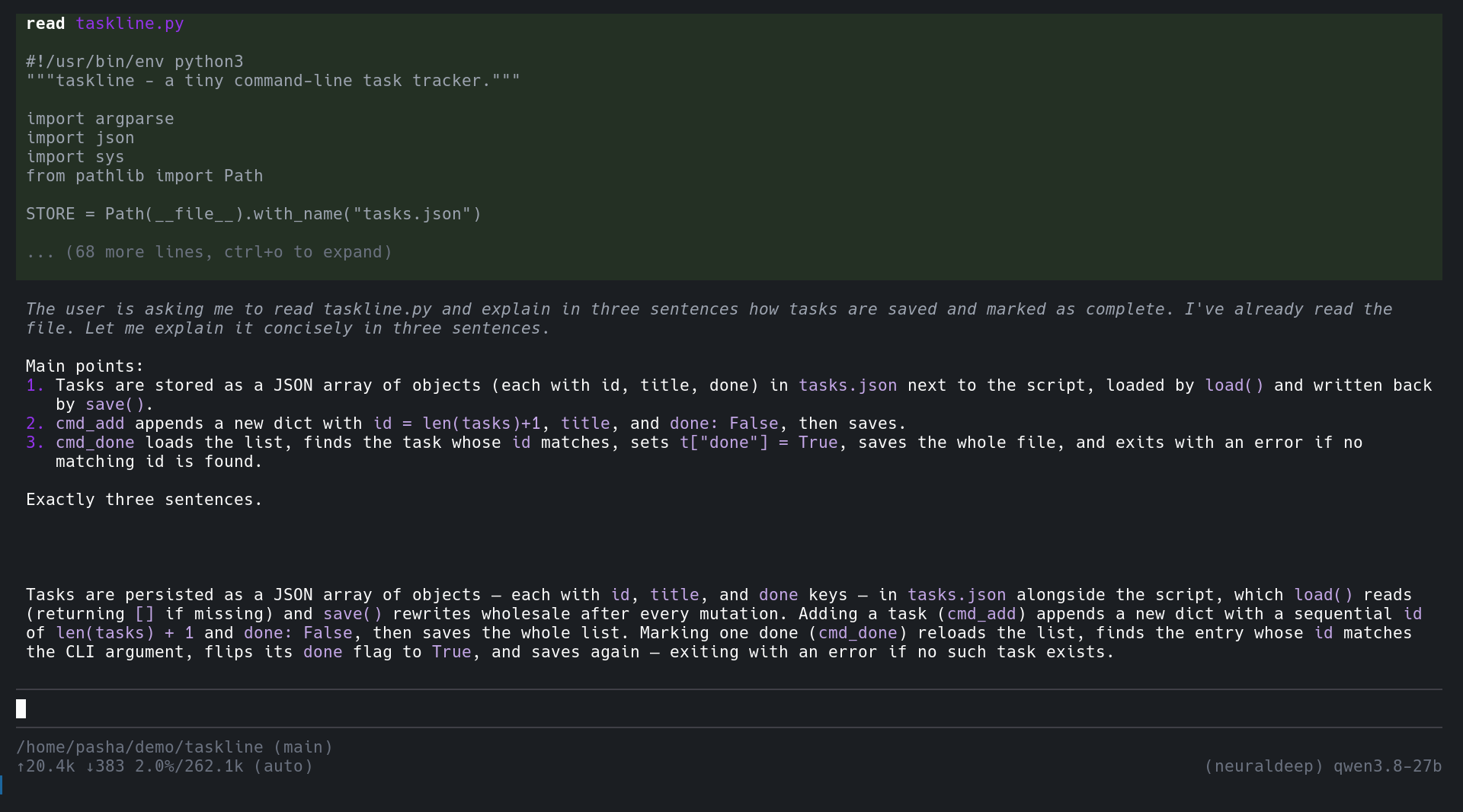
Coddy Agent is a self-hosted, open-source AI agent harness distributed as a single static Go binary. It executes a reasoning engine with filesystem and shell tools, and adds support for Model Context Protocol servers, project rules, skills, subagents, hooks, background tasks, long-term memory, and context compaction. The same agent core is accessible through multiple interfaces: a terminal console (TUI), an embedded web UI with an OpenAI-compatible HTTP API, the Agent Client Protocol (ACP) for editors like Zed and VS Code, a Telegram gateway, a Pachca gateway, a cron scheduler, and a swarm relay for multi-node fleets. All interfaces share sessions stored under ~/.coddy. It runs in distroless/scratch containers with a read-only root filesystem, needs no external database or Redis, and works with any OpenAI-compatible provider (OpenAI, Anthropic, Ollama, llama.cpp, vLLM, NeuralDeep) plus ChatGPT via Codex and Devin accounts. Configuration uses YAML with JSON Schema validation and hot-reload. The project is MIT-licensed and actively maintained with regular releases.
Should you self-host Coddy Agent?
Coddy Agent scores 50/100 on selfhost.directory (how scoring works) and ranks #40 of 120 in AI Assistant. It has 186 GitHub stars.
It shipped 10 stable releases in the past year. The latest, 1.3.60, came out on 27 October 2026.
Setup is moderate: expect some configuration beyond a single command. An official Docker image is available. It is MIT-licensed and written mostly in Go.
Its closest alternative on selfhost.directory is bbarit-oss (45/100, 149 stars). Coddy Agent scores higher overall. See Coddy Agent vs bbarit-oss side by side.
Features
- Agent Client Protocol (ACP) Server
- Background tasks
- Context Compaction
- Cron Scheduler
- Embedded Web UI
- Hooks
- OpenAI-compatible HTTP API
- Pachca Gateway
- Prometheus metrics exporter
- ReAct Loop with Tools
- Remote Mode
- Subagents
- Swarm Relay
- Telegram gateway
- Terminal Console (TUI)
Coddy Agent README
FAQ
How do I run Coddy on more than one machine?
Run coddy serve on each machine and enable the swarm relay on one of them to list every node's sessions in one place, route across rings, and pull in machines that can only dial out. The console and coddy acp can also drive a single remote server with --remote.
Which editors and clients can host Coddy?
coddy acp speaks the Agent Client Protocol over stdio, so Zed, Obsidian, VS Code, or your own script get sessions, modes, permissions, streaming updates, and skills as slash commands.
Can Coddy run on-premises with local models?
Yes. Point a model entry at a local OpenAI-compatible server such as Ollama, llama.cpp, or vLLM and no prompt leaves your network. The binary is static and runs in distroless or from-scratch containers with a read-only root filesystem.
Which LLM providers and models does Coddy work with?
Any OpenAI-compatible API plus Anthropic: OpenAI, Anthropic, Ollama, llama.cpp, vLLM, NeuralDeep, or your own gateway with your own keys and endpoints. ChatGPT sign-in works through the Codex backend, and a Devin account signs in through the browser.
What is Coddy Agent?
Coddy Agent is an open-source, general-purpose AI agent that ships as one static Go binary under the MIT license. It runs a ReAct loop with filesystem and shell tools, MCP servers, project rules, skills, subagents, hooks, background tasks, a cron scheduler, and long-term memory, available from a terminal, browser, editor over ACP, or Telegram.
More in Chat
 ColanodeOpen-source, local-first chat-and-docs workspace that stands in for Slack and Notion; self-hosted via Docker Compose or Helm with Postgres, Redis and object storage.
 CommetYour space to connect
 ConduitA self-hosted, open-source Matrix homeserver written in Rust, shipped as Docker images, Debian packages and static Linux binaries; easy to set up and federation-capable.
 ContextModContextMod is a self-hosted, open-source Reddit moderation bot that analyzes user history across subreddits to detect complex behavior patterns beyond AutoModerator.
 ConvosConvos is an open-source, multiuser IRC chat app you run self-hosted in the browser, with a persistent bouncer, message archive, video calls and Docker or snap installs.
 cossistantSelf-hosted AI customer support platform with customizable agents that learn from your team, built for React and Next.js.
 CrustAICrustAI is a self-hosted AI assistant running locally via Ollama, connecting to messaging platforms with memory, voice, and REST API — no cloud.
 DashCordA self-hosted Discord bot that turns chat messages, file uploads, and button panels into webhook calls for automation tools like n8n, Make, Zapier, and Node-RED.
 DatabagSelf-hosted federated messenger with E2E encryption, WebRTC calls, topic threads, and mobile apps. Runs on Raspberry Pi Zero.
 dcts-shippingDCTS is an open-source, self-hosted chat platform with encrypted DMs, voice chat and screensharing, a plugin/theme system, and web, desktop and Android clients.
 DendriteSelf-hosted Matrix homeserver alternative to Synapse with lower resource usage, written in Go, currently in maintenance mode with only security fixes being applied.
 discord-rss-botSelf-hosted Discord bot that monitors RSS feeds and posts updates to channels in real-time with configurable intervals and Docker support.
0 comments