
Self-host bbarit-oss
v0.1.21Terminal-native AI coding agent as a single Rust binary
- Stars
- 149

What is bbarit-oss?
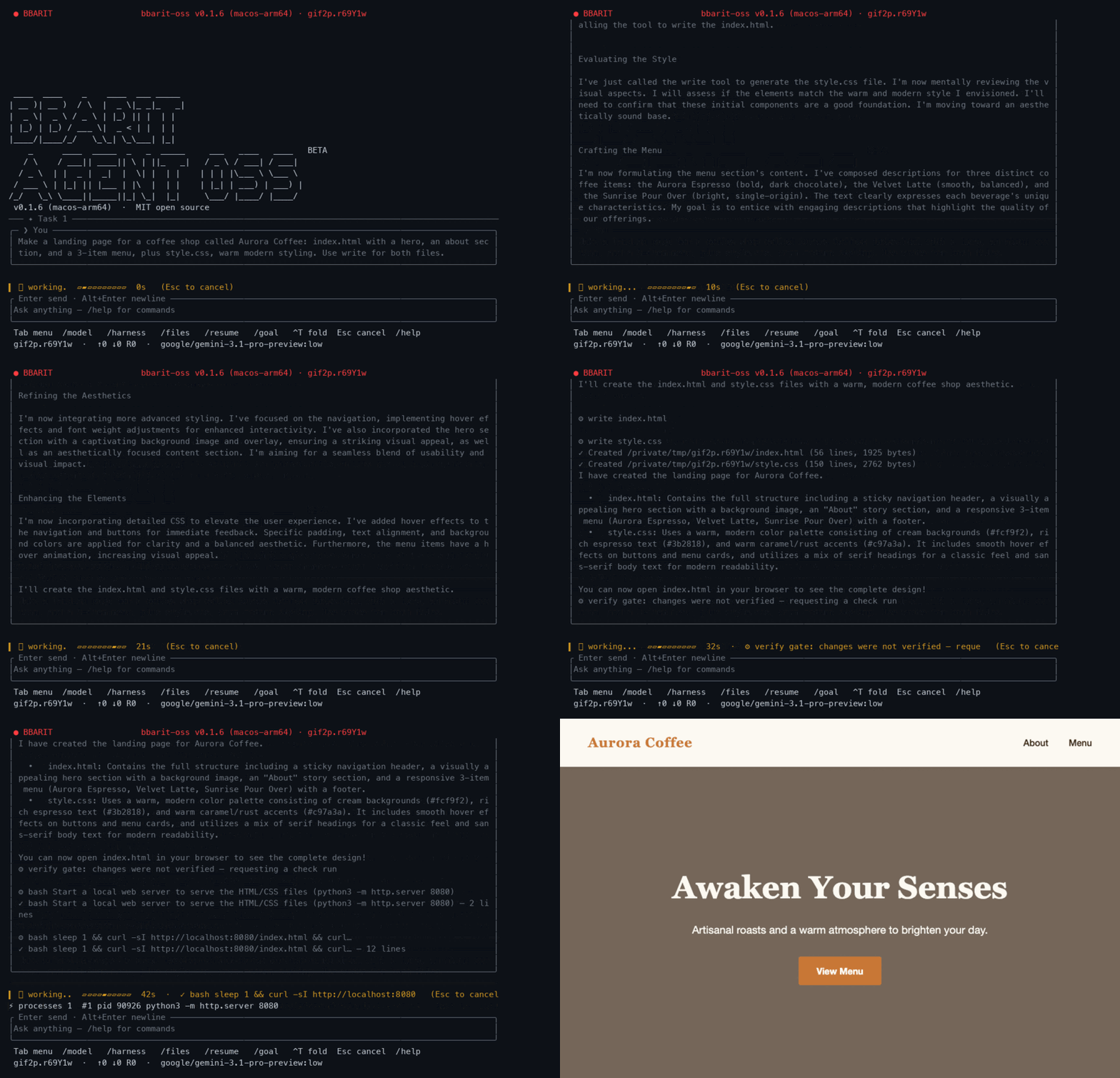
bbarit-oss is a terminal-based AI coding assistant delivered as one self-contained Rust executable that requires no separate runtime. It works with more than fifteen LLM providers — including Anthropic, OpenAI, Google, OpenRouter, and local models through Ollama — covering over a thousand models from a single registry. The agent can read and write files, execute shell commands, search code semantically, retrieve web pages, and launch parallel sub-agents on its own. It includes 295 ready-made specialist personas spanning 30 fields, automatic cross-session memory that captures lasting facts, a per-project wiki for durable codebase knowledge, and support for MCP, LSP, and custom skills. A toggle lets it reuse MCP servers and skills already configured in Claude Code or Codex. You install it with one curl command on macOS or Linux, one PowerShell line on Windows, or grab a binary from GitHub releases. The code is MIT licensed and runs entirely on your hardware; nothing phones home.
Should you self-host bbarit-oss?
bbarit-oss scores 45/100 on selfhost.directory (how scoring works) and ranks #66 of 120 in AI Assistant. It has 149 GitHub stars.
It shipped 10 stable releases in the past year. The latest, v0.1.21, came out on 21 July 2026.
Setup is easy: most people get it running in one sitting. It is Other-licensed and written mostly in Rust.
Its closest alternative on selfhost.directory is Theia IDE (59/100, 613 stars). It scores higher overall, so compare the two before you pick. See bbarit-oss vs Theia IDE side by side.
Features
- 295 built-in personas
- Claude Code & Codex interop
- Cross-session auto-memory
- LSP integration
- MCP server support
- Multi-Provider LLM Support
- Offline/local model support
- Parallel sub-agents
- Project wiki
- Self-update
- Semantic code search
- Session Management
- Single static binary
- Skills & Extensions
- TUI with themes
bbarit-oss README
FAQ
Does it phone home?
No, your API keys and code stay on your machine.
Is my code private?
Yes, your keys and code stay on your machine and go only to the provider you choose. It is fully self-hostable; nothing routes through the vendor.
How do I install it on Windows?
One line in PowerShell: irm https://bbarit.com/agent/install.ps1 | iex — installs to %LOCALAPPDATA%\Programs\bbarit-oss and adds to PATH.
Is it free?
The agent is free and open source (MIT). You only pay your own LLM provider or run a local model for $0.
Can I use it with a local model / offline?
Yes, point it at Ollama (/ollama) to run entirely on your machine with no API key and no data leaving your computer.
Which LLM providers are supported?
Anthropic Claude, OpenAI (GPT + Codex), Google Gemini/Vertex, OpenRouter, Groq, Mistral, Together, Fireworks, DeepSeek, Cerebras, Amazon Bedrock, GitHub Copilot, and local models via Ollama — 15+ providers, 1,000+ models.
Is it related to Pi?
Yes, its design is based on Pi (MIT). It is an independent Rust rewrite with exact measured source overlap and differences published in PROVENANCE.md.
How is this different from Claude Code / Codex CLI / Gemini CLI?
It is open source, model-agnostic (any provider or local model), and ships as a single Rust binary with no runtime.
More in CLI Tools
 BubBub is a self-hosted, open-source agent runtime for developers to build and customize AI agents with a plugin system, tape-based context, and channel-agnostic design.
 ClaudePantheonSelf-hosted Docker app running persistent Claude Code in a browser with web terminal, file manager, WebDAV, and MCP integrations via a single port.
 crawliecrawlie is a self-hosted, open-source technical SEO and GEO crawler with 57+ checks. Runs locally via CLI, MCP server, or Tauri desktop app.
 ctxctx is a self-hosted, open-source CLI tool for managing AI coding agent conversations with workstreams, transcript binding, and local SQLite storage.
 Deadend CLIDeadend CLI is a self-hosted, open-source CLI for autonomous web app pentesting using feedback-driven AI with any LiteLLM model, achieving ~80% on XBOW.
 EntrolyEntroly is a self-hosted, open-source tool that reduces AI token usage by picking relevant code evidence within a budget and providing auditable receipts.
 ffmpeg-over-ipOpen-source, self-hosted client and server that run GPU-accelerated ffmpeg on a remote machine and tunnel file I/O back, dropping GPU passthrough and NFS/SMB shares.
 leatherleather is a self-hosted, open-source local agent runtime running declarative AI agents from a single zero-dependency Go binary.
 ManagarrManagarr is a self-hosted, open-source terminal interface and CLI for managing Radarr, Sonarr, Lidarr, and Readarr from one unified tool.
 MyCoderMyCoder is a self-hosted, open-source command-line AI agent for developers. Runs locally via npm, uses multiple AI providers, integrates with GitHub.
 nxvSelf-hosted, open-source CLI and API server indexing 9+ years of nixpkgs history to instantly find any package version and its exact commit.
 Open CodexOpen Codex is an open-source CLI AI assistant that converts natural language to shell commands using local LLMs via Ollama, running offline on macOS, Linux, and Windows.
0 comments