
Self-host yantrikdb-server
v0.20.0Memory engine that forgets, consolidates, spots conflicts
- Stars
- 177
- RAM
- 1 GB
- Storage
- 1 GB
- Ports
- 7437 (wire protocol (binary, multiplexed)), 7438 (HTTP gateway (REST + JSON)), 7440 (cluster port (YRP replication))
ghcr.io/yantrikos/yantrikdb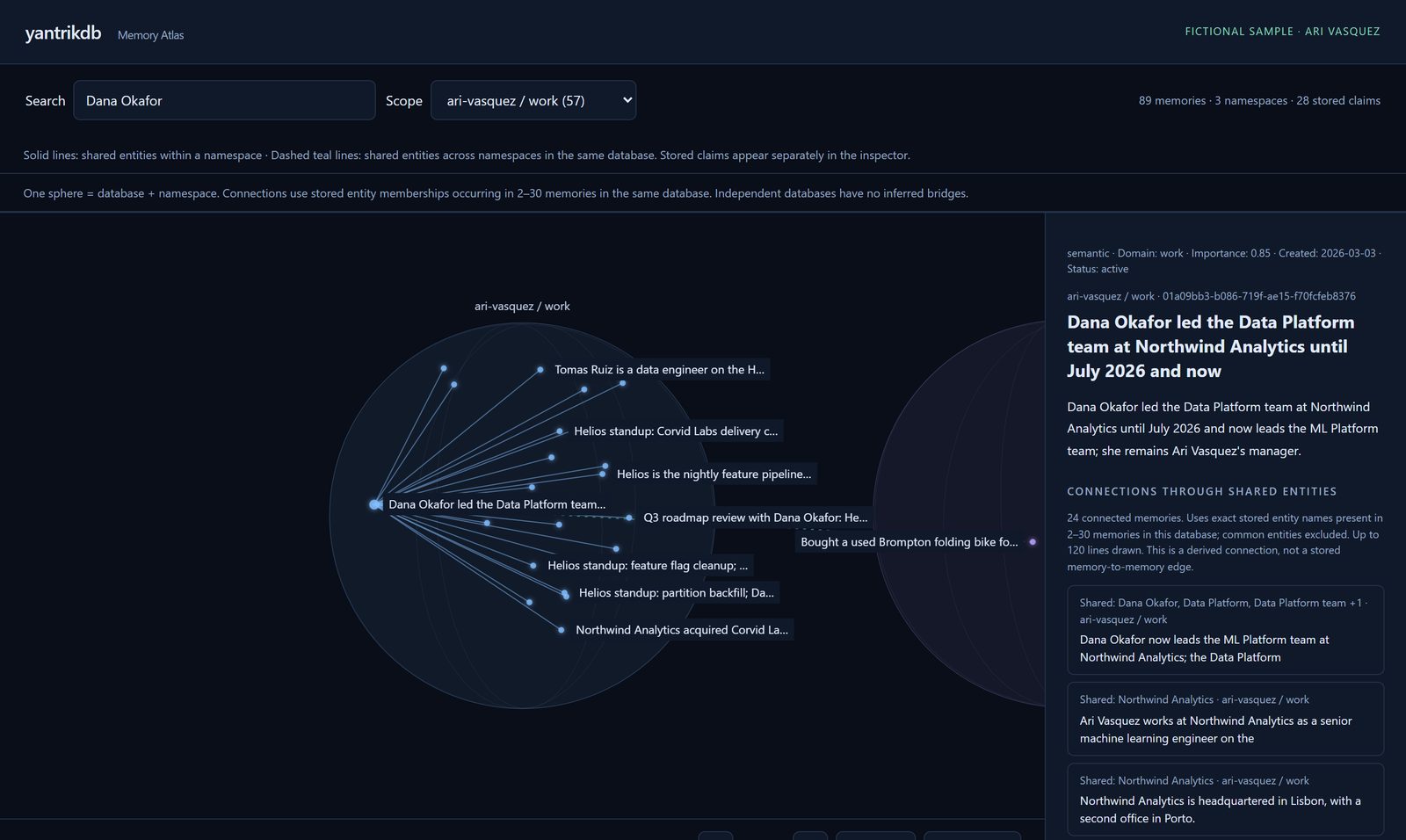
What is yantrikdb-server?
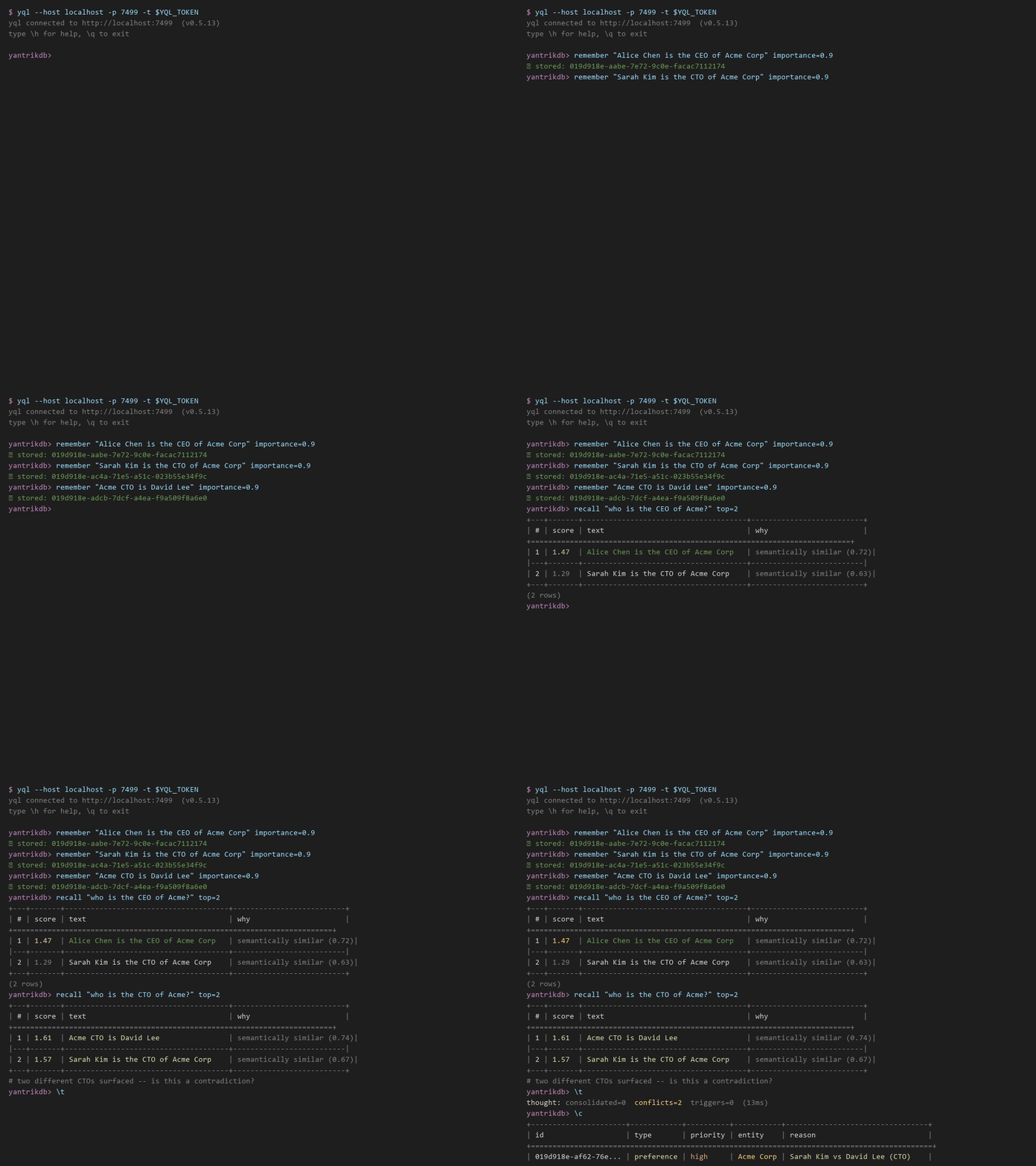
This project gives AI agents persistent long-term memory that works like human memory — it forgets unimportant details, merges duplicate recollections, and flags conflicting facts. You can embed the Rust engine directly, use the Python bindings, run an MCP server for coding assistants, or deploy a multi-tenant HTTP cluster with high-availability replication. The system combines vector search with a knowledge graph, temporal decay, and structured claim tracking. It supports CRDT-based sync for offline-first operation, encryption at rest, and Prometheus metrics.
Should you self-host yantrikdb-server?
yantrikdb-server scores 47/100 on selfhost.directory (how scoring works) and ranks #64 of 125 in AI. It has 177 GitHub stars.
It shipped 21 stable releases in the past year. The latest, v0.20.0, came out on 15 October 2026. New versions land roughly every 3 days.
Setup is moderate: expect some configuration beyond a single command. An official Docker image is available. It is Apache-2.0-licensed and written mostly in Rust.
Its closest alternative on selfhost.directory is Typesense (79/100, 27 062 stars). It scores higher overall, so compare the two before you pick. See yantrikdb-server vs Typesense side by side.
Features
- Autonomous Consolidation
- Contradiction Detection
- Embedded library
- Encryption at Rest
- HA clustering
- Knowledge Graph
- Knowledge Packs
- MCP Server
- Multi-device sync (CRDT)
- Multi-tenancy
- Proactive Triggers
- Prometheus Metrics
- Semantic recall
- Sessions & temporal awareness
- Temporal Decay
yantrikdb-server README
FAQ
What's the difference between yantrikdb, yantrikdb-server, and yantrikdb-mcp?
yantrikdb is the embeddable Rust engine with Python bindings. yantrikdb-server is the multi-tenant network database with HTTP, wire protocol, and clustering. yantrikdb-mcp is the MCP server wrapper for AI clients like Claude Code and Cursor.
Where can I get help?
Documentation at yantrikdb.com, GitHub Discussions for questions and ideas, GitHub Issues for bug reports, and a live AGI experiment at agi.yantrikdb.com.
Does YantrikDB support skills as a first-class primitive?
Yes, as of v0.8.11 the skill substrate exposes skill definition, semantic search, append-only outcome event logs, and tombstoning with schema validation but no semantic ontology enforcement.
How does YantrikDB compare to mem0?
mem0 is an LLM-driven memory layer using an LLM to extract facts backed by a vector store. YantrikDB is a cognitive memory database storing structured memories with importance, decay, polarity, and knowledge graph at the substrate level.
Is YantrikDB production-ready?
Embedded and single-node modes are production-ready and power real workloads. Cluster mode is structurally production-ready but empirical validation on real clusters is ongoing.
What is temporal decay in YantrikDB?
Temporal decay models how memories fade over time. Each memory has a configurable half-life (default 168 hours/7 days). After one half-life, retrieval relevance is halved. Importance and access frequency counter-balance decay.
How does YantrikDB detect contradictions?
YantrikDB stores facts as structured claims with polarity, validity windows, source attribution, and confidence. The conflict detector compares claims about the same entity-relation-target tuple and flags conflicts when opposite polarity claims with overlapping validity coexist.
What does the Apache-2.0 license mean for my use?
Apache-2.0 allows free use, modification, distribution including in closed-source and commercial products, self-hosting, and offering as a hosted service with no obligation to publish changes. It includes a patent grant.
Does YantrikDB support clustering and replication?
Yes, YantrikDB Server supports YRP native replication with leader election, quorum-durable writes, automatic failover, exactly-once keyed writes, linearizable reads, and witness quorum for 2-node HA.
What hardware does YantrikDB need?
Single-node: any 64-bit Linux, macOS, or Windows machine with 1 GB RAM and 1 GB disk. Production cluster: 3-node deployment with 4 GB RAM and SSD recommended.
Is YantrikDB free?
Yes, YantrikDB is open source under Apache-2.0, free to use, modify, self-host, and embed in closed-source products with no copyleft or commercial license required.
Does YantrikDB work with Claude Code, Cursor, and Windsurf?
Yes, YantrikDB ships an MCP server (yantrikdb-mcp) that drops into any MCP-compatible AI client including Claude Code, Cursor, Windsurf, Copilot, and Claude Desktop.
How is YantrikDB different from a vector database?
A vector database only stores embeddings and returns top-k by cosine similarity. YantrikDB models how memory actually works with importance, valence, half-life decay, source attribution, validity windows, a knowledge graph, contradiction detection, and autonomous consolidation.
What is YantrikDB?
YantrikDB is a cognitive memory database for AI agents providing persistent long-term memory with semantic recall, knowledge graph, contradiction detection, autonomous consolidation, and temporal decay.
More in Databases
 AntflyAntfly is a self-hosted, open-source Zig database unifying full-text, vector, and graph search with built-in ML for embeddings, reranking, and RAG.
 Apache CassandraSelf-hosted, open-source distributed NoSQL database: a masterless partitioned row store with multi-datacenter replication, queried with CQL over the native protocol.
 Apache CouchDBSelf-hosted, open-source Apache CouchDB is a document database with an HTTP/JSON API, bi-directional replication for offline-first sync, and multi-server clustering.
 Apache IoTDBApache IoTDB is a self-hosted, open-source time-series database for industrial IoT with high-throughput reads/writes, ultra-high compression, and SQL-like queries.
 arangodbSelf-hosted multi-model database for documents, graphs and key-values, queried in one AQL language; the open-source Community edition is free for non-commercial use.
 autobaseOpen-source MIT DBaaS for PostgreSQL: Patroni-based HA clusters, backups, failover and upgrades driven from a web console, Ansible collection or GitOps.
 brain-dbSelf-hosted memory database for AI agents with fused semantic, lexical, graph, and temporal retrieval. Single Rust core, binary wire protocol, Apache-2.0.
 chromaOpen-source vector database for AI retrieval: dense, sparse, full-text, regex and metadata search. Self-host it with pip, the chroma CLI, or Docker on port 8000.
 CondensationAn open-source distributed data system for app builders: conflict-free sync, end-to-end encryption and self-hosted store servers on a file system or MySQL.
 CondensationDBAn open-source distributed data system: build apps with its client libraries and run a self-hosted store server, with semilattice merging and end-to-end encryption.
 convexThe open-source reactive database for app developers
 cratedbA self-hosted, open-source distributed SQL database with PostgreSQL wire protocol support, for real-time analytics over time-series, full-text and vector data.
0 comments