
Self-host SayIt
v0.2.3Open-source voice typing for Windows with AI cleanup
docker compose up -d --build- Stars
- 456
- CPU
- NVIDIA GPU with CUDA for GPU inference
- Port
- 8000 (FastAPI backend server)
What is SayIt?
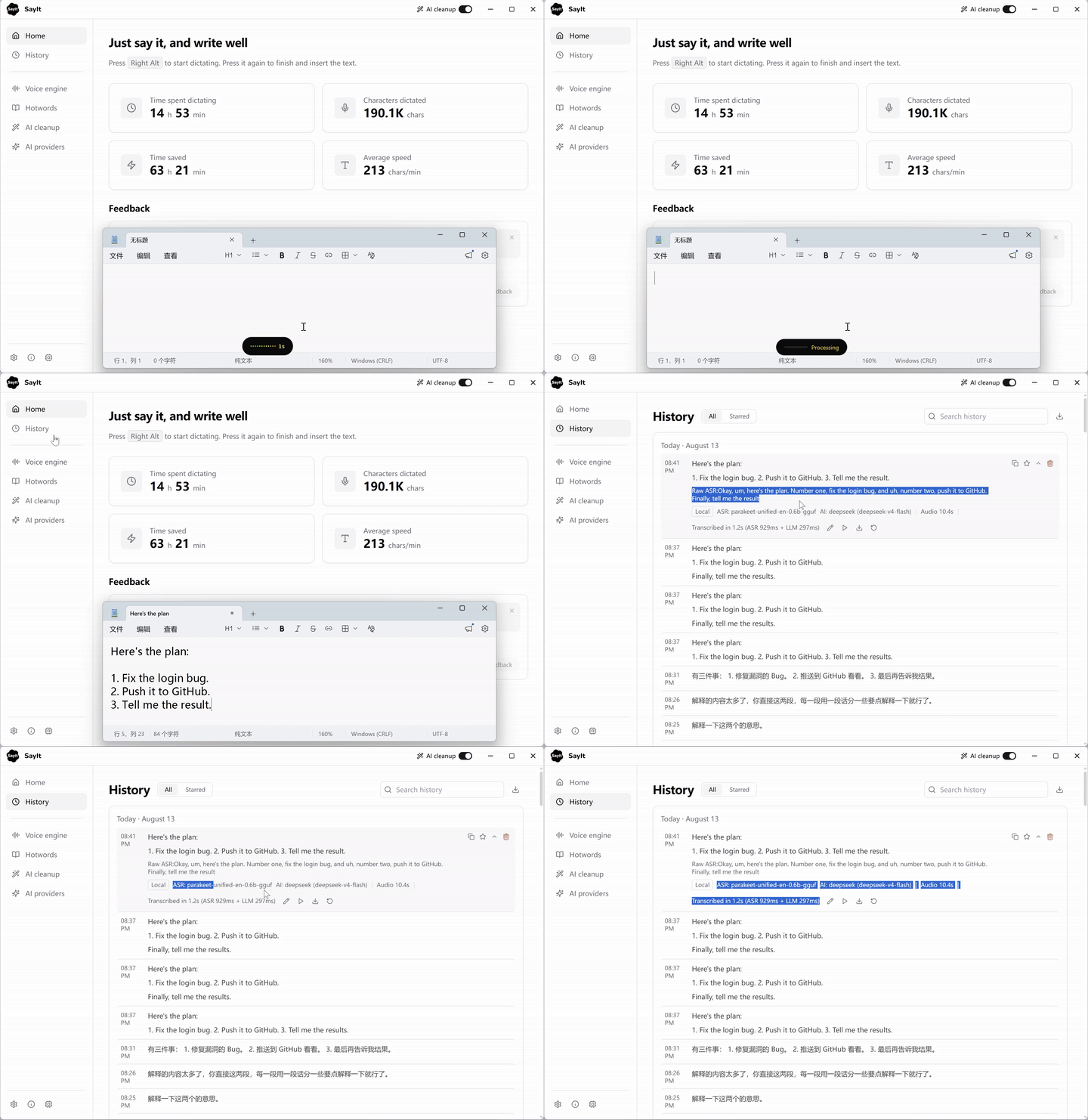
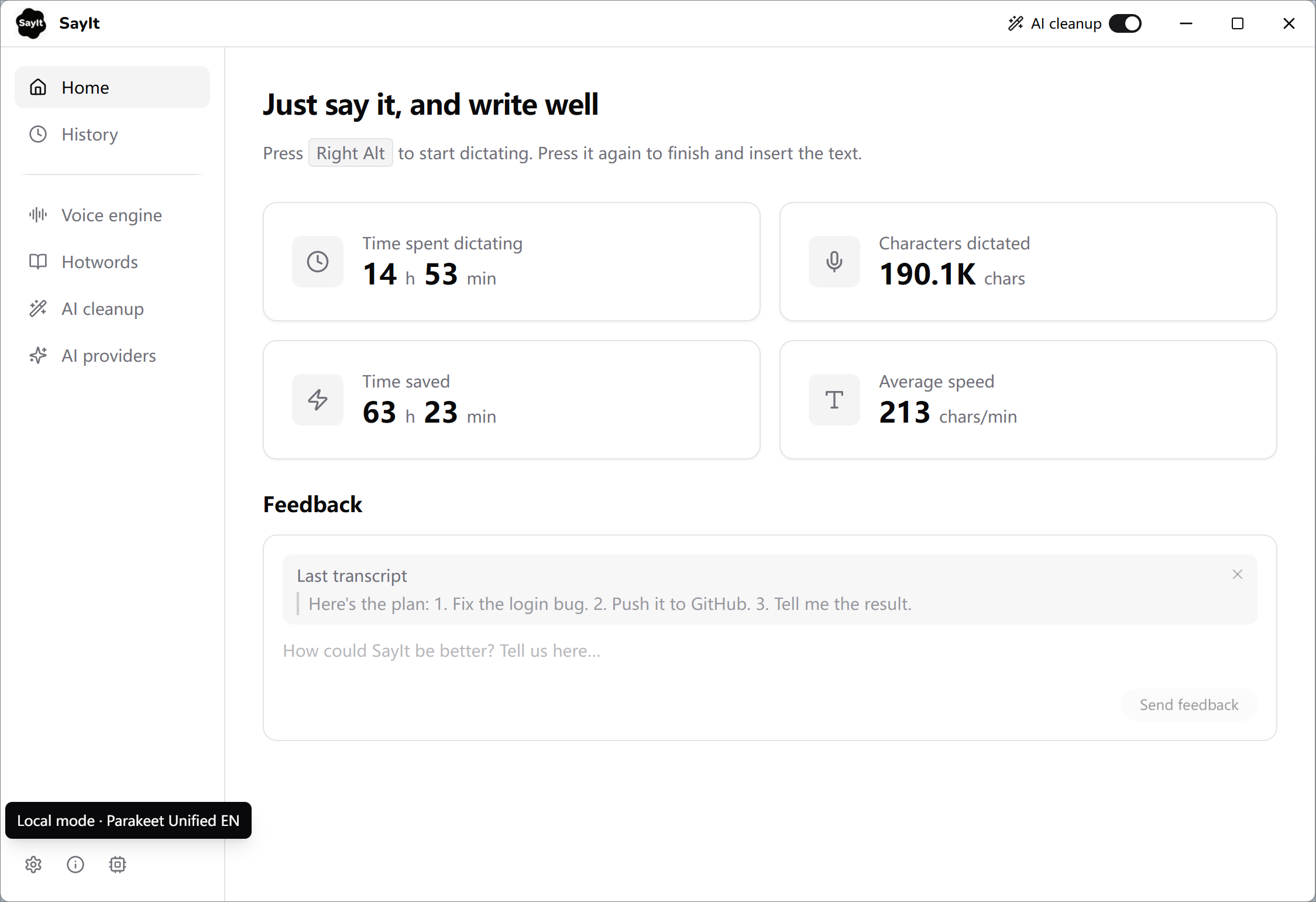
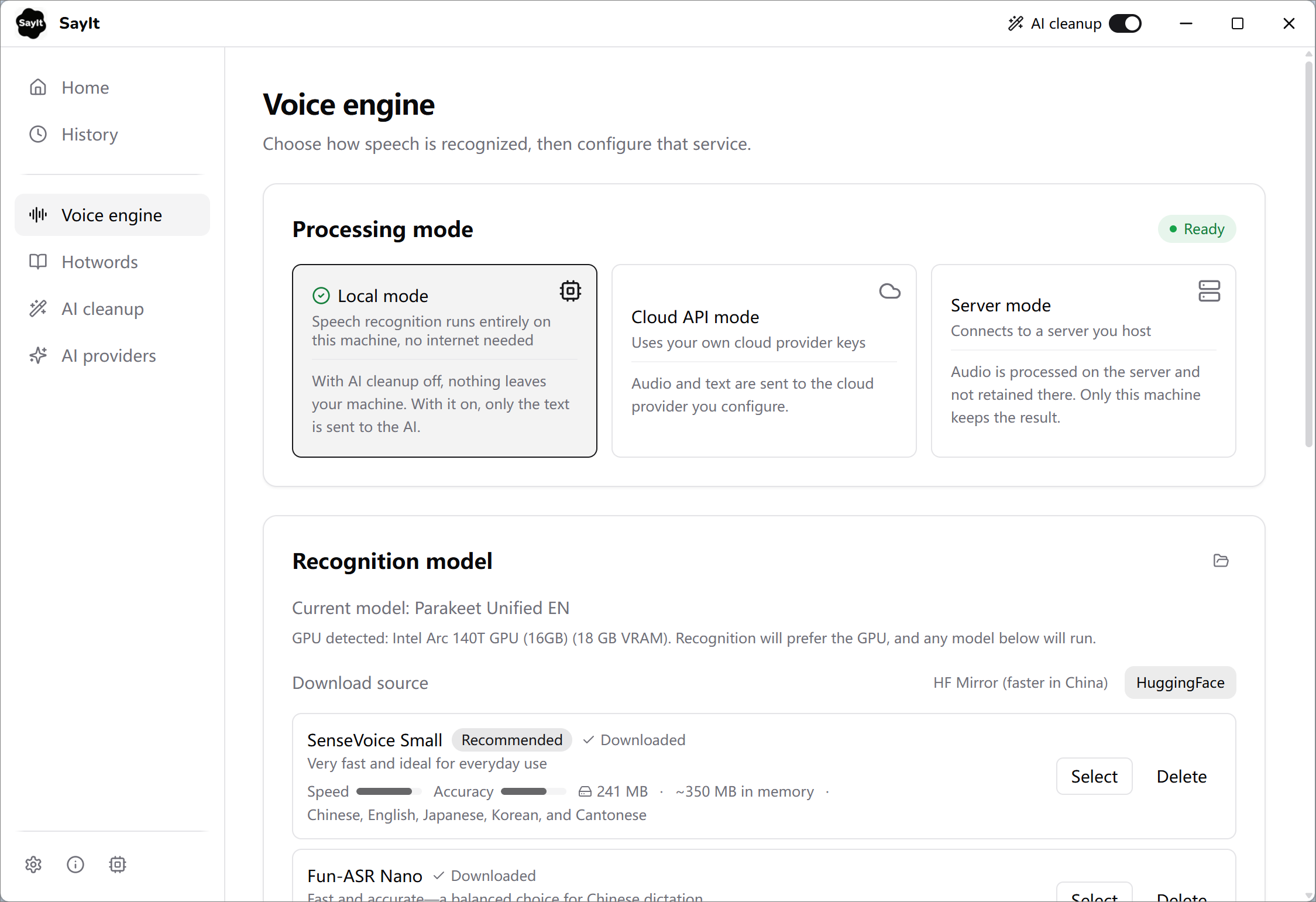
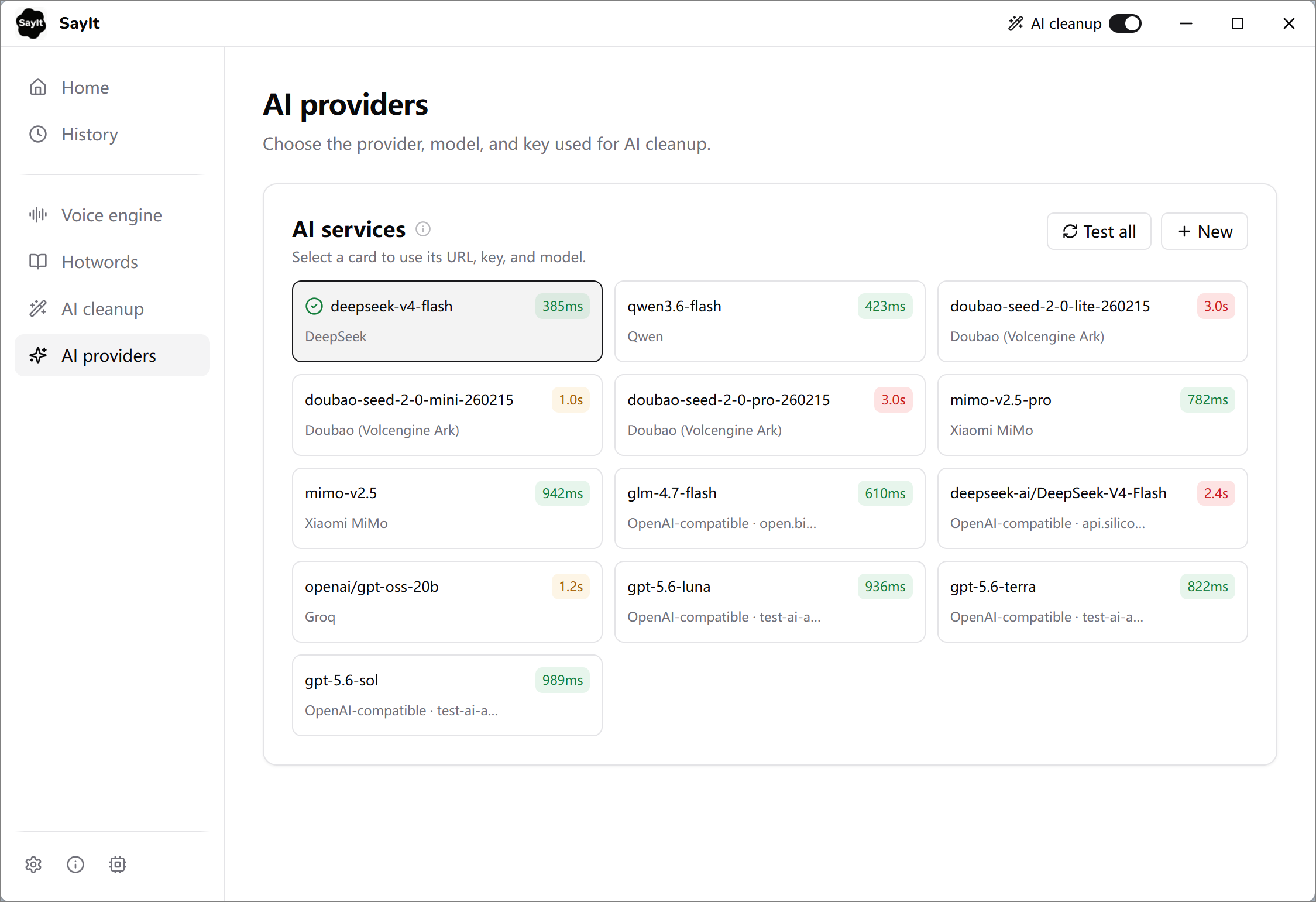
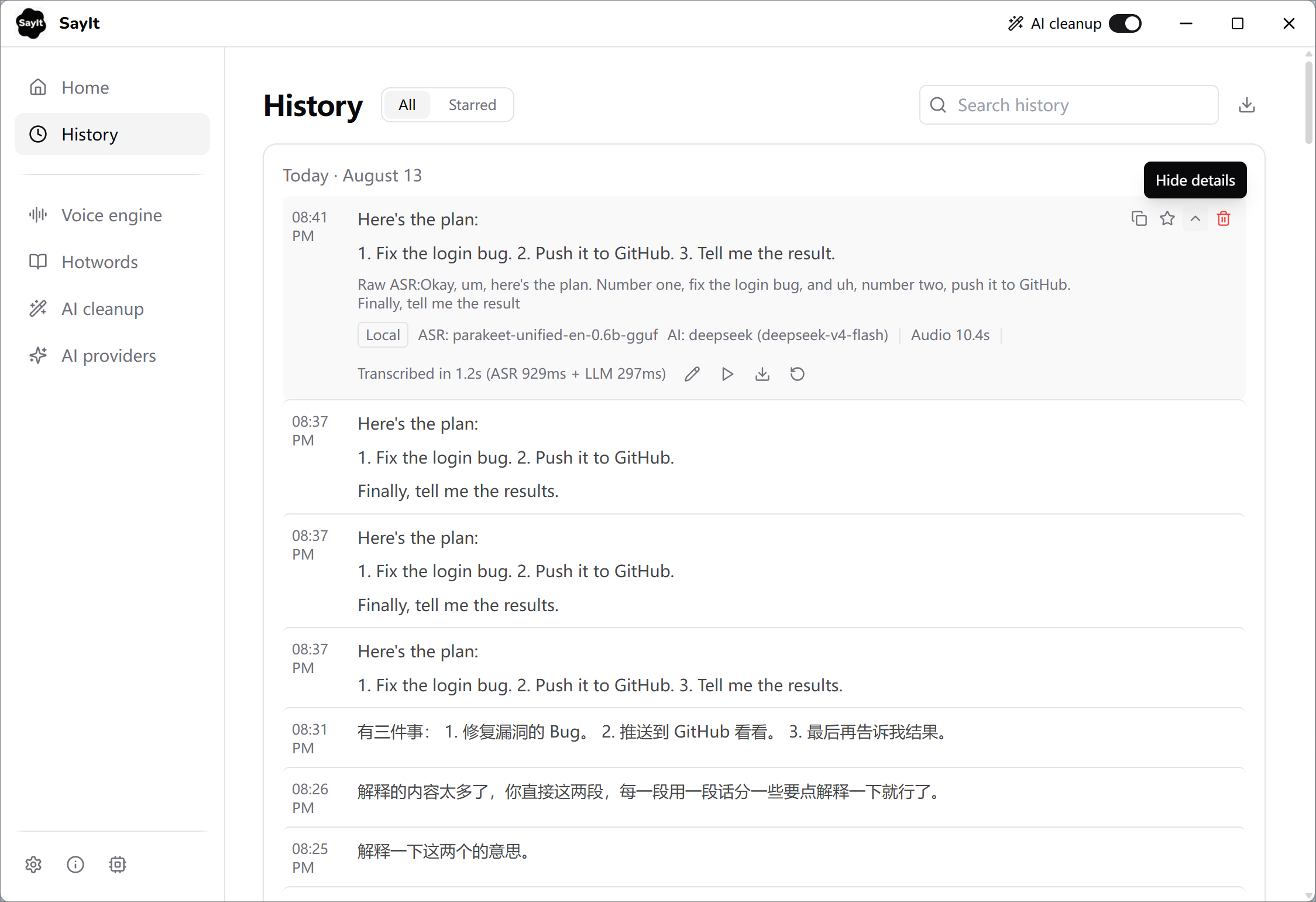
SayIt lets Windows users dictate text by pressing a hotkey. The spoken words are transcribed and then refined by an AI model before being inserted at the cursor position. Three recognition backends are offered: a local mode that runs GGUF models on the user's graphics card, a cloud mode that sends audio directly to provider APIs, and a server mode that connects to a self-hosted FastAPI backend. The backend can be deployed with Docker Compose and uses Qwen3-ASR for transcription with optional AI cleanup. The project includes a Tauri-based desktop client and a Python server component. It is distributed under the AGPL-3.0 license.
Should you self-host SayIt?
SayIt scores 48/100 on selfhost.directory (how scoring works) and ranks #5 of 11 in Voice Assistants. It has 456 GitHub stars.
It shipped 10 stable releases in the past year. The latest, v0.2.3, came out on 19 October 2026. New versions land roughly every 5 days.
Setup is moderate: expect some configuration beyond a single command. It is AGPL-3.0-licensed and written mostly in Typescript.
Its closest alternative on selfhost.directory is AnythingLLM (88/100, 67 666 stars). It scores higher overall, so compare the two before you pick. See SayIt vs AnythingLLM side by side.
Features
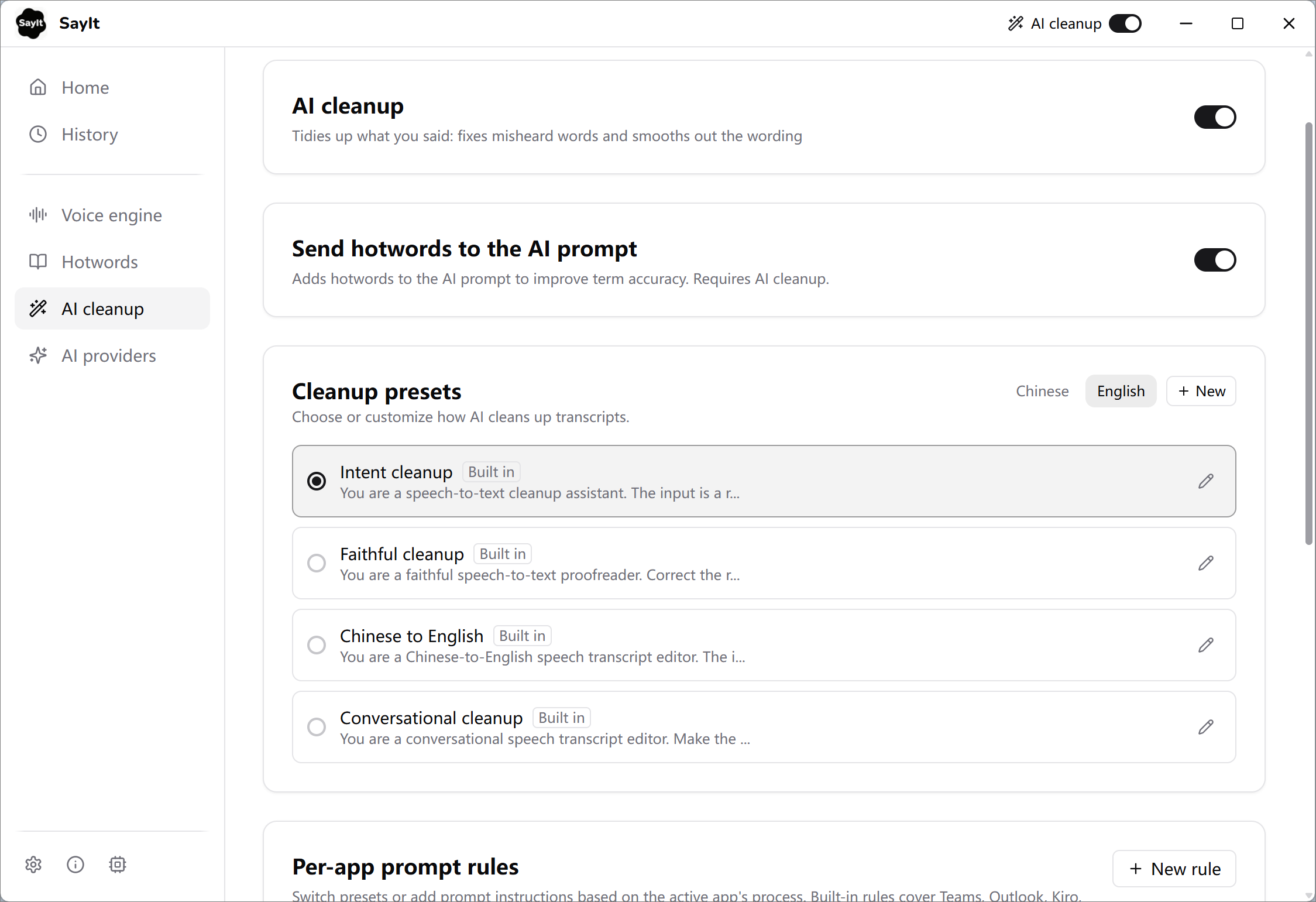
- AI text cleanup
- Context-aware writingOff by default
- Hotwords support
- Local GGUF models
- Local history and re-transcription
- Multi-language UI
- Multiple recognition modes
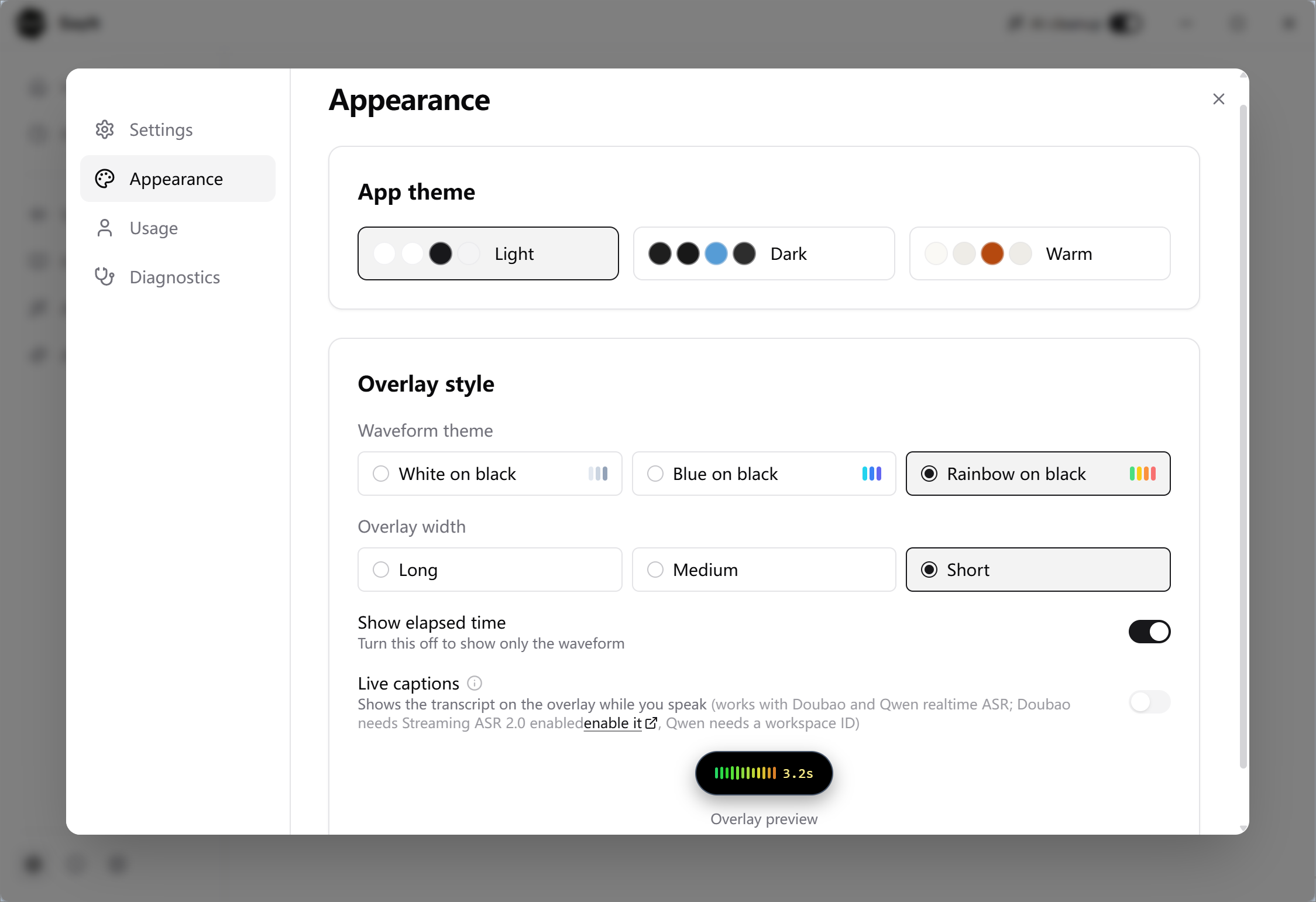
- Overlay feedback
- Per-app cleanup rules
- Self-hosted server
- Voice typing anywhere
SayIt README
FAQ
Can I use my own AI cleanup prompts?
Yes, every built-in preset is editable and you can write your own prompts from scratch for commit messages, translation, email tone, etc.
What are the hardware requirements for the self-hosted server?
GPU speech recognition requires an NVIDIA GPU; 16 GB or more of VRAM is recommended for the default server model.
Can I self-host the SayIt server?
Yes, the server is open source and can be deployed via Docker Compose on your own infrastructure. The team shares one server and audio/text never leaves your network.
What speech recognition models are supported?
Local mode includes Parakeet Unified EN, SenseVoice Small, Fun-ASR Nano, Nemotron 3.5 ASR, and three Qwen3-ASR sizes. Cloud mode supports Doubao, Qwen, OpenAI, Gemini, OpenRouter, Xiaomi MiMo, Groq Whisper, and any OpenAI-compatible endpoint.
How does SayIt handle privacy?
In Local mode with AI cleanup off, nothing leaves your device. In Cloud API mode, audio goes directly to your chosen provider. In Server mode, audio goes to your self-hosted server.
More in Voice Assistants
 SelenaCoreSelf-hosted offline smart home hub for Pi/Jetson with local voice (Vosk, Piper, Ollama), modular providers, automations, energy monitoring, multilingual UI — no cloud.
 smart-mirrorSelf-hosted open-source voice smart mirror for the Raspberry Pi: control IoT devices by speech, display info services, with plugins, wake-word spotting and remote config.
 Sovereign AI WorkstationSelf-hosted AI workstation for macOS running 100% locally with voice, vision, and autonomous agents. Controls apps, writes code, manages Google Workspace.
 speech-to-phraseSelf-hosted speech recognition matching only predefined phrases from Home Assistant entities. Runs via Docker or Python, uses Wyoming protocol, supports 20+ languages.
 voice-chat-aiSelf-hosted open-source voice chat app for talking to AI characters in a web UI or terminal, mixing Ollama and cloud LLMs with Spark-TTS, Kokoro or ElevenLabs voices.
 WillowSelf-hosted open-source ESP32 voice-assistant firmware for $50 hardware, with wake-word detection, on-device or server STT, and Home Assistant integration.
 wyoming-openwakewordSelf-hosted Wyoming protocol server that runs openWakeWord for wake word detection, enabling voice assistants to detect custom wake words locally via TCP on port 10400.
 wyoming-piperSelf-hosted Wyoming protocol server for Piper TTS, providing neural text-to-speech for Home Assistant and Wyoming clients. Open-source, runs locally via Docker or Python.
 Yandex Smart HomeOpen-source Home Assistant component exposing devices to Yandex Alice and VK Marusia voice assistants via cloud or direct connection.
 AgenticSeekSelf-hosted, open-source alternative to Manus AI: a voice-enabled agent that browses the web, writes and runs code, and plans tasks on local LLMs.
 asknavidromeAskNavidrome is an open-source Alexa skill that streams your music from a Subsonic server like Navidrome to Amazon Echo devices, without subscription fees or ads.
 audiobook-studioSelf-hosted open-source app for producing audiobooks locally using XTTS voice cloning, with optional Voxtral cloud voices. Multi-voice, segment repair, chapter assembly
0 comments