
Self-host OpenConnector
v1.9.4AI agent gateway connecting 1500+ SaaS services
- Stars
- 6 110
- Port
- 3000 (HTTP API, MCP, Web Console, OpenAPI)
ghcr.io/oomol-lab/open-connector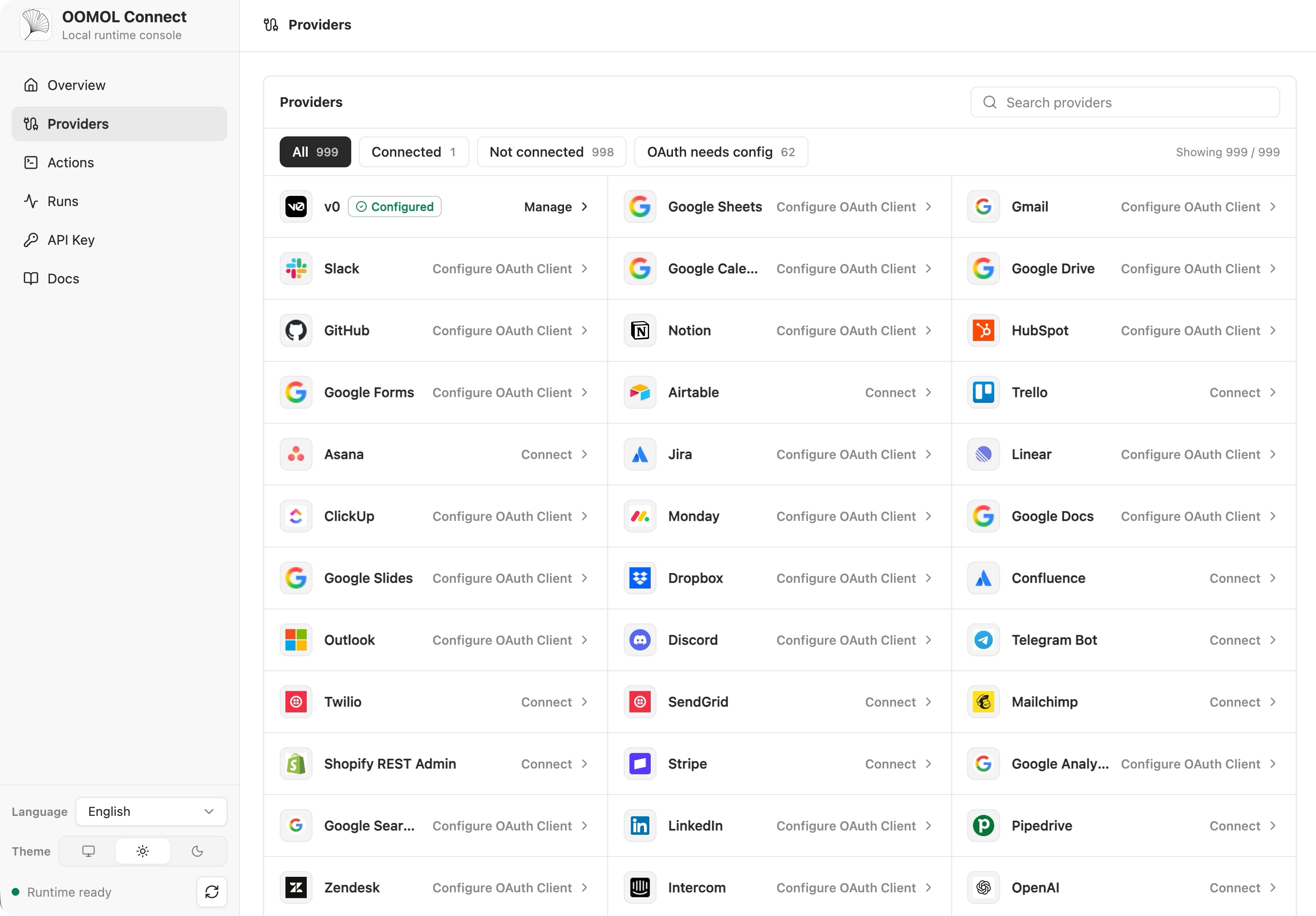
What is OpenConnector?
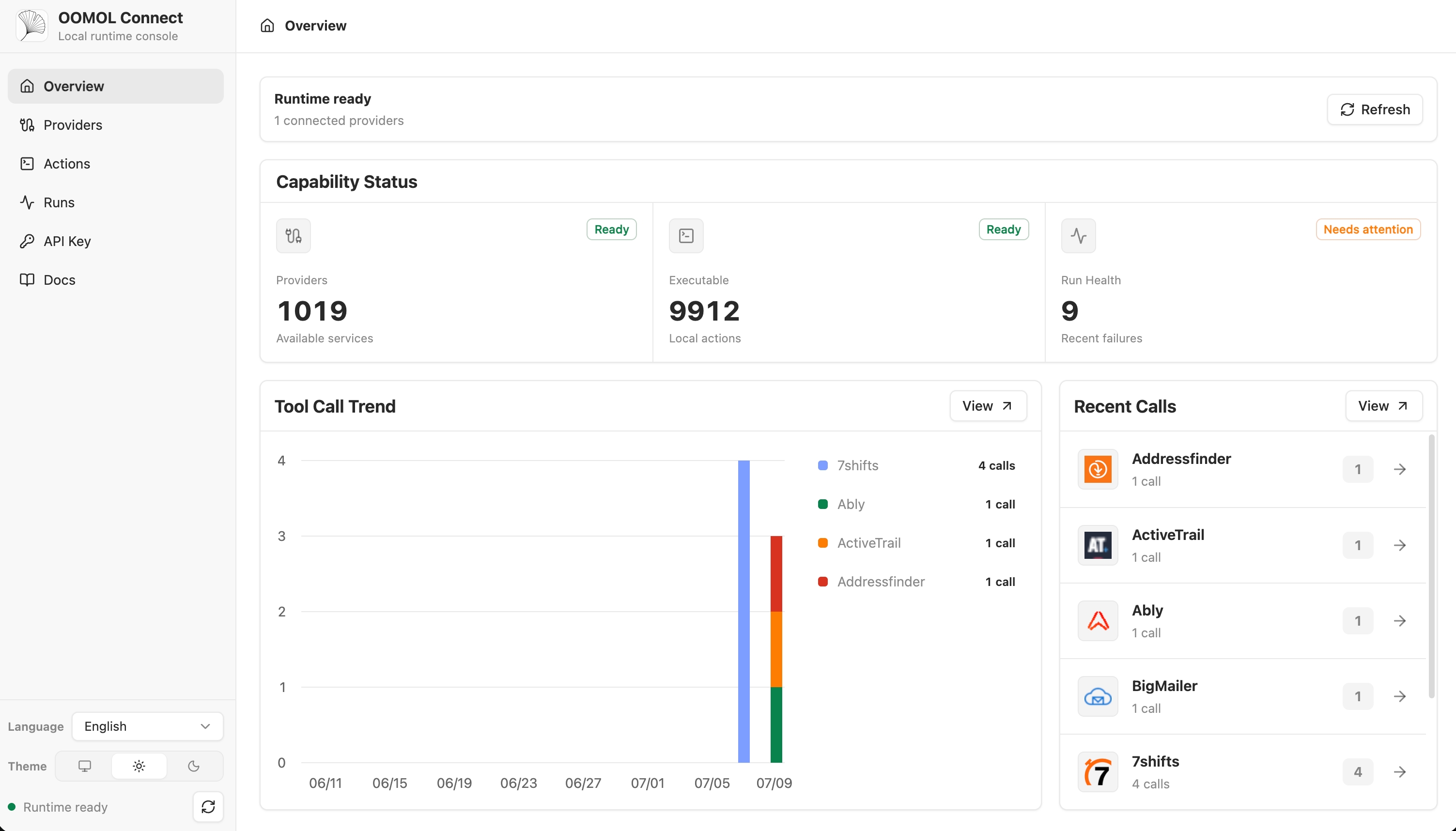
OpenConnector is an open-source gateway that lets AI agents connect to over 1,500 SaaS providers through a single catalog of more than 10,000 ready-made actions. It works with a variety of credential formats — including API keys, OAuth2, custom credentials, and no-auth providers — keeping provider secrets behind a runtime boundary so agents never see raw tokens. The software exposes actions via MCP (Model Context Protocol), HTTP, and OpenAPI, and includes a web console for browsing providers, configuring credentials, creating runtime tokens, and debugging actions. You can run it yourself with Docker Compose, plain Docker, Node.js, a Helm chart on Kubernetes, or on Cloudflare Workers using D1 and R2. State lives in SQLite by default, with PostgreSQL 15+ as an option, and transit files can stay local or go to any S3-compatible store. OAuth providers require you to register your own OAuth apps when self-hosting; a hosted option with managed OAuth is also available from the vendor.
Should you self-host OpenConnector?
OpenConnector scores 65/100 on selfhost.directory (how scoring works) and ranks #41 of 209 in AI Agents. It has 6 110 GitHub stars.
It shipped 10 stable releases in the past year. The latest, v1.9.4, came out on 27 October 2026. New versions land roughly every 3 days.
Setup is moderate: expect some configuration beyond a single command. An official Docker image is available. It is Other-licensed and written mostly in Typescript.
Its closest alternative on selfhost.directory is Webhook.site (66/100, 6 786 stars). It scores higher overall, so compare the two before you pick. See OpenConnector vs Webhook.site side by side.
Features
- Action Allow/Block Policies
- Cloudflare Workers deployment
- Connector Gateway
- Credential encryption
- Credential Management
- HTTP/OpenAPI Interface
- MCP Support
- Prebuilt Actions Catalog
- Provider Proxy Allow/Block
- S3-compatible Transit Storage
- Web Console
OpenConnector README
FAQ
What is the difference between a Tool and a Skill? Why does OOMOL manage Skills?
A Tool is a concrete action an agent can call, such as reading a GitHub PR, writing to Google Sheets, or sending a Slack message. A Skill is reusable execution knowledge for an agent: which oo tools to call, how to pass parameters, and how to check results. The agent follows the Skill, while OOMOL provides oo tools plus cross-agent installation, publishing, and sharing.
Which apps and Tools does OOMOL support? What if I need something missing?
OOMOL provides 1500+ connections, including work systems such as Gmail, GitHub, Notion, and Slack, along with image, video, voice, transcription, and file services. Browse the App and Tool catalogs for available actions, or use Studio to connect a private API or custom capability.
How does OOMOL work with the agent I already use?
You can keep starting tasks in the agent you already use. Installing OOMOL App also installs oo CLI, and the App and CLI share the same account data. Any agent environment that can work through a CLI can call the available Tools and Skills.
What data and actions can agents access? Can I view, revoke, or limit them?
An agent's available capabilities come from the connected accounts, authorized scopes, and Tools provided by OOMOL. In OOMOL App, you can review connections, permissions, usage, results, and run records, then adjust access by account or Tool.
Will agents receive my account passwords or raw tokens?
OOMOL manages account authorization and credentials. Agents call third-party services through Tools within the scopes you approve, and each call leaves usage, results, and run records for review.
What does "connect once, use everywhere" mean?
After you connect services such as Gmail, GitHub, Notion, and Slack in OOMOL, agents connected to OOMOL can share those connections. You authorize account-based services first, and the corresponding Tools determine which actions an agent can call.
What does OOMOL enable AI agents to do?
OOMOL connects third-party service accounts, provides callable Tools, and lets Skills be installed, published, and shared across agents. You can keep working in Codex, Claude Code, Cursor, or a local agent.
More in API Gateway
 OpenGateLLMSelf-hosted open-source API gateway unifying generative AI models with OpenAI-compatible endpoints, access control, rate limiting, and usage tracking.
 OtariA self-hosted, open-source LLM gateway that unifies 40+ model providers behind one OpenAI-compatible endpoint, with virtual keys, budget controls, and usage analytics.
 planoOpen-source, self-hosted Envoy-based AI proxy from Katanemo: LLM routing across many providers, multi-agent orchestration, guardrail filter chains and OTel observability.
 Qwen GateQwen Gate is a self-hosted, open-source API gateway that lets you use Qwen AI models from chat.qwen.ai as a free, drop-in replacement for the OpenAI API.
 RouterlySelf-hosted LLM gateway routing requests across AI providers with multi-policy scoring, cost tracking, budget enforcement, and zero infrastructure dependencies.
 rustunnelrustunnel is a self-hosted, open-source tunnel server in Rust exposing local services via encrypted WebSocket. Free managed cloud with pay-as-you-go billing and MCP.
 sendiumSendium is a self-hosted, open-source SMS gateway bridging apps and SMPP providers with advanced routing and data sovereignty.
 SmarterRouterSelf-hosted AI gateway that automatically routes queries to the best local or cloud LLM based on prompt analysis, with VRAM management and OpenAI-compatible API.
 SwingsonicSelf-hosted, open-source translation layer letting Subsonic, Jellyfin, and Euterpe music clients connect to a Swing Music server via Docker on port 3000.
 systemprompt-templateSelf-hosted AI governance gateway between AI clients, models, and tools with policy enforcement, audit logging, and extensible Rust runtime.
 TraefikTraefik is a self-hosted, open-source reverse proxy that auto-discovers services from Docker, Kubernetes, and other orchestrators to route traffic without manual config.
 TykSelf-hosted open-source API and AI gateway proxying REST, GraphQL, gRPC, TCP and MCP traffic with auth, quotas, plugins and analytics.
0 comments