
Self-host GeoLook
v0.2.0Open-source GEO platform for AI search visibility
- Stars
- 789
- Port
- 8765 (Local dashboard HTTP server)

What is GeoLook?
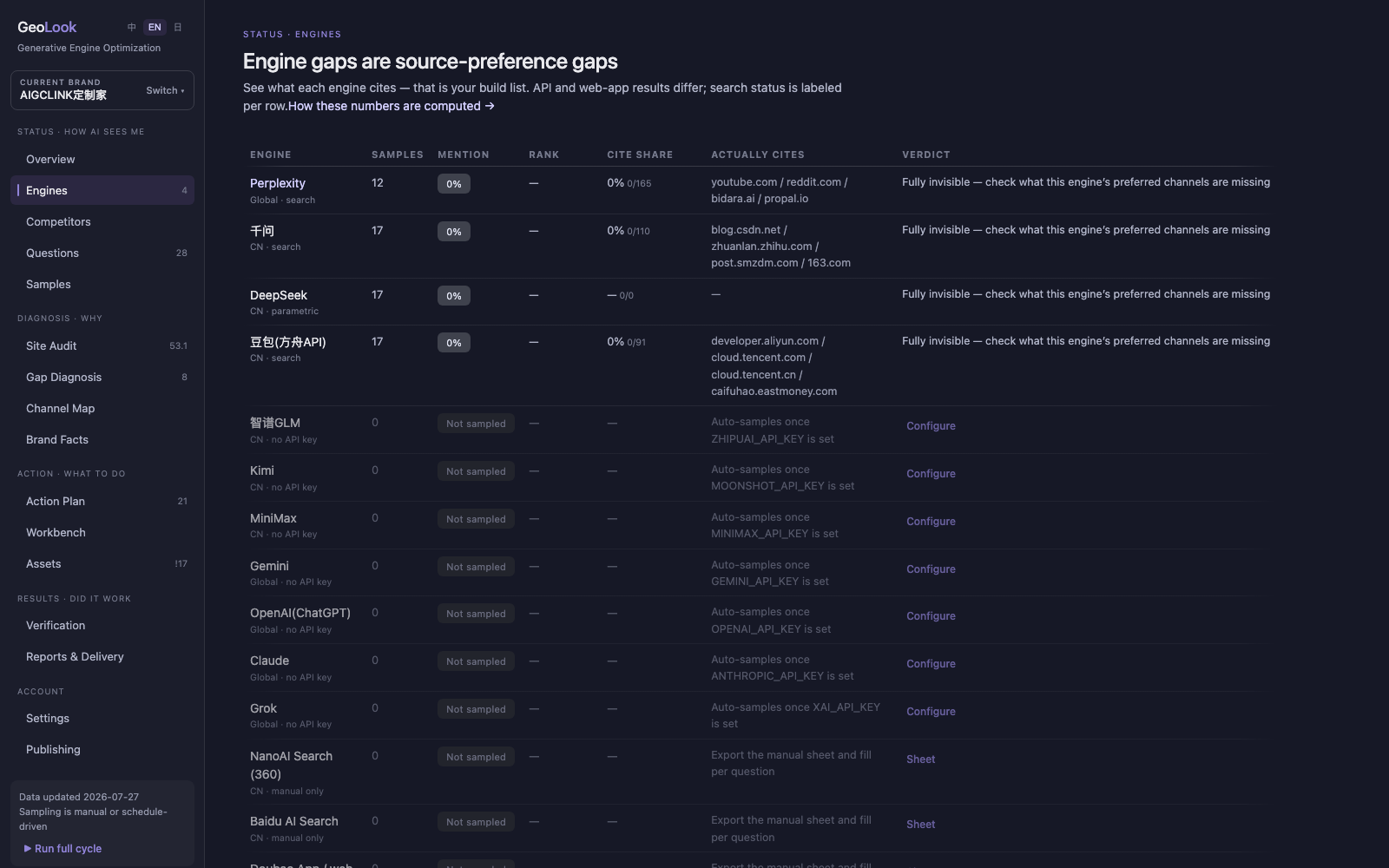
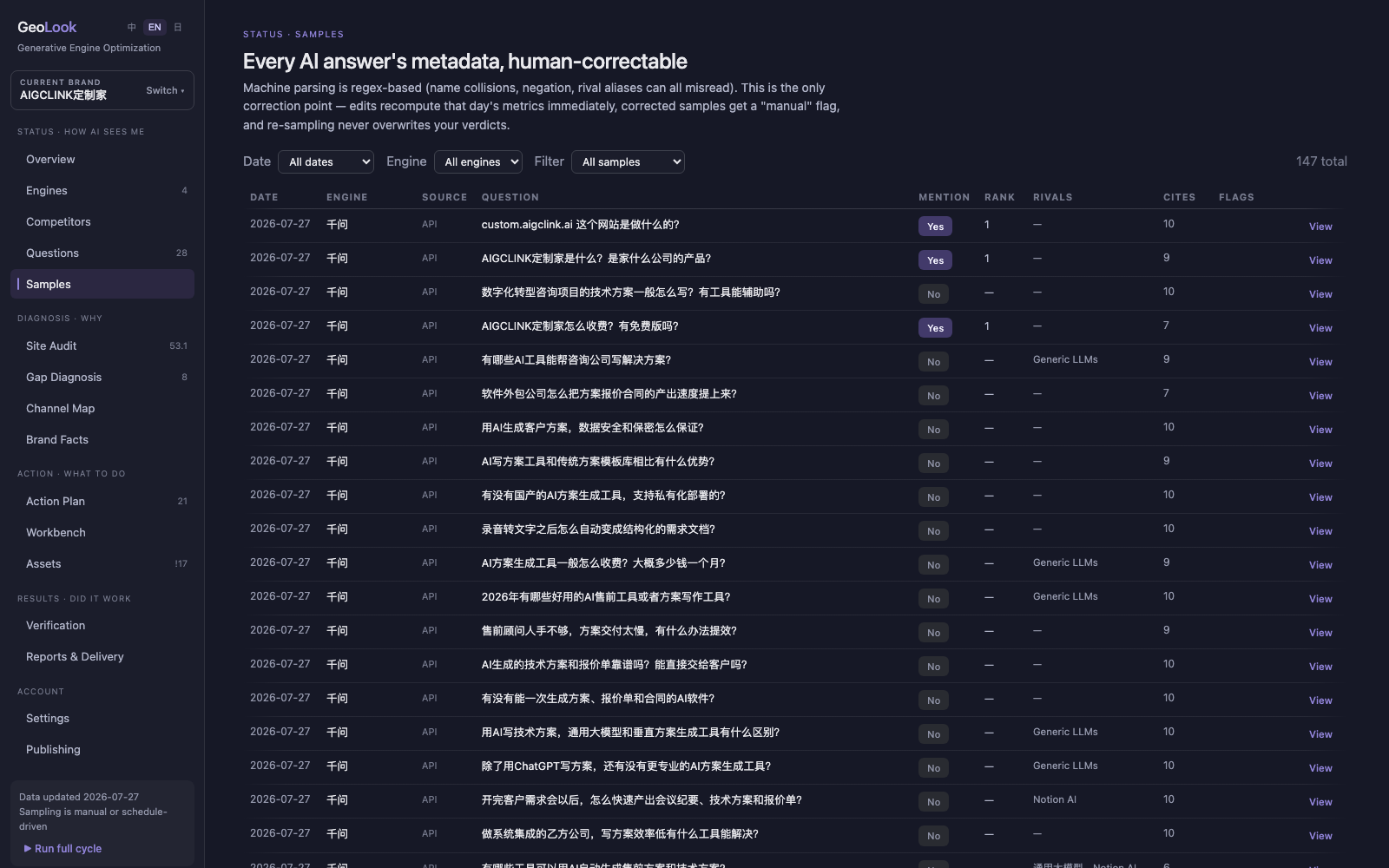
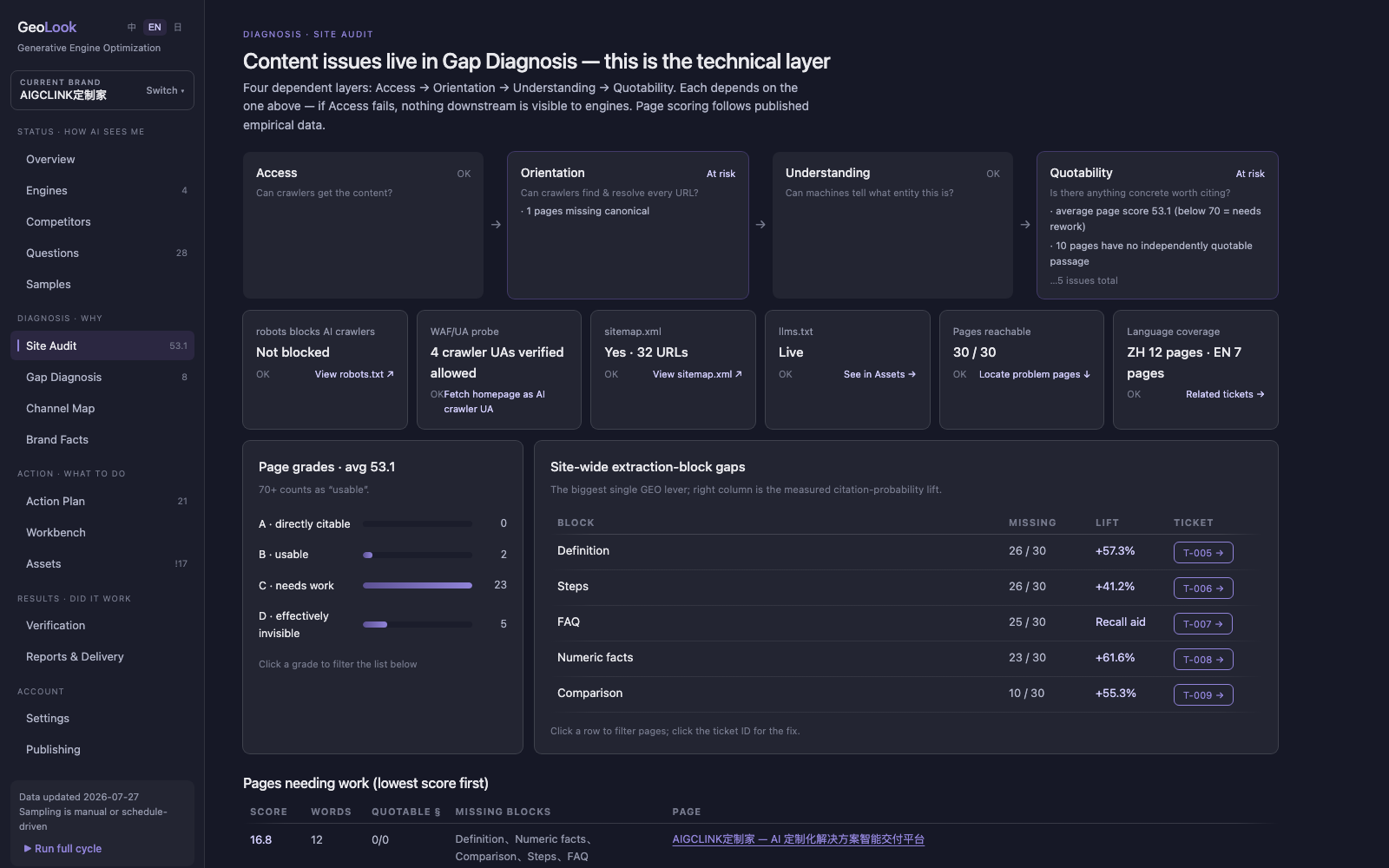
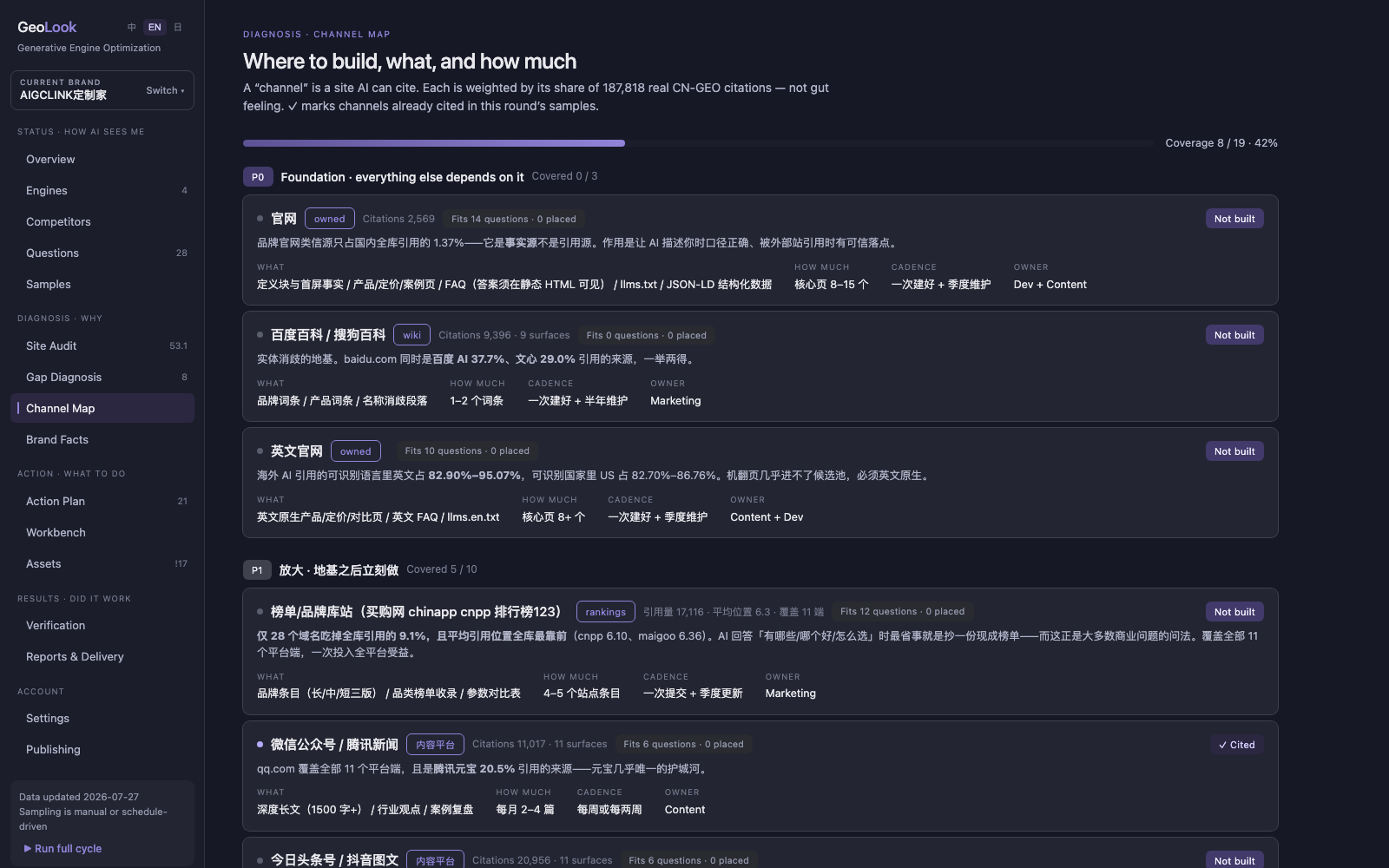
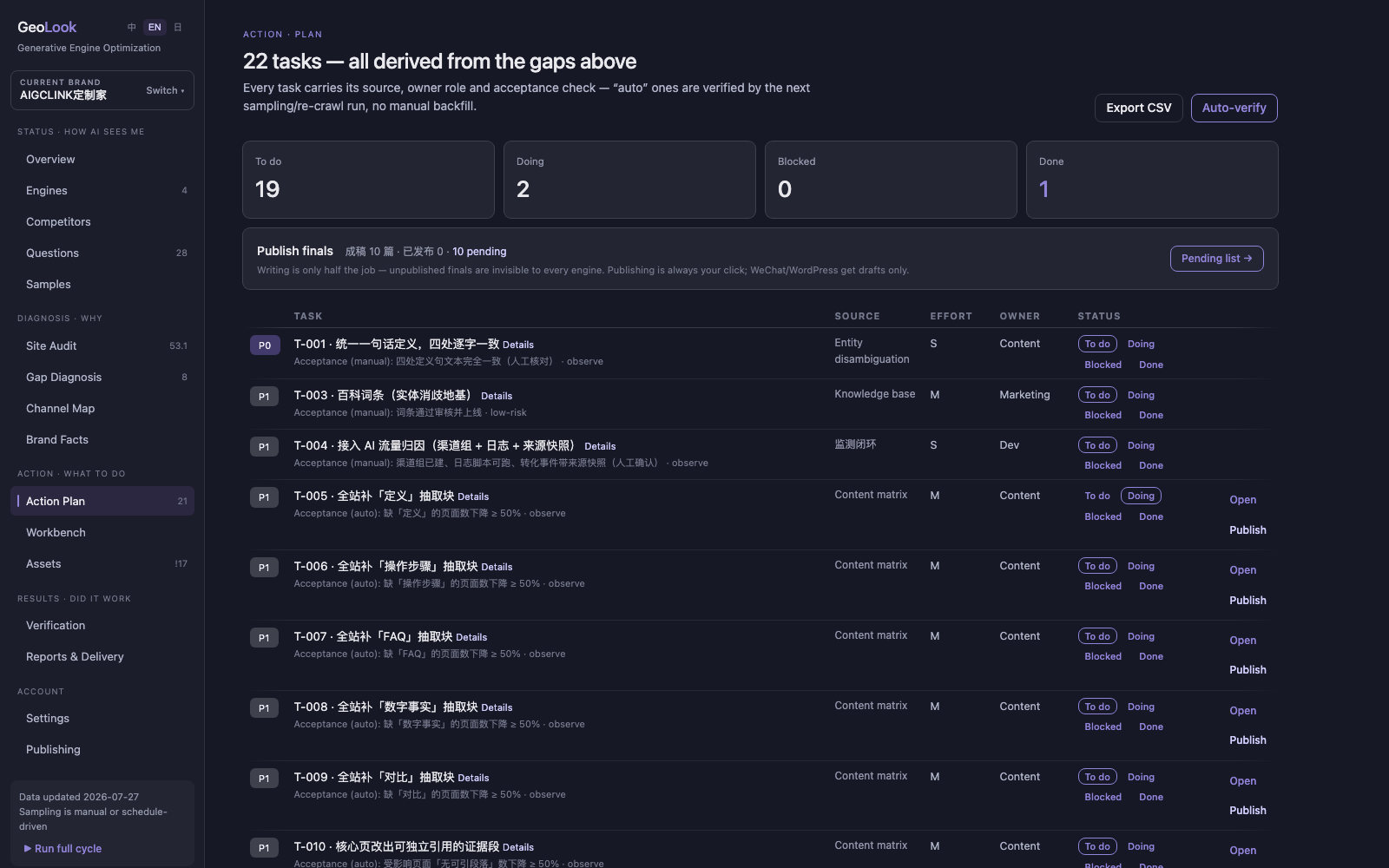
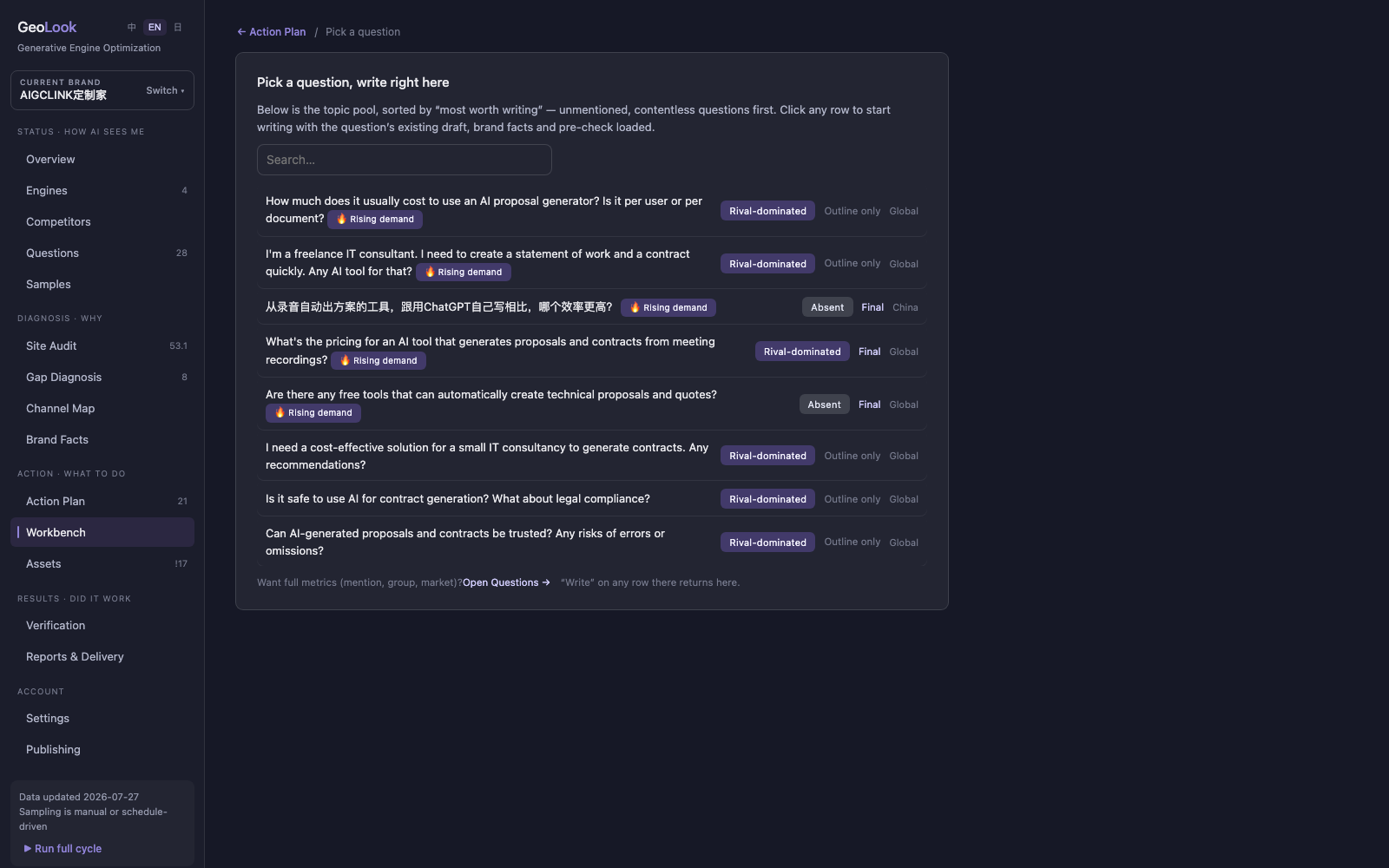
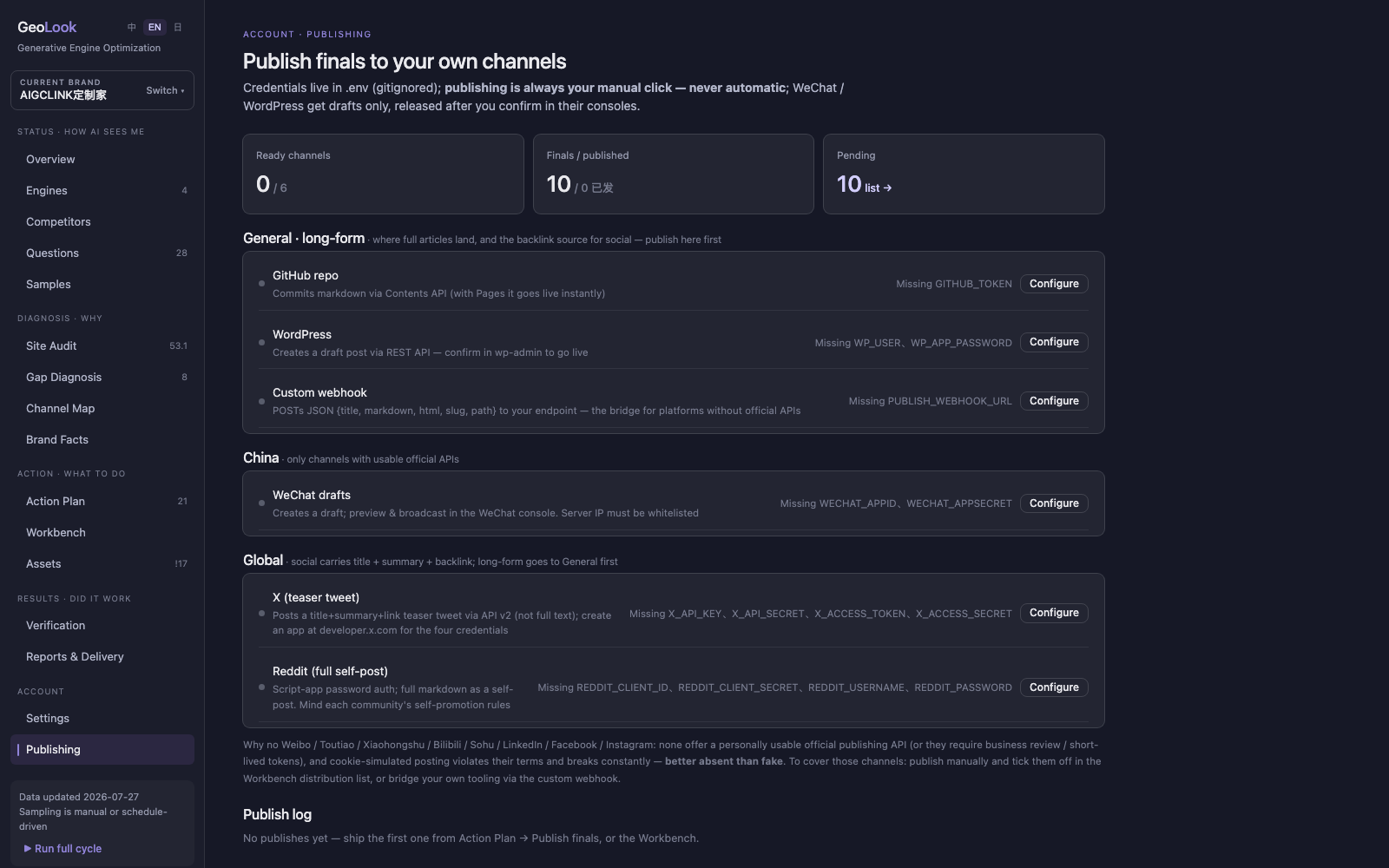
GeoLook is an open-source, self-hosted platform for end-to-end Generative Engine Optimization. It helps brands understand and improve how AI engines mention and cite them when answering user questions. The platform runs locally on macOS or Linux with Python 3.9+ and three dependencies, storing all data as plain files. It covers 17 engines across Chinese and global markets, sampling real answers to measure mention rate, rank, and citation share. A four-layer site audit diagnoses why engines may not cite a brand, including robots.txt parsing, WAF/CDN probing with real AI-crawler user agents, and passage-level quotability checks. The Action stage creates implementation tickets with acceptance criteria and risk grades, a content workbench with citability pre-checks, and deployable assets like llms.txt and JSON-LD. Publishing integrations cover several channels for content distribution. Results are auto-verified by re-crawling and next sampling rounds. A Chrome sampling assistant helps with engines lacking APIs. The project is MIT-licensed with no external database or service dependencies, using a local HTTP server on port 8765.
Should you self-host GeoLook?
GeoLook scores 51/100 on selfhost.directory (how scoring works) and ranks #26 of 41 in Search Engines. It has 789 GitHub stars.
It shipped 1 stable release in the past year. The latest, v0.2.0, came out on 8 August 2026.
Setup is moderate: expect some configuration beyond a single command. It is MIT-licensed and written mostly in Python.
Its closest alternative on selfhost.directory is SearXNG (86/100, 38 940 stars). It scores higher overall, so compare the two before you pick. See GeoLook vs SearXNG side by side.
Features
- Auto-verification
- Brand mention distribution analysis
- Channel map with 19 channels
- Chrome sampling assistant
- Client delivery package
- Content workbench with citability pre-check
- Deployable assets generation
- Four-layer site audit
- Implementation tickets with acceptance criteria
- Keyword mining from search demand
- Multi-channel publishing
- Multi-engine AI mention tracking
- Passage-level quotability analysis
- Sample library with human correction
- Scheduled re-runs and multi-brand support
GeoLook README
FAQ
AI answers differ every time — how can sampling results be stable?
GeoLook never reads a single answer as a metric. Stability comes from aggregation over dozens of questions × multiple engines, fixed variables (pinned sampling models, fixed question bank), repeat rounds (sampling each question multiple times), and attribution discipline (only two consecutive rounds moving the same way count as a trend; ticket verification relies on deterministic re-crawling rather than sampling alone).
More in Search Engines
 HisterA self-hosted private search engine that indexes visited web pages and local files for full-content search from web, terminal, or MCP AI assistants.
 houndOpen-source source code search engine: a Go backend indexes every configured repository and a React UI runs regex queries against a trigram index.
 How-to-host-LibreXFramework and javascript free privacy respecting meta search engine
 hubgrep_searchHubGrep is a self-hosted, open-source search engine that queries multiple code-hosting platforms simultaneously, treating all services equally.
 librecrawl-technical-seo-audit-mcpSitewalk is a self-hosted, open-source SEO crawler running inside AI assistants via MCP, with unlimited audits, 50+ checks, PDF reports, and zero data retention.
 librexLibreX is a self-hosted, open-source metasearch engine that pulls from Google, Qwant, Ahmia, and torrent sites without tracking users or needing JavaScript.
 LibreYLibreY is a self-hosted, open-source meta search engine that aggregates results from Google, DuckDuckGo, Brave, and others without JavaScript or user tracking.
 Manticore SearchSelf-hosted, open-source search database that speaks SQL and HTTP JSON, with full-text, vector, hybrid and conversational search pitched as an Elasticsearch alternative.
 Marginalia SearchAn open-source internet search engine with its own crawler and index that you can self-host to rank text-heavy, non-commercial sites on a single server.
 mcp-searxngOpen-source MCP server that adds privacy-focused web search and URL reading to AI clients like Claude and Cursor through a self-hosted SearXNG instance.
 MeiliSearchSelf-hosted, open-source search engine with hybrid search (full-text + semantic), typo tolerance, filtering, faceting, and multi-tenancy. Runs via Docker or binary.
 Meme SearchMeme Search is a self-hosted, open-source meme search engine using local AI for semantic search. Run with Docker Compose to find memes by meaning, not filenames.
0 comments