
Self-host crikket
v0.1.3Open-source bug reporting with replay context
- Stars
- 154
- CPU
- 2 vCPU
- RAM
- 4 GB RAM
- Storage
- 40 GB SSD
- Ports
- 3000 (API server), 3001 (Web dashboard)
- Requires
- PostgreSQL, S3-compatible Object Storage
ghcr.io/redpangilinan/crikket-server:latest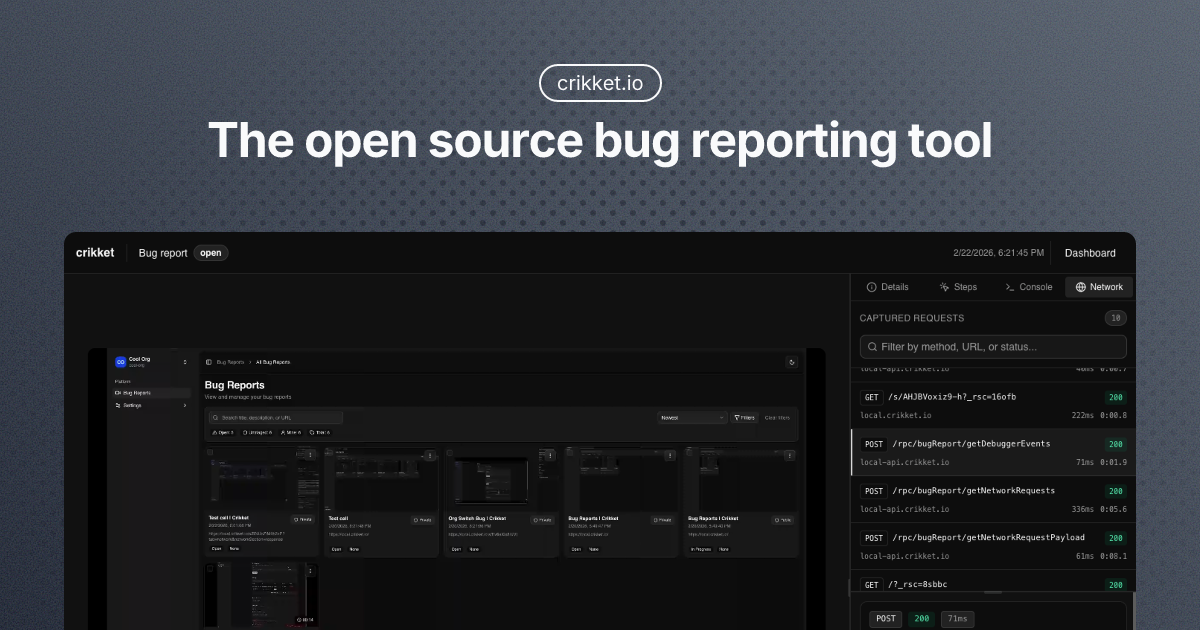
What is crikket?
This platform helps development teams capture and share bug reports efficiently. Users can record screenshots or videos directly in the browser, and the system automatically attaches reproduction steps, console output, and network activity. Each report gets a shareable link with configurable visibility. The software supports team workspaces with invitation management and includes an SDK for embedding the capture widget into other web applications. It runs via Docker Compose with a setup wizard, uses PostgreSQL for data and S3-compatible storage for artifacts, and is licensed under AGPL-3.0.
Should you self-host crikket?
crikket scores 44/100 on selfhost.directory (how scoring works) and ranks #7 of 7 in Issue Tracking. It has 154 GitHub stars.
It shipped 4 stable releases in the past year. The latest, v0.1.3, came out on 17 March 2026. New versions land roughly every 3 days.
Setup is moderate: expect some configuration beyond a single command. An official Docker image is available. It is AGPL-3.0-licensed and written mostly in Typescript.
Its closest alternative on selfhost.directory is Trac (65/100). It scores higher overall, so compare the two before you pick. See crikket vs Trac side by side.
Features
- Automatic reproduction steps
- Browser Extension
- Console logs capture
- Embeddable capture SDK
- Network requests capture
- One-click screenshot capture
- Screen Recording
- Shareable report links
- Team Workspaces
crikket README
FAQ
What is Crikket?
Crikket is an open-source bug reporting tool and an alternative to jam.dev and marker.io.
More in Issue Tracking
 fizzyA kanban tool for tracking issues and ideas from 37signals — entirely free hosted, or self-hosted via the ONCE installer, a Docker image, or Kamal.
 GitLab-CESelf-hosted, open-source DevOps platform for Git repositories, merge requests, CI/CD pipelines, issue boards and wikis, with free CE and paid Premium/Ultimate tiers.
 It's a PlanOpen-source, self-hosted issue tracker where AI agents work alongside humans on shared boards. Replaces Linear, Jira, Plane with built-in AI, multiple views, initiatives.
 KaneoOpen-source, self-hosted project tracker for teams: kanban boards, Gantt and calendar views, a backlog, time tracking, and free single sign-on via OAuth or OIDC.
 MantisBTMantis Bug Tracker is a self-hosted, open-source issue tracker in PHP with role-based access, customizable workflows, LDAP auth, and REST/SOAP APIs.
 Mantis Bug TrackerMantis Bug Tracker (MantisBT)
 OpenProjectSelf-hosted, open-source project management tool: Gantt timelines, Scrum and Kanban boards, time and cost reports, wikis, meetings and forums.
 pacaSelf-hosted and open-source Scrum tooling: AI agents share the board and the sprint with people, plus IAM-style role policies and WASM plugins.
 PlanePlane is a self-hosted open-source project management platform combining work items, cycles, wiki docs, and AI agents as an alternative to Jira, Linear, and ClickUp.
 RedmineRedmine is a self-hosted, open-source project management web app in Ruby on Rails with issue tracking, Gantt charts, time tracking, wikis, forums, and SCM integration.
 Request TrackerRequest Tracker (RT) is a self-hosted, open-source ticket tracking system for teams with email integration, workflows, scrips automation, dashboards, assets, and REST API
 Roundup Issue TrackerRoundup is a highly customizable issue-tracking system with command-line, web, REST, XML-RPC, and e-mail interfaces. It is designed to be easy to install and use, and can be adapted to various use cases.
0 comments