
Self-host Usertour
v0.9.7Open-source user onboarding for tours, checklists, surveys
- Stars
- 2 335
- Ports
- 80 (HTTP web interface (container port)), 3000 (NestJS server internal port (default))
- Requires
- PostgreSQL, Redis
usertour/usertourWhat is Usertour?
Usertour lets teams build in-app onboarding — product tours, checklists, surveys, banners, launchers, and a searchable resource center — without code. A visual builder handles point-and-click flow creation, while a built-in MCP server lets AI assistants (Claude Code, Cursor, Codex) generate production-ready flows that match the host app's design. The platform supports advanced targeting with custom attributes and events, version-controlled environments, fully customizable themes, and built-in analytics showing completion rates and drop-off per step. The Community Edition is MIT-licensed and free for commercial self-hosting via Docker Compose with PostgreSQL and Redis. Business/Enterprise features like SSO, audit logs, 2FA, and branding removal require a paid license under a separate Enterprise License.
Usertour alternatives
 LimeJourneySelf-hosted open-source platform for AI-driven user journeys, visual builder, dynamic segmentation, and BYOI integrations — a Customer.io alternative.CompareLimeJourney with Usertour
 laudspeakerSelf-hosted, open-source customer engagement platform for building visual onboarding journeys and sending event-triggered email, SMS, push and webhook messages.Comparelaudspeaker with Usertour
 FormbricksSelf-hosted, open-source survey and experience-management platform: link, website, in-app and email surveys with no-code builder, webhooks, API, and analytics dashboards.CompareFormbricks with Usertour
 ToolJetSelf-hosted, open-source low-code platform for internal tools and dashboards: visual builder, 90+ data sources, built-in database, AI app generation and MCP agent access.CompareToolJet with Usertour
 pneumaticworkflowSelf-hosted workflow platform with visual process design, AI template generation, task buckets, and API/Zapier integrations — Apache 2.0 licensed.Comparepneumaticworkflow with Usertour
 PostHogOpen-source product toolkit - analytics, session replay, feature flags, error tracking - with a one-line self-hosted hobby deploy using Docker Compose.ComparePostHog with Usertour
 docmostSelf-hosted, open-source collaborative wiki with real-time editing, diagrams, AI features, and enterprise SSO as a Confluence/Notion alternative.Comparedocmost with Usertour
 AppFlowyA self-hosted AI workspace that lets teams run projects, wikis, and knowledge bases on their own infrastructure with private AI and complete data ownership.CompareAppFlowy with Usertour
All self-hosted alternatives to Appcues → All self-hosted alternatives to Chameleon → All self-hosted alternatives to Userflow →
Should you self-host Usertour?
Usertour scores 57/100 on selfhost.directory (how scoring works) and ranks #1 of 3 in Customer Engagement. It has 2 335 GitHub stars, +19 in the last 30 days.
It shipped 23 stable releases in the past year. The latest, v0.9.7, came out on 30 October 2026. New versions land roughly every 4 days.
Setup is moderate: expect some configuration beyond a single command. An official Docker image is available. It is MIT-licensed and written mostly in Typescript.
Its closest alternative on selfhost.directory is laudspeaker (48/100, 2 632 stars). Usertour scores higher overall. See Usertour vs laudspeaker side by side.
Features
- Advanced user targeting
- AI-assisted flow creation (MCP)
- Analytics & completion tracking
- Banners
- Checklists
- Launchers
- Multi-Environment Support
- Product tours
- Resource Center
- Single Sign-On (OIDC)Requires Business/Enterprise license for self-hosted
- Surveys & NPS
- Two-factor authenticationRequires Business/Enterprise license for self-hosted
- Version control & environments
- Visual Builder
Usertour README
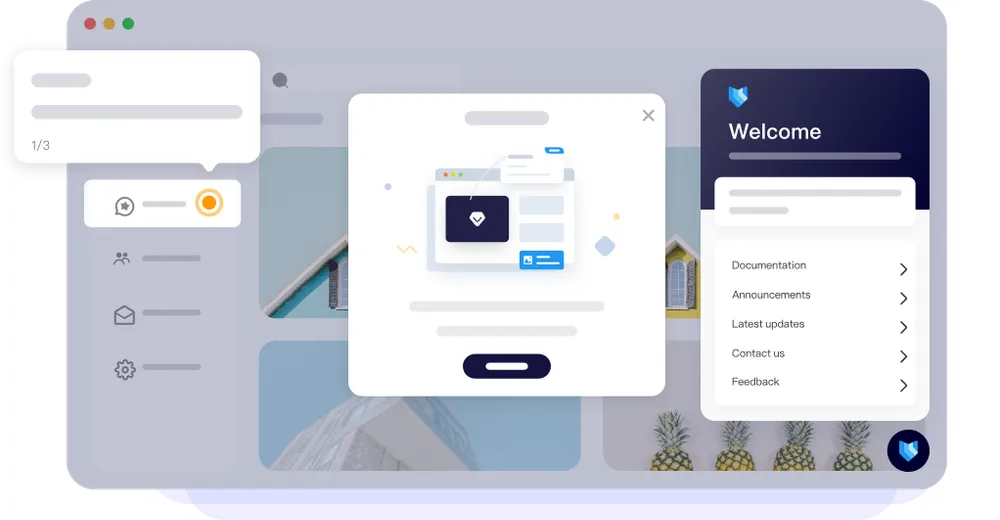

Usertour is an open-source user onboarding platform. It allows you to create in-app product tours, checklists, and surveys in minutes—effortlessly and with full control.
Website | Documentation | Blog | Twitter | Discord
How to install Usertour
Install Usertour with Docker Compose
cp .env.example .env # make sure all required envs are properly set docker compose up -d
Includes PostgreSQL and Redis containers for development/testing
Usertour releases & version history
This release makes the server faster and steadier rather than adding a content type. Content reaches the page sooner over the SDK connection: a message handler no longer loads a user's whole event history, no longer waits for the user's other tabs, and no longer waits for a receipt on every push, so a batch that used to show its pieces one at a time shows them together. Under a reconnect storm after a deploy the server queues work on itself instead of on the database, the per-connection rate limit applies as designed, and a hidden session can no longer send a process into a loop. Self-hosted instances get a readiness endpoint apart from liveness, OpenTelemetry configured through the standard OTEL_* variables, and a Debian-based image whose query engine costs a fraction of the CPU it did on Alpine. The dashboard says what was wrong when it refuses an input, in the user's language, and its data layer was rebuilt on documents typed from the server's own schema.
What's Changed
⚡ Content reaches the page sooner
Three changes on the SDK websocket, each removing a wait from the path between a client message and the content it starts:
- The newest event per content is picked in the database. Every evaluation used to fetch the user's whole event history on the contents in play and walk it in memory for two rows per content. Postgres now picks those rows. On an account with twelve contents and 3.7k events,
EndBatchwent from 1120 to 387 ms andEndContentfrom 1965 to 713 ms on staging. - A user's other tabs are synced through their own queues. Activating or cancelling a session no longer waits for every other connection of the same user across the cluster to acknowledge; the sender is answered as soon as its own connection is in step, and the others follow a moment later. A tab that has stopped answering no longer costs anyone else its emit timeout.
- Pushes go out without a receipt. Every push to a client awaited an acknowledgement with a 2 s timeout, so an evaluation that activated six sessions paid six client round trips in series. The receipt carried no information (the SDK acknowledged before it processed), so the emitter now sends and returns. Six pieces of content that used to appear one after another appear together, and a slow link is no longer recorded as a failed push.
🛡️ Steady under reconnect storms
After a deploy or a replica restart every client reconnects at once. The server now admits websocket work through a per-replica gate: a handshake and a client message are each one unit, at most 16 run at a time, the rest wait up to 15 s and are refused with a retryable rejection the SDK backs off on; handshakes are paced at 50 per second. A refused identify or group write is left unanswered so the SDK replays it. The gate reports refusals and long waits in one warn line per 5 s window.
Two causes of the pressure are gone as well. The server image moves from Alpine to Debian: the query engine's musl build did not scale across its worker threads and used about 2.8 cores under a burst against about 0.4 on Debian, starving the application thread and surfacing as "Can't reach database server" while the database sat idle. And user, company and membership writes are planned outside the row lock and applied under it only when something changes, so dozens of identical concurrent identifies from one user no longer queue on the lock until the transaction closes.
🚦 The per-connection rate limit applies as designed
The websocket limiter had been counting messages against the REST limiter's 1000 per minute since July: the throttler module keeps one options token and the REST registration won it. Each guard now builds its own options. A socket sending more than 30 messages in a second or 300 in a minute has the excess answered false, which the SDK treats as a refusal rather than a network failure. For scale, the busiest production socket observed sent 7 in a second. Idle limiter records are swept, so the limiters' memory no longer grows with every connection and credential seen.
🩺 Readiness, telemetry and the image, for self-hosted instances
GET /api/health/readyanswers 200 only when the database and Redis answer from this process, within three seconds each, and 503 naming what is down otherwise.GET /api/healthstays dependency-free liveness. Point the deploy-time healthcheck at/ready: a new replica then takes traffic only once it can serve, and a deploy that coincides with a dependency outage stays on the previous replicas.- OpenTelemetry is configured from the standard variables (
OTEL_EXPORTER_OTLP_ENDPOINT,OTEL_TRACES_EXPORTER,OTEL_TRACES_SAMPLER, …) and starts before the framework loads, so every instrumentation the SDK ships is active, each websocket message is one span named by its kind, and the packages are on the current 0.300 line. With noOTEL_*variable set the SDK is not built; previously it exported tolocalhost:4318and failed on every batch. - The image is
node:22.23-trixie-slim(was Alpine, Node 22.13). Same packages one to one;pg_dump17; nginx workers run aswww-data; about 200 MB larger. - nginx proxies to the app by
127.0.0.1instead oflocalhost: the latter resolved to two addresses, an implicit two-server upstream that answered sporadicno live upstreams502s without attempting a connection. A path under the web root that begins with a dot (/.env,/.git/…) answers 404 instead of the SPA shell;/.well-knownkeeps its routing.
🧭 Dashboard
- Refusals say what was wrong, in the dashboard's language. A variable the GraphQL schema rejects answers
E1017with status 400 instead of a masked internal error; an explicit null for a column that cannot hold one is refused before it reaches the database; catalogue messages answer in the request's language, which the dashboard sends. - System Admin refusals name their cause (E0064 to E0072: no valid instance license, a license issued for another instance, the last active System Admin, the owner role that needs a transfer, …) instead of the generic "System parameter error", and "Use Instance License" is offered only when the instance has a valid license to assign.
- A project list that could not be read shows a retry card instead of sending the user to the create-project form as if they had none.
- The seven content-type icons are one set on the same grid and weight, and the nav rail shows them a little larger and softer.
🐛 Fixes
- A hidden session on a superseded version could pin a replica. The resume strategy handed back a session whose own version's hide rules were active, cancelling it came back to the resume, and the laps held the socket's data until the process ran out of memory. Such a session is now passed over for the next live one, and resumes with the same id once the rules clear.
- The mouse went dead after closing a select inside a dialog (#568): two copies of Radix's dismissable layer each remembered body's
pointer-events. One copy remains; Escape inside a select closes only the select. Transaction already closedon the identify path when one user's many identical identifies queued on the row lock. A write that changes nothing opens no transaction, and the first write of a new user or company no longer fails under concurrency.- Save & Leave in the builder raised
Invalid blocker state transitionwhen Stay or a second click arrived while the save ran, and switching between a flow's steps while a save was pending raised the unsaved-work dialog although nothing could be lost. - The builder's save gate rejected segment and content conditions while those lists were still loading.
- The CSV export wrote a single-choice answer stored as text and a zero score; the user activity feed's events carry their user.
- The question editor no longer logs a
missingKeywarning per render. - Log levels. Log lines carry
"level":"warn"and so on instead of a number, so level filters on a log platform work; every evaluation's "nothing to start" warn line is gone (it was close to half of the volume under load); catalogue refusals on GraphQL log once atwarnwith the code, path and reason instead of aterrorwith a stack; logs no longer carry end-user identifiers, attributes or payloads.
Behaviour changes to check
- A socket over 30 messages per second or 300 per minute has the excess answered
false. Nothing in normal SDK use comes near; an integration that drives the connection itself should watch for it. OTLP_TRACES_ENDPOINTandOTLP_METRICS_ENDPOINTare no longer read. Tracing is configured by the standardOTEL_*variables and off until one names an endpoint or an exporter./api/healthkeeps answering 200; its body losestimestampand takes terminus'sinfo/error/detailsshape. Both health routes answerCache-Control: no-cache.- GraphQL schema (the dashboard's API): ten
Stringfields are enums, the integration config and mapping fields are object types needing selection sets, the config, settings, target and analytics payloads are named scalars, and fields backed by NOT NULL columns are non-null.E1017'smessageis the localized catalogue text; the specific text moved toextensions.reason. REST v2 and MCP are unchanged. - Creating a content without a name stores
''instead of NULL. POST /api/auth/refreshaccepts only a refresh token carrying its ownjtianduserId, and consumes exactly that row.
Upgrade notes
Usertour Cloud is already running this release. Self-hosted:
- One migration,
20261012000000_required_content_step_theme_segment_columns:Content.name/publishedAt/environmentId,Step.name/type/setting/data/target,Theme.settingsandSegment.sourcebecome NOT NULL with the defaults their writers assume. On a snapshot it ran 22 statements in about 0.5 s with every backfill touching zero rows. A row with NULL inContent.environmentIdorStep.typefails it and has to be resolved first; such a row was already unreadable through the API. - Switch the platform healthcheck to
/api/health/readyafter the deploy./api/healthkeeps working, so the order is safe; a rollback to an older image needs the path back. - Environment variables. New and optional:
WS_ADMISSION_CONCURRENCY(16),WS_ADMISSION_HANDSHAKE_WAIT_MS(15000),WS_ADMISSION_MESSAGE_WAIT_MS(15000),WS_HANDSHAKE_RATE_PER_SECOND(50), per replica, andJWT_REFRESH_SECRET(defaults toJWT_SECRET; setting or changing it makes every user sign in again once). Replaced:OTLP_TRACES_ENDPOINT/OTLP_METRICS_ENDPOINTby the standardOTEL_*set, documented in.env.example. Removed:SENTRY_DSN, which nothing read. A blank or zeroAPI_THROTTLE_*value now means the default instead of a limit of zero. - The image is about 200 MB larger, runs Node 22.23, and its nginx workers run as
www-data. Every replica restarts on deploy, as with any image change; the reconnect burst that follows is the load the gate was measured against. - No SDK bundle change. apps/sdk stays at 0.8.1 and usertour.js on npm stays at 0.0.26; older SDK builds take a push without an acknowledgement id the same way. Nothing to upload.
- Dashboard tabs opened before the deploy fail document validation on the operations whose variables became named scalars until they reload; from this build on, a stale tab reloads itself on that error.
- Rollback is a plain revert of the application; the migration stays in place and the previous build runs against the tightened columns.
🛠️ Under the hood
- Typed dashboard data layer (ADR 0021). The server emits its SDL from resolver metadata and CI fails on drift; the dashboard reads it through typed documents in one query layer that decides what
loadingmeans and surfaces each failure once.@usertour/hooksis now@usertour/dataand absorbs@usertour/gql;@usertour/editorand@usertour/business-components(renamedconditions) moved intoapps/web. The session-detail chunk shrank from 324 KB to 12 KB. - Websocket core.
AdmissionService(per-replica concurrency and handshake pacing),RoomSyncService(a job per activation or cancellation, carried to the other servers of a cluster through the adapter's server-side event), receipt-lessSocketEmitterServicewithSocketParallelServiceremoved, and a trace interceptor that gives each message one span. Both rate-limit guards build their ownThrottlerModuleOptions;ThrottlerModuleis registered nowhere, on@nestjs/throttler6.7.1. - Writes.
ON CONFLICT DO NOTHINGinserts a newborn user or company before the lock; every part of a composed write (group()with its company and membership, the REST user endpoint with its companies and memberships) applies under its lock. - Health through
@nestjs/terminuswith our own database indicator. Tracer is the first import ofmain.ts; OpenTelemetry packages on 0.300 / 3.0, the socket.io instrumentation dropped in favour of the interceptor. - Dependencies.
@nestjs/graphql/@nestjs/apollo12.2.2 (forskipNullProperties: false), Radix Select 2.1.2 with 25 Radix 1.0.x helpers gone from the lockfile, axios 1.20.0 (covers the advisories published against 1.7.7; the web app's unused copy removed),turbopinned to 2.11.9, Node 22.23. - Tests. New e2e suites for the newest-event pick (with a brute-force comparison over the whole history), room sync on one server and across two, the admission gate, the receipt-less push on both servers of a cluster, the websocket rate limit over real connections, the three resume behaviours, the health endpoints, the refresh endpoint's token shapes, and null inputs and concurrent identifies on the write path. Full server e2e at release: 90 suites, 1790 tests.
Full Changelog: v0.9.6...v0.9.7
This release gives attribute writes a vocabulary — set_once, add, union, remove, and a data_type pin — and adds two attribute types whose values Usertour assigns, Random A/B and Random number, so a flow can be shown to a stable slice of users without any client-side code. The SDK now recovers its connection on its own and replays the writes it lost, and usertour.setDebug(true) opens its console log. Localized content can translate where its buttons navigate, translations are readable and writable over the API, and themes, attributes, segments and events soft-delete instead of disappearing from history. Under the hood the server moved into a modules layout, the SDK got the test suite it never had, and that suite found four runtime bugs in the start rules, all fixed here.
What's Changed
✍️ Attribute write operations
An attribute value sent from the SDK, the REST v2 API or MCP can now be an operation instead of a plain value: { set_once: value } writes only when the attribute has no value yet; { add: n } adds to a number (negative to subtract); { union: [...] } appends the values a list does not have yet; { remove: [...] } takes values out of a list; { set: value, data_type: 'datetime' } pins the type of an attribute that this write creates. null removes the attribute, and a Date is sent as ISO 8601 UTC. A counter kept with add is never lost to a concurrent write: every user, company and membership write runs under a row lock.
The typings had promised this vocabulary since January; the server now implements it with one rule shared by every entry point. The SDK path stays lenient — a value the server refuses is dropped, logged, and reported back — while the v2 API and MCP refuse the whole request with a 400 that names the key. identify(), group() and their update* forms resolve to { rejected: [...] }, listing any key the server refused and why. The legacy subtract / append / prepend spellings still work: the SDK rewrites them and logs a deprecation warning.
Acceptance is also wider and more predictable: a numeric string into a Number, a number into a String and any ISO 8601 date-time into a DateTime are stored rather than dropped as type mismatches, and a date-time already in strict UTC is stored as sent, so re-identifying a user no longer makes unchanged values look changed. Reference: https://docs.usertour.io/developers/usertourjs-reference/overview#attributes
🎲 Random bucketing attributes
Two new attribute types, Random A/B (A or B) and Random number (1 to a maximum you choose), are assigned by Usertour rather than written by you. The value is derived from a hash of the attribute and the user or company id: fixed when the entity is created, identical on every device, and unchanged when you later raise the maximum. Existing users and companies are backfilled when you create the attribute, so a segment such as rollout ≤ 30 or a start rule on experiment = B is usable at once. Writes to these attributes are refused as system-generated. The attribute dialogs, the condition editor and the segment table all understand the new types. Reference: https://docs.usertour.io/api-reference-v2/attributes#random-bucketing
🔌 The SDK reconnects on its own
The SDK used to have two ways to go permanently silent for the rest of a page's life: a disconnect the server initiated, and a handshake the server refused for a reason that was only temporary. Both now reconnect by themselves, backing off from one second to a minute with jitter, and stop only when the server says the credentials are wrong. identify() and group() calls that failed for a transport reason are replayed on the next connection (with add operations stripped, so nothing is counted twice), a reconnect re-evaluates content once, and wait timers and tracked conditions keep their state across it. On the server side every refused or rate-limited message is answered with false instead of silence, so the SDK never waits on a reply that is not coming.
🐞 usertour.setDebug(true)
The SDK is silent in the console by default. usertour.setDebug(true) — or ?usertour_debug=1 on the URL for one page load — turns on a log with one line per decision: what connected, which content was evaluated and why it was or was not shown, which element a step is waiting for. The switch is remembered across page loads until you turn it off. Only two lines print unasked, and both mean nothing will show: the UI failed to initialise, or the connection was rejected for good. Guide: https://docs.usertour.io/developers/usertourjs-reference/advanced/set-debug
🌐 Localization: destinations, alt text, and the API
A localized banner whose button sends people to a per-language landing page can now translate that destination: the navigate action on buttons, survey questions, checklist tasks, launchers, resource-center blocks and content-list entries has its own row in the translation editor, as do image alt text and the fallback text of a user-attribute chip.
Translation is no longer a dashboard-only workflow. A version's translation is readable and writable over the v2 API and MCP as flat units (path / source / translation / optional / outdated / kind), the project's locales are an API resource with their own scopes, and GET /v2/locales serves the same language catalog the dashboard's picker uses. The dashboard saves translations through the same service, by unit, so two people translating one locale merge instead of overwriting each other. Guide: https://docs.usertour.io/how-to-guides/localization
🗑️ Soft delete for themes, attributes, segments and events
All four used to be hard-deleted: deleting a theme stripped it from every historical version, and deleting an attribute a live flow targeted made its conditions silently stop matching. They now soft-delete under one rule — a live surface never references a deleted definition; history may. Deleting something still in use is refused, and the delete dialog shows what uses it before you click, with a live / draft marker and a link to each place. A deleted definition can be restored from the API or MCP, and creating an attribute or event with the same code name restores it. Error reference: https://docs.usertour.io/api-reference-v2/errors
🐛 Fixes
- A brand-new flow started right after another was dismissed even with a quiet period ("at least N minutes after any flow") configured: the quiet period never held for a content the user had no event on yet.
- A start rule combining an event with a browser condition never fired when the event alone satisfied its group: the browser leaf was never tracked.
- Content gated on a condition that had toggled could not start after a reconnect, because the reconnect carried the condition's stale state.
- Text-input "has any value" was true whenever the input existed, empty or not; it now requires a non-empty value.
- A hover launcher's tooltip closes when the pointer leaves it; the banner frame no longer shows the browser's default iframe border on hosts without a CSS reset.
- Two OAuth handshakes in the same second could no longer collide on their
statevalue. - The self-hosted installation snippet's
ASSETS_URIno longer carries a trailing slash, as the docs say, and the snippet queues asetDebugcall placed before the script loads. identifyAnonymous()'soptsparameter is documented as having no effect: anonymous ids are minted client-side, so a backend can never sign one.
Behaviour changes to check
- Text-input "has any value" now requires a value. A rule that meant "the input is on the page" should use an element "present" condition on the same selector.
- The quiet period now holds for content the user has never seen.
- Segments using
is empty/has any valueon a List attribute never matched anyone before; they match now, so their membership changes after upgrade. - Attribute acceptance is wider (numeric strings into Numbers, numbers into Strings, any ISO 8601 date-time into a DateTime). Inference on first creation stays strict.
- Deletes can be refused. An attribute, segment, theme or event still used by live content answers 409 (E1042 / E1043 / E1030 / E1031); E1030 now means "used by live content" rather than "has recorded events", so fired events can be deleted. Publishing a version that references a deleted definition answers E1044.
identify()/group()resolve to{ rejected }instead of a boolean; truthiness is unchanged, and an older SDK reads the new acknowledgement as truthy.
Upgrade notes
Usertour Cloud is already running this release. Self-hosted:
- One migration, additive (
Localization.deleted, default false, no backfill), and one seed backfill that runs on start: translation rows below schema version 2 get their navigate / alt / chip-fallback clones blanked so the new rows start as real untranslated copy. Expect aLocalized unit stores backfill completedlog line. - A new BullMQ queue,
attribute-backfill, runs in the server process on your existing Redis; a job is enqueued when a bucketing attribute is created or restored. - SDK 0.8.1 ships in the image. The server is backward compatible with pages still running 0.8.0, and the handshake log line now names each connection's SDK version (
… authenticated for user u1 (sdk 0.8.0)), so the pages that have not reloaded since the deploy can be counted from the logs. - usertour.js 0.0.26 on npm carries the operation typings, the
setDebugstub and the write-result type; it is safe with every bundle version, including ones older than this release. - Nest log contexts that used the old class names change (for example
SharedModule→CommonModule); update any log filters that key on them. - No new environment variable. Rollback is a plain revert: bucketing values already written are inert under the previous server, and SDK 0.8.1 accepts the previous server's acknowledgements.
🛠️ Under the hood
- Server modules layout (ADR 0015). Every directory under
apps/server/srcmoved intosrc/modules/<name>/;src/holds only the entry points (api/,openapi/,mcp/,web-socket/). A test enforces the import direction. Queue, cron, Redis key, cookie and event names are unchanged. The GraphQL schema and the v2 OpenAPI document are byte-identical before and after. - One rule point for attribute writes (ADR 0017).
resolveAttributeWrites→judgeAttributeWrite→applyAttributeWrites, shared by the socket, v2 and MCP paths; user, company and membership rows are locked withFOR NO KEY UPDATE(so foreign-key inserts never deadlock against them), in the order user → companies by id → memberships; a write that changes nothing takes no lock. Prisma transactions wait up to 10 s and may run 15 s, so the socket queue's 10 s timeout is always the first limit to fire. - Connection recovery (ADR 0018) is an explicit state machine in the SDK; failed writes are kept in a replay registry with one record per target, keyed by the latest send, replayed once within ten minutes. The server disconnects a socket whose data is gone instead of rebuilding it from a stale handshake, and the throttler marks a refused message rather than throwing.
- Debug logging (ADR 0019) reclassified every SDK message into
debug/info/warn/error/criticalwith a scope per component. - Bucketing (ADR 0020) values are a hash of attribute and entity id, materialised at birth and by the backfill, derived at read time when missing.
- Tests and CI. 65 real-browser widget render checks, a 71-scenario SDK runtime suite against a protocol server the test controls, 26 server rules-conformance scenarios including composite start-rule trees, and a GitHub Actions workflow that lints, type-checks and runs the unit, server e2e and browser suites on every pull request and on pushes to
stagingandmain. - Authorization registry. The endpoint-to-capability test now covers every endpoint, including the identity-verification signing secrets and the audit log, which had drifted out of it.
- Validation. v2 bodies skip class-transformer in the global pipe (zod DTOs carry no metadata for it);
__proto__is refused as an attribute name on every path.
Full Changelog: v0.9.5...v0.9.6
This release brings Usertour into your CRM and spreads project administration across more than one person. HubSpot is now a two-way integration — contact and company properties arrive as attributes you can target on, Usertour attributes are written back onto the records, and onboarding milestones land on HubSpot timelines — and the app is listed on the HubSpot Marketplace. Team roles are redrawn as Viewer ⊂ Editor ⊂ Admin ⊂ Owner, with each editor's publishing limited to the environments you tick. Existing Admin members become Editors on upgrade — read the roles section before you deploy. Transactional emails are redesigned, and the MCP server is in the official MCP registry.
What's Changed
🔗 HubSpot: two-way property sync
Settings → Integrations → HubSpot connects with a single OAuth consent — or start from the Marketplace listing (https://ecosystem.hubspot.com/marketplace/apps/usertour), which signs you in and asks which environment to install into. A HubSpot account connects to one environment at a time.
Two object pairs are available: contacts ↔ users and companies ↔ companies. Each pair has a match rule and a field list per direction. Contacts match by email (any email-typed contact property, email by default) or by a contact property holding the id you pass to usertour.identify(); companies match by a property holding your usertour.group() id.
Properties coming in — lifecycle stage, plan, industry, owner — become Usertour attributes marked with the HubSpot logo wherever an attribute name appears: attribute settings, user and company detail, the condition builder. They target content like any other attribute. HubSpot owns them: SDK writes to a synced attribute are dropped, API writes are rejected, and the attribute cannot be deleted or retyped while a mapping syncs it. Attributes going out are written to a "Usertour" property group as usertour_user_<name> / usertour_company_<name>, created on demand. Your own HubSpot properties are never a write target, and an empty value on the owning side clears the other side rather than being skipped.
Sync links records, it never creates them. A CRM is mostly leads and sign-ups that never activated; materialising them would bury your user list in people who have never opened the product. A link exists only when both records do, unmatched records are counted on the mapping card, and each round re-evaluates them.
Run full sync links the records that already exist, and a daily round runs as a backstop. In between, changes move on their own: a HubSpot edit reaches Usertour in about 30 seconds, an attribute change is written back as it happens, and a user identified for the first time is looked up and filled in on the spot rather than waiting for the next round. Incremental sync pulls from HubSpot's change journal, so no public inbound URL is needed — self-hosted instances on private networks sync too.
Sync activity, on the connection's menu, lists every full round and journal poll with its record counts and, on failure, HubSpot's own status and message. Write-backs appear in the message log with payload and attempts, on the same retry ladder as webhooks. If the app is uninstalled or the authorizing user removed, the integration switches off at once with a banner naming the cause, and Reconnect is the remedy. Disconnect revokes the grant and keeps your mappings and logs.
On Usertour Cloud the HubSpot integration is included from the Growth plan; self-hosted instances are never gated (see the self-hosting notes for the one-time app setup). Guide: https://docs.usertour.io/integrations/hubspot.
📌 Onboarding milestones on the HubSpot timeline
The Timeline events card sends eight milestones to HubSpot: flow started, completed and ended; checklist started, completed and task completed; question answered; launcher activated. Each is written to the linked contact and, when the event carries a linked company, to that company as well.
They arrive as real HubSpot events, usable in lists, workflows and reports, with no requirement on your HubSpot tier. Each carries what a workflow would filter on: content name and version, step or task name, the question, answer and score, the Usertour user id and the page URL. Timestamps are the moment the event happened, and a retried delivery never produces a duplicate.
The set is deliberately the milestones. page_viewed, step-level events and your own custom events are not sent, and there is no "stream everything" switch — a CRM record is not an analytics sink; the analytics integrations are. Deselecting a milestone also stops deliveries already queued. Users with no linked contact produce nothing.
👥 Four roles, and a publish whitelist for editors
Until now a project had one person who could invite a teammate, rotate a token, configure a webhook or see why a sync failed — the Owner — while an "Admin" was an editor by another name. Roles are now four, strictly nested:
| Role | Can do |
|---|---|
| Viewer | Read everything |
| Editor | Build and edit content, themes, attributes, events, segments and localization; manage users, companies and environments; connect integrations, configure webhooks, read environment tokens and rotate signing secrets; publish to the environments they are allowed |
| Admin | Everything an Editor can, plus publish anywhere, manage the team, configure SSO, edit project settings, read the audit log, and see the plan and usage |
| Owner | Everything, plus billing (checkout, portal, license) and transferring ownership |
The line between Editor and Admin is drawn by consequence, not by where a page sits in Settings. Anything that only affects the project's own operation — installing the SDK, wiring a webhook, connecting a CRM — belongs to the Editor, so a builder can finish the job without asking anyone. Anything that changes who gets in or costs money sits above.
An Editor publishes (and unpublishes) only to the environments ticked for them when they are invited or their role is changed. The default is none: an editor with nothing ticked edits everything and ships nothing. "Can build but must not ship to production" is one unchecked box, set per member. Admins and the Owner publish anywhere.
Alongside it:
- Ownership transfer is its own action, available only to the Owner; the previous owner becomes an Admin. An Admin can invite, re-role and remove anyone except the Owner, and the Owner's row can no longer be changed through the team endpoints at all.
- Webhook and integration auto-disable emails go to every Admin as well as the Owner.
- SSO auto-provisioning assigns Editor or Viewer only, Editor by default; a just-in-time editor starts with an empty whitelist.
- Personal API keys inherit their owner's whitelist as a publish ceiling: REST and MCP publish calls outside it are refused with
E1039, and over MCP the refusal names the environments the key may publish to, so an assistant can recover on its own. The key's own environment scope still governs everything else.
What happens to existing members on upgrade. Every current Admin becomes an Editor whose whitelist holds all of the project's current environments, so nobody loses the ability to publish. Pending Admin invites and SSO default roles follow the same rule. Those members also gain integrations, webhooks and environment tokens, which were Owner-only before — nothing beyond what they already held, since they could already delete environments and publish to production. Nobody holds the new Admin role after the upgrade; owners promote deliberately. Environments created later join nobody's whitelist until an Admin ticks them.
✉️ Redesigned transactional emails
Verify email, reset password, team invite and the two auto-disable notices share one layout: the Usertour wordmark, a single clear action, the full link spelled out on its own line as a fallback, and a footer saying why you are receiving the message. Every email now ships a plain-text alternative alongside the HTML. The wordmark is served by your own instance, so a self-hosted deployment never calls out to us to render an email.
🤖 In the official MCP registry
The hosted MCP server is published to registry.modelcontextprotocol.io as io.github.usertour/mcp, which feeds the server directories inside MCP clients. The entry carries no API-key header: the endpoint advertises OAuth discovery, so a client authorizes in the browser instead of asking you to paste a token.
🐳 Self-hosting notes
- Seven migrations run on upgrade, including the role migration described above. It is not a no-op: memberships, pending invites and SSO default roles are rewritten. After deploying, open Settings → Team and promote whoever should be an Admin.
- HubSpot needs your own HubSpot app. Redirect URLs and secrets are bound to an app, so upload your copy of
integrations/hubspotto your HubSpot developer account (the directory README has the procedure) and setHUBSPOT_CLIENT_ID/HUBSPOT_CLIENT_SECRET. The callback defaults to${API_URL}/api/integrations/hubspot/oauth/callback, overridable withHUBSPOT_CALLBACK_URL. It must be registered on the app and served by the host the dashboard sends API requests to. Without credentials the HubSpot page shows a pointer to this setup instead of Connect. No traffic is relayed through Usertour Cloud. Redis_DBselects a logical Redis database (0–15) for the cache, the queues and the socket adapter. Unset, it stays 0.- The default email sender reads
Usertour <support@usertour.io>(it was spelledUserTour). SettingEMAIL_SENDERoverrides it as before.
🐛 Fixes
- Any signed-in user could read another project's plan and usage, or open a checkout or billing-portal session against it, by project id. The subscription endpoints were never attached to the permission guard. Reads now require project membership, and checkout and portal require the Owner.
- Switching a flow's frequency from Once to Multiple crashed the builder when the flow's start rules had been written through the API or MCP; the page showed "Something went wrong" and reloading did not help. The missing repeat window is now filled in on read. Delivery to end users was never affected.
- A project could be left with no owner. The role-change endpoint accepted Owner as a target and would re-role the Owner's own row; the dashboard hid both, the API did not.
- Auto-disable notifications could silently fail to send when a project had many recipients. Each message opened its own SMTP session, and a provider refusing a dozen parallel logins dropped them. Mail now goes through one pooled connection set, and a send during shutdown fails fast instead of hanging the process.
- The activity feed on a company's page was slow on large workspaces. Its query scanned every event in the table — 660 ms on a million rows — and now resolves through indexes in under a millisecond.
- An integration's page flashed "not connected" on load before settling on its real state. It holds a skeleton until the environment is known.
- The plan comparison left excluded features blank, which read as missing data. They show a cross, and integrations are listed by name in their own section, next to webhooks.
🛠️ Under the hood
ADR 0013 records the HubSpot design and ADR 0014 the role model; both were revised to match what shipped after their review rounds. The shape behind the sections above:
- The sync engine is provider-agnostic below the adapter: mappings, links and sync runs are three tables with no HubSpot assumptions, and the engine is named for object sync rather than for its first provider. The HubSpot app project lives in
integrations/hubspot, outside the pnpm workspace because HubSpot's CLI builds and deploys it. - Write-backs and timeline events are messages on the outbound ledger, under topics that name the message rather than the recipient —
sync.object.updateandevent.tracked.<codeName>. A write-back carries the field set, not values; values are read at delivery, so retries send current data. The timeline occurrence id is the ledger message id, which is what makes a retry idempotent. - Loops are impossible by construction, through three gates that each suffice alone: inbound applies only listed properties (our own
usertour_*write-backs never re-enter), outbound skips changes whose origin is the provider, and a field cannot sit in both lists of one mapping. - The OAuth handshake binds the callback to the browser that started it: a signed ten-minute state plus an httpOnly
SameSite=Laxtransaction cookie set on the authenticated response, so a forwarded authorize link cannot attach a victim's HubSpot account to an attacker's environment. A Marketplace-initiated install finishes inside HubSpot's frame where that cookie never arrives, so its state is verified by being spent once instead;returnUrlis honoured only for HubSpot app hosts. - Tokens are AES-256-GCM encrypted and refreshed under a single-flight lock with compare-and-set, so a disconnect mid-refresh is never overwritten. A rejected access token is refreshed once, then treated as a revoked grant. Provider errors are stripped of their request before they propagate — the token form carries the app secret.
- Errors are one of four kinds, each with one handling: transient (retry ladder, feeds the breaker), rate limit (wait for
Retry-After, never the breaker), revoked (off at once), refused (a 4xx closes the round immediately with HubSpot's reason, instead of walking a 25-hour ladder). A round is alive while its heartbeat is fresh, and the stale window outlasts any single wait a job can take; one journal poller runs under a renewed Redis lease so ticks never overlap across instances. - Every dated HubSpot path — OAuth, CRM objects and properties, the webhooks journal — hangs off one
HUBSPOT_API_VERSIONconstant (2026-09). Timeline events stay on/integrators/timeline/v4until HubSpot publishes a dated replacement. - Behaviour is decided only by capability —
roleCan(role, capability)on the server,can(capability)in the web app — and role names are compared only where roles are assigned. TheUSER → EDITORenum change is a hand-writtenALTER TYPE … RENAME VALUE, metadata-only, instead of the drop-and-recreate Prisma generates. - The permission test suite now fails on any unguarded resolver: every resolver class must register the guard, and every query and mutation must be in the capability map or in an explicit, reasoned exemption list. The e2e endpoint matrix moved to four tiers.
- Emails render from typed props in a new
@usertour/emailspackage (React templates replacing mjml + handlebars). The SMTP pool closes in the application-shutdown phase, after the queue workers drain. - The MCP registry entry is published by CI on release tags over OIDC, taking its version from the tag, so a release cannot ship a stale listing. The e2e suite runs on its own Redis database so it no longer consumes a local dev server's jobs.
Full Changelog: v0.9.4...v0.9.5
This release connects Usertour to your analytics stack in both directions, and to Zapier. Every tracked event can now stream to Amplitude, Heap, Mixpanel, PostHog or Segment the moment it happens; cohorts you define in Mixpanel or Amplitude come back as segments you can target flows and checklists at; and a Zapier app triggers Zaps from Usertour events and creates users, companies and events from thousands of other apps. Server-side code gets its own way to record events through the v2 API, and localized content can finally translate where its links point. Under the hood, integrations ride the same outbound ledger webhooks shipped on, and the dormant legacy integration module is gone.
What's Changed
📡 Event streaming to analytics providers
Settings → Integrations is open. Pick a provider, paste its API key (Heap takes an app id), choose the EU region where the provider offers one, and flip Event streaming on. From then on every event tracked in that environment — flow and checklist lifecycle, survey answers, launcher activations, your own custom events, and page_viewed — is forwarded as it happens. There is no topic picker on purpose: an analytics destination's contract is the full stream, and per-event routing is what webhook subscriptions are for.
Two details make the forwarded data trustworthy. Events carry their event time, not the time we managed to deliver them, and destinations that support a dedup key (Mixpanel's $insert_id, Amplitude's insert_id) receive the message id, so a retry can never double-count. Each event also carries its session id under a per-type name — flow_session_id, checklist_session_id, and so on — so a destination can group one user's runs into sessions instead of seeing a flat event list.
Delivery inherits everything webhooks got in v0.9.3: eight attempts across roughly 24 hours, Retry-After honoured, a cooldown for a destination that keeps failing, auto-disable with an owner email after seven days of continuous failure, and a 30-day message log on the integration's page with the payload, every attempt, and a Send test event button. Fixing a key or region applies to retries already in flight.
API keys are AES-256-GCM encrypted at rest and never returned by the API; the dashboard shows the key's last four characters so you can tell which one is configured. On Usertour Cloud integrations are included from the Starter plan; self-hosted instances are never gated.
🔁 Cohort sync from Mixpanel and Amplitude
The reverse direction: a cohort built on product analytics ("power users who never opened the checklist") becomes a Usertour audience without re-modelling the condition here. Turn on Cohort sync on the Mixpanel or Amplitude integration and you get a receive URL. Paste it into a Mixpanel Custom Webhook or an Amplitude Cohort Webhooks destination and pick the cohorts to sync.
Each synced cohort materialises as a read-only segment named after the cohort, marked with the provider's logo in the segment sidebar, the Users page, and the condition picker — and usable in content targeting exactly like any other segment. Membership follows the provider's enter and exit batches; Mixpanel's full-roster exports are treated as a replace, so members who drop out of the cohort drop out of the segment. Renames follow. The same cohort synced from several environments converges onto one segment per project, so targeting that references it works in every environment.
Members Usertour has not seen yet are created as bare users — external id only — so the flagship scenario works: circle dormant users in your analytics tool, greet them on their next visit. Cohort sync never writes attributes; the SDK and API stay the single authority on user data. Identity needs no setup when your Mixpanel distinct_id or Amplitude user_id is the id you pass to identify(); an optional User ID property covers Mixpanel Identity Merge and other divergences. The synced-cohort list shows each cohort's member count, last sync, a link to its users, and an unresolved count — the one signal that a payload arrived without a usable identity.
The receive URL's token can be rotated (the old URL dies immediately). Deleting the integration releases its segments as ordinary segments rather than deleting them, so live targeting never breaks.
⚡ Zapier
Usertour is on Zapier: https://zapier.com/apps/usertour/integrations. Connect with an API token (and your server URL, if self-hosted), then build Zaps from eight triggers — Flow Started, Flow Completed, Flow Ended, Checklist Completed, Survey Question Answered, Launcher Activated, User Created, and a generic Event Tracked with a dropdown of every event your workspace defines, custom ones included. Actions create or update users and companies and track events, with attribute values sent as each attribute's declared type; Find User and Find Company searches pair with the actions for Zapier's standard "create if not found" step.
Triggers work by subscribing an ordinary webhook in the environment, labelled Managed by Zapier, so Zap deliveries get the same retries, breaker and message log as your own endpoints — leave those webhooks to Zapier; deleting one by hand silently stops its Zap. Zapier also appears as a card on the integrations page with the two setup steps and a link to the guide: https://docs.usertour.io/integrations/zapier.
🧾 Track events from your own servers
POST /v2/projects/{projectId}/environments/{environmentId}/events records an event for a user from server-side code — a purchase, a plan change, an import finishing — through the same pipeline as SDK events, so webhooks, analytics destinations and targeting see it identically. Unknown users are created bare, an unknown event name registers its definition on first use, attribute names join the definition's list, and occurredAt backdates. Built-in event names are refused: analytics must not be forgeable.
GET /v2/me introspects the bearer token — its name and the projects and environments it may act on — so integration platforms can validate a pasted token and populate pickers.
🌐 Localized link destinations
A link's destination is per-locale content too — a localized page behind localized anchor text. Inline links in rich text and image click-through links now get a destination row in the localization editor, travel in the CSV exchange, and are skipped by machine translation and missing-translation counts, exactly like image and embed URLs. Destinations that contain a user-attribute chip stay source-managed.
🐳 Self-hosting notes
RUN_SEED=falseskips the startup seed on an instance. Multi-instance deployments set it on all but one instance (or run the seed from a one-off job) so the idempotent backfills execute once instead of once per replica. Unset, behaviour is unchanged.- If you front the server with your own reverse proxy, route
/inboundto the API (cohort-sync receive URLs live there) and allow request bodies up to 5 MB on the API location; the bundled nginx already does both. - The legacy integration tables are dropped, not migrated. That module was never reachable — hidden menu entry, dead call site — so any rows in them never took effect.
jsforceleaves the dependency tree.
🐛 Fixes
- A page holding only the public environment token could record built-in events such as
flow_completed. The SDK's socket channel kept its own event registration and accepted any name, polluting analytics and firing every webhook or Zap on that topic. It now rides the same core as the REST endpoint and refuses built-in names. - Reload buttons on user and company detail pages misbehaved. The activity feed's reload crashed with a circular-structure error because the click event was passed as query variables; the sessions list emptied itself on refresh and never repopulated. Both keep their rows on screen, and the buttons now show an in-flight spinner.
- A long URL blew the link popover open in the editor, pushing the attribute and delete buttons outside the card. The URL wraps inside the editable instead. Same fix for the image link panel and the page-navigate action input.
- Un-entitled projects flashed all provider cards before the upsell on the integrations page. Skeleton cards hold the layout while entitlement settles.
- An integration running only cohort sync read as "Disabled". The status badge now considers both capabilities.
🛠️ Under the hood
The integrations surface was rebuilt end-to-end rather than repaired; ADR 0011 records why the legacy module could not be revived (error-swallowing queues that disabled retries, plaintext credentials, dedup keyed on the event name, delivery-time timestamps). ADR 0012 covers cohort sync.
- Integrations are a second transport over the outbound ledger:
BIZ_EVENT_TRACKED→ listener → ledger → one delivery queue → pure per-provider adapters. The ledger stores the canonical envelope and the wire body is derived at delivery time, which is what lets a key or region fix apply to in-flight retries and keeps the message log uniform across webhooks and integrations. The retry ladder and reconcile parameters moved tooutbound/delivery-backoff.ts, shared by both transports. - Cohort sync is one provider-agnostic engine behind per-provider entry adapters that normalise payloads into a single batch contract. Writes are set-based and idempotent (
createMany … skipDuplicates, bulk deletes), so a retried or out-of-order batch cannot corrupt state; full-roster rounds carry their state on the mapping row and only reap members their own environment bridged. Processing is synchronous in the request — a failure returns 5xx and the provider retries. Tokens areutin_-prefixed, encrypted at rest with a sha256 lookup column; a bad token 404s, a disabled switch or lapsed plan 503s so the provider keeps retrying rather than pausing permanently. - Custom event registration is one idempotent step outside the event transaction (
registerCustomEvent: definition upsert, reserved-name guard, attribute registration, one retry absorbing concurrent first use), shared by the v2 REST endpoint, the SDK socket channel and the Zapier action. - Localization replaces the "stored value equals live source, so not an override" heuristic with an explicit format stamp on every localized write, plus an idempotent seed-time backfill for rows saved before link units existed.
- The integration catalog moved to
@usertour/constantsand provider types split into analytics and automation unions; the Zapier app lives inintegrations/zapier, deliberately outside the pnpm workspace because the Zapier Platform CLI builds and deploys it. - Test coverage: end-to-end suites for cohort sync (materialisation, idempotent increments, paged replace, cross-environment convergence, read-only enforcement, token rotation, release-on-delete), the Amplitude entry, the track-event route, and built-in-name refusal on the socket channel.
Full Changelog: v0.9.3...v0.9.4
This release ships outbound webhooks: tracked events, content publishes, and user or company changes POSTed to an endpoint you control the moment they happen. Every message is signed with a per-endpoint secret, retried across a day-long ladder when your receiver is down, and kept for 30 days with each delivery attempt — so you can see exactly what was sent, what came back, and re-send it. New signups also land on a starting-point screen: build with an AI assistant, or go straight into the dashboard.
What's Changed
🪝 Outbound webhooks
Endpoints live in Settings → Webhooks and belong to one environment — Production and Staging keep separate lists, separate signing secrets, and never see each other's traffic. Point one at any public HTTPS URL and pick what it should receive from a subscription tree: everything, a whole family (all tracked events, all user changes, all company changes), a group, or a single topic. Families cover topics added later, so subscribing to user today keeps working when a new user topic ships.
Available topics are the tracked events your workspace already defines (event.tracked.flow_completed, event.tracked.checklist_task_completed, …), content.published, and the entity-change set — user.created / user.updated / user.deleted and the same three for company. Entity messages carry the full object plus previousAttributes holding just the keys that changed. High-volume page_viewed is excluded from the wildcard forms and has to be named explicitly.
Each request carries X-Usertour-Signature — a timestamp and an HMAC-SHA256 of the exact bytes on the wire, computed with the endpoint's whsec_… secret — so a receiver can verify authenticity and reject replays. Rotating a secret takes effect immediately, including for retries already in flight. Send test event delivers a webhook.test message on demand, so you can prove the URL and your signature check work before any real event fires.
On Usertour Cloud webhooks are included from the Starter plan; self-hosted instances are never gated. Managing endpoints requires the Owner role.
🛡️ Delivery that survives an outage
A receiver that is down for an afternoon does not cost you messages. Each delivery gets 8 attempts spread over roughly 24 hours (5s, 1m, 10m, 1h, 4h, 8h, 12h), and a 429 or 503 carrying Retry-After pushes the next attempt out to the time you asked for. Between attempts the job costs nothing — no held connection, no worker.
An endpoint that keeps failing is slowed rather than dropped. After ten consecutive failed attempts it enters a cooldown (a minute, doubling toward an hour while failures continue, shown as a Cooling down badge). Messages created during a cooldown are still recorded and still delivered once the window passes — the pause defers traffic, it never discards it. A successful Send test event ends the cooldown immediately, so fixing your receiver and probing it is the fastest way back. If an endpoint fails continuously for seven days, Usertour disables it and emails the project owner; re-enabling resets the whole breaker.
🧾 A message log you can re-send from
The endpoint's detail page keeps every message for 30 days: the payload exactly as sent, its status, and each delivery attempt with response code, response excerpt, error and duration. Open a message to inspect the full JSON, or Re-send it — same payload, same message id, appended to the same attempt history — after fixing your receiver.
Delivery is at-least-once and message ids are stable across retries and re-sends, so deduplicating on the id is safe. Ordering across messages is not guaranteed; use each object's own timestamps.
🔌 Endpoints as an API resource
Webhooks are also a v2 REST resource under the environment, so you can provision them from scripts or infrastructure-as-code, and the MCP server exposes them as list_webhooks, create_webhook, update_webhook and delete_webhook for AI assistants. The signing secret is only returned to tokens holding webhook:manage — a read-only token gets every other field, because the secret is the ability to sign deliveries.
🚀 A starting point after signup
A fresh signup now chooses how to begin instead of landing cold on the dashboard: Build with AI opens the connection guide for your assistant, Build it yourself continues straight in. The guide leads each client with a one-click entry — a VS Code install deeplink with the values pre-filled, Cursor's deeplink, and direct paths into Claude's and ChatGPT's connector settings — and flips to a copyable starter prompt the moment your authorization lands. Manual steps remain as the fallback.
🐛 Fixes
docker stopalways burned the full grace period and then killed the container. A shell held PID 1 with no signal handler, so the SIGTERM never reached Node. The image now runs Node as PID 1 and shuts down cleanly — HTTP server, Redis and Prisma closed in order.- Detail dialogs could grow past the screen and jump while closing. They are now bounded by the viewport and scroll inside, and the closing animation no longer collapses their content.
- Long values broke the webhook screens' layout. Status badges and table headers no longer wrap inside their columns, long topics and URLs truncate with the full value on hover, and an over-long URL or an oversized topic list is caught inline in the form instead of coming back as a raw server error.
🛠️ Under the hood
The delivery pipeline is built on a shared outbound ledger — one row per message holding the payload as sent, one row per attempt — deliberately generic, because the integrations event push lands on the same bookkeeping next. The design and its failure-handling decisions are written up in ADR 0010.
- Domain events are emitted after commit, so a rolled-back transaction can never produce a webhook. Delete events are sourced from
DELETE … RETURNING, which gives per-row attribution: concurrent duplicate deletes emit exactly one message instead of two with different ids. - Signing secrets are AES-256-GCM encrypted at rest, the treatment the SDK signing secrets and 2FA secrets already had. The plaintext boundary is the domain service; the delivery worker decrypts its own read.
- User-controlled URLs run behind the shared SSRF egress guard — HTTPS-only fail-fast at save time, DNS-rebinding-pinned resolution and IP-literal vetting at send time, and proxy environment variables are disabled on guarded deliveries, since dialing a proxy would leave the guard inspecting the wrong host.
ALLOW_PRIVATE_NETWORK_EGRESSopts self-hosted deployments out. - Retries live in Redis for a day, so an hourly reconcile sweep re-queues messages whose job was lost with the queue — resuming from the highest logged attempt, never from a row count.
- Concurrent writes to breaker and message state are compare-and-swap guarded end to end; the rules that came out of it are now a written convention (
docs/conventions/concurrent-state-writes.md) rather than tribal knowledge.
Full Changelog: v0.9.2...v0.9.3
@ Every self-hosted release, weekly
One Monday email with the week's stable releases across the directory.
FAQ
Can I use one project for several applications?
Not recommended. Content, themes, attributes, end users and team members are scoped to a project. Use separate projects for separate applications.
Is there a limit on the number of projects?
No. An account can belong to any number of projects on any plan. Each project has its own subscription.
Do I need a commercial license to self-host Usertour?
No, the Community Edition (MIT) is free to self-host for any purpose including production. Only Business/Enterprise features require a license.
Can I remove the "Made with Usertour" branding?
Branding removal requires a Business or Enterprise license.
Is Usertour really free?
Yes, the Community Edition is free for production and commercial use under the MIT license. Business/Enterprise features require a paid license.
More in Customer Engagement
 B1AdminSelf-hosted open-source church platform with member database, attendance, online giving, website builder, mobile PWA, and children's check-in on one shared database.
 ClearFlaskOpen-source feedback management tool pitched as a Canny/UserVoice alternative for ideas, roadmaps and announcements, self-hosted via Docker Compose or Helm.
 Countly Community EditionOpen-source, self-hosted product analytics and engagement suite covering events, crashes, push and remote config — a privacy-first alternative to Amplitude and Mixpanel.
 FiderSelf-hosted, open-source feedback portal where users post feature requests, discuss and vote. Runs as a Docker image with PostgreSQL, configured via env vars.
- FormbricksSelf-hosted, open-source survey and experience-management platform: link, website, in-app and email surveys with no-code builder, webhooks, API, and analytics dashboards.
- laudspeakerSelf-hosted, open-source customer engagement platform for building visual onboarding journeys and sending event-triggered email, SMS, push and webhook messages.
- LimeJourneySelf-hosted open-source platform for AI-driven user journeys, visual builder, dynamic segmentation, and BYOI integrations — a Customer.io alternative.
 refrefSelf-hosted open-source software for managing referral, affiliate, and loyalty programs with billing provider connections.
0 comments