
Self-host Scrutiny
v0.10.0S.M.A.R.T hard-drive health dashboard built on smartd
- Stars
- 8 417
- Ports
- 8080 (webapp (Web UI and API)), 8086 (influxDB admin)
- Requires
- InfluxDB, Smartmontools (smartctl)
ghcr.io/analogj/scrutiny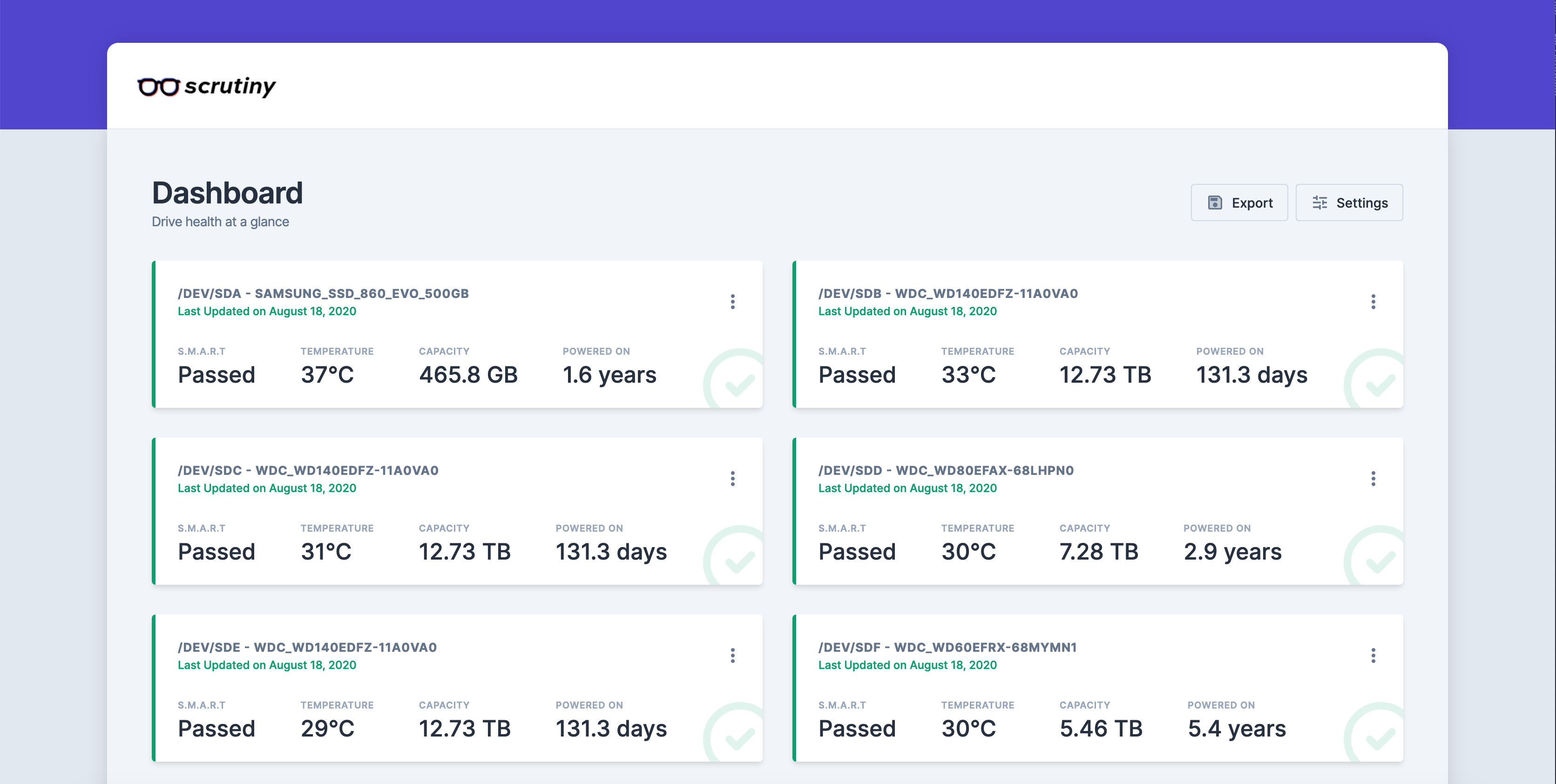
What is Scrutiny?
Scrutiny puts a web dashboard on top of the smartd/smartctl tooling you already know, combining vendor S.M.A.R.T attributes with real-world failure statistics so you can spot a drive that is about to fail instead of one that already died. It auto-detects disks with smartctl --scan, follows attribute history and temperatures over time, and surfaces critical metrics first in the UI. RAID controllers handled by smartctl work automatically, and detection quirks can be corrected in the collector config (for example forcing a device type or ignoring a disk). Collection runs on a cron-like schedule (daily at midnight by default) and can also be triggered by hand. Impending drive failures and collector errors raise alerts through many notification backends such as email, webhooks, Discord, Slack, Telegram or ntfy. Deployment options are a single all-in-one Docker image with an embedded InfluxDB, a hub/spoke layout with dedicated InfluxDB, web and per-host collector containers, or a manual binary install paired with a systemd timer. The project describes itself as a work-in-progress with rough edges, and hard-drive performance testing is still on the roadmap.
Scrutiny alternatives
 nas-doctorSelf-hosted NAS monitoring with SMART health, Docker, ZFS, UPS tracking, service checks, and Prometheus metrics — runs on Unraid, TrueNAS, Synology, Proxmox, Kubernetes.Comparenas-doctor with Scrutiny
 zpulseA self-hosted monitor that pushes drive health, ZFS state, and I/O metrics from many machines to a central web dashboard via WebSocket, with Gotify notifications.Comparezpulse with Scrutiny
 vigilVigil is a self-hosted terminal dashboard for Raspberry Pi that collects metrics, stores them in SQLite, and sends alerts via Discord, webhooks, or ntfy.sh.Comparevigil with Scrutiny
 lab-dashSelf-hosted dashboard for managing homelab applications with customizable grid layout, service health checks, and PWA support.Comparelab-dash with Scrutiny
 simonSimon is a self-hosted, open-source system monitor in Rust with real-time metrics, Docker monitoring, file browser, and alerting via webhooks — all in a single binary.Comparesimon with Scrutiny
 PulseOpen-source, self-hosted ops dashboard for Proxmox, Docker, Kubernetes, vSphere and TrueNAS, with buffered alerts, metric history and scheduled AI patrols.ComparePulse with Scrutiny
 NetProbe_PythonA containerized network monitor that checks connectivity, DNS response times, and bandwidth, then shows results in a dark-themed web dashboard with historical graphs.CompareNetProbe_Python with Scrutiny
 checkmateSelf-hosted, open-source uptime and infrastructure monitor: HTTP, ping, DNS, Docker and gRPC checks with incidents, status pages and Slack or email alerts.Comparecheckmate with Scrutiny
Should you self-host Scrutiny?
Scrutiny scores 68/100 on selfhost.directory (how scoring works) and ranks #24 of 105 in Monitoring & observability. It has 8 417 GitHub stars, +131 in the last 30 days.
It shipped 12 stable releases in the past year. The latest, v0.10.0, came out on 1 November 2026. New versions land roughly every 4 days.
Setup is moderate: expect some configuration beyond a single command. An official Docker image is available. It is MIT-licensed and written mostly in Go.
Its closest alternative on selfhost.directory is prometheus (92/100, 67 605 stars). It scores higher overall, so compare the two before you pick. See Scrutiny vs prometheus side by side.
Features
- Alerting / notifications
- Automatic drive detection
- Historical S.M.A.R.T trend tracking
- Hub/spoke distributed collection
- Manual trigger of collector run
- RAID / virtual drive support
- Real-world failure thresholds
- REST API
- Scheduled collection
- Smartd/smartctl integration
- Temperature tracking
- Web UI dashboard
Scrutiny README


More in Homelab
 SuggestArrSelf-hosted, open-source automation that turns Plex, Jellyfin or Emby watch history into TMDb or LLM suggestions and files requests in Jellyseerr or Overseerr.
 TailOpsMCPSelf-hosted MCP gateway centralizing infrastructure management via AI assistants with Tailscale security and capability-based authorization.
 timenestOpen-source, self-hosted Time Capsule replacement for Raspberry Pi and Linux servers. Gives Macs automatic Bonjour discovery, per-user quotas, and a web dashboard.
 tsbridgeA self-hosted reverse proxy using Tailscale's tsnet to expose many services on a Tailnet from one process, configured via TOML or Docker labels.
 unifi-gatewaySelf-hosted Python daemon emulating a Ubiquiti UGW3 gateway so non-Ubiquiti routers appear in UniFi Controller with full network topology.
 unraid-config-guardianSelf-hosted open-source tool that backs up Unraid containers, settings, and plugins — generating templates, compose files, and a restore script for flash drive recovery.
 WatchYourLANSelf-hosted, open-source LAN IP scanner in Go: inventories devices via arp-scan, tracks online/offline history, alerts on new hosts; exports to InfluxDB2 or Prometheus.
 WebSSHSelf-hosted SSH/SFTP browser workspace with multi-user terminals, split panes, file transfers, and optional Passkeys/OIDC/LDAP. Deploy via Docker on your infrastructure.
 yantrYantr is a self-hosted homelab app store running as a rootless Podman container alongside your Linux OS — no appliance, no root daemon, ~140 MB RAM at idle.
 ZoraxyOpen-source reverse proxy manager for self-hosted services, with a web UI, ACME TLS, TCP/UDP forwarding, an uptime monitor and a built-in SSH terminal.
 Ansible-NASSelf-hosted Ansible playbook for building homelabs or NAS replacements on Ubuntu Server 22.04 LTS. Installs over 50 preconfigured applications using Docker.
 atlasOpen-source, self-hosted network scanner that discovers Docker containers and subnet hosts, then maps them in an interactive React dashboard.
0 comments