
Self-host openlit
openlit-2.1.1Agent observability, evals and guardrails on OpenTelemetry
helm install openlit openlit/openlit- Stars
- 3 072
- Ports
- 3000 (OpenLIT web UI and API), 4317 (OTLP gRPC receiver), 4318 (OTLP HTTP receiver)
- Requires
- ClickHouse
ghcr.io/openlit/openlit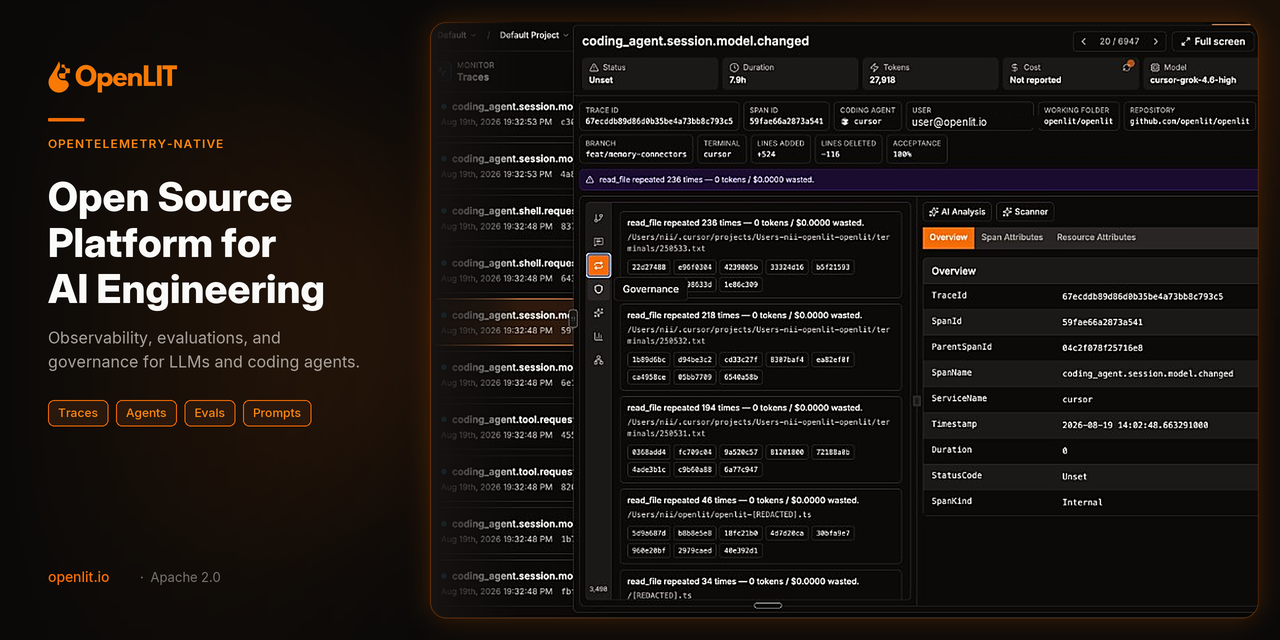
What is openlit?
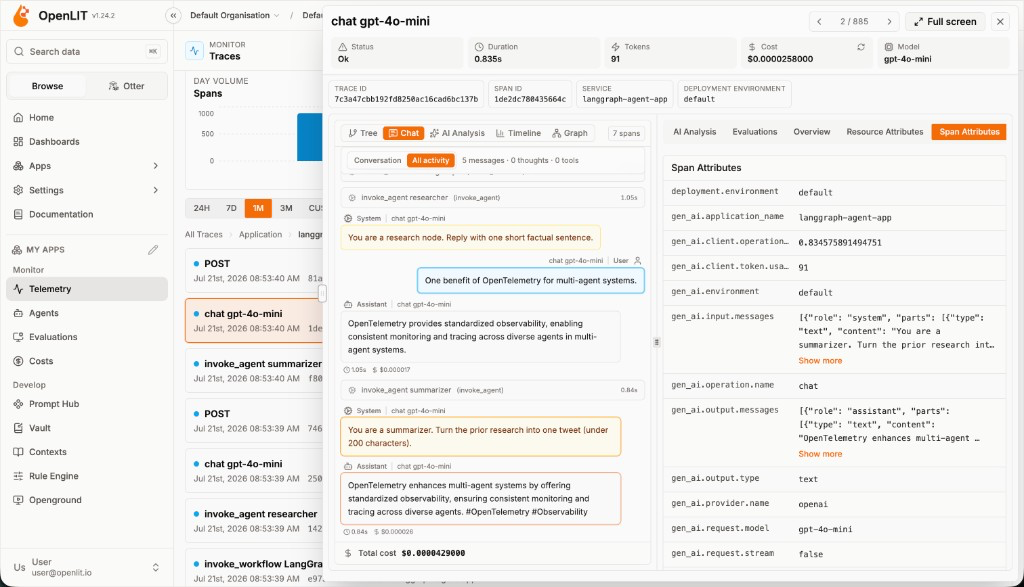
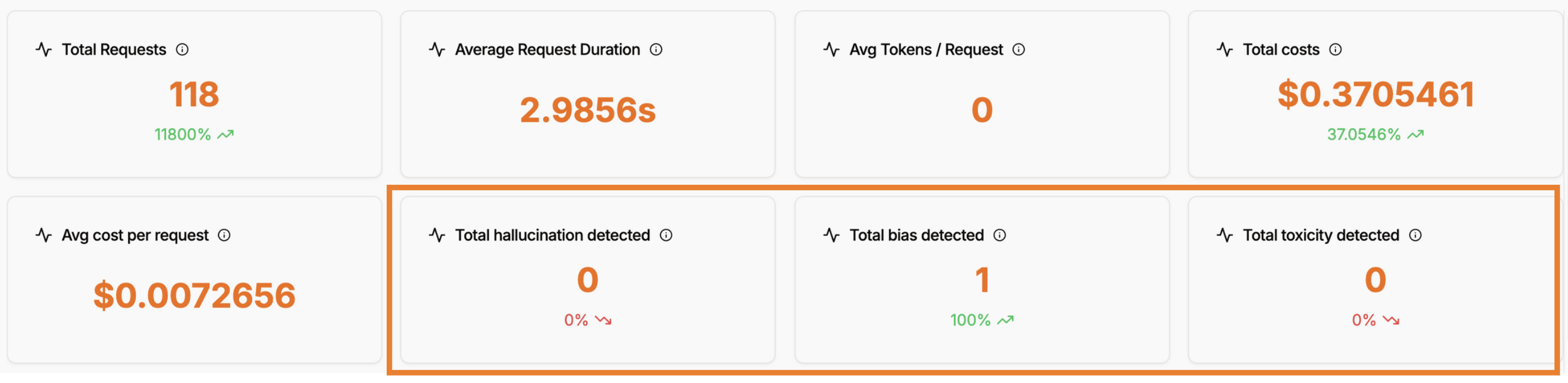
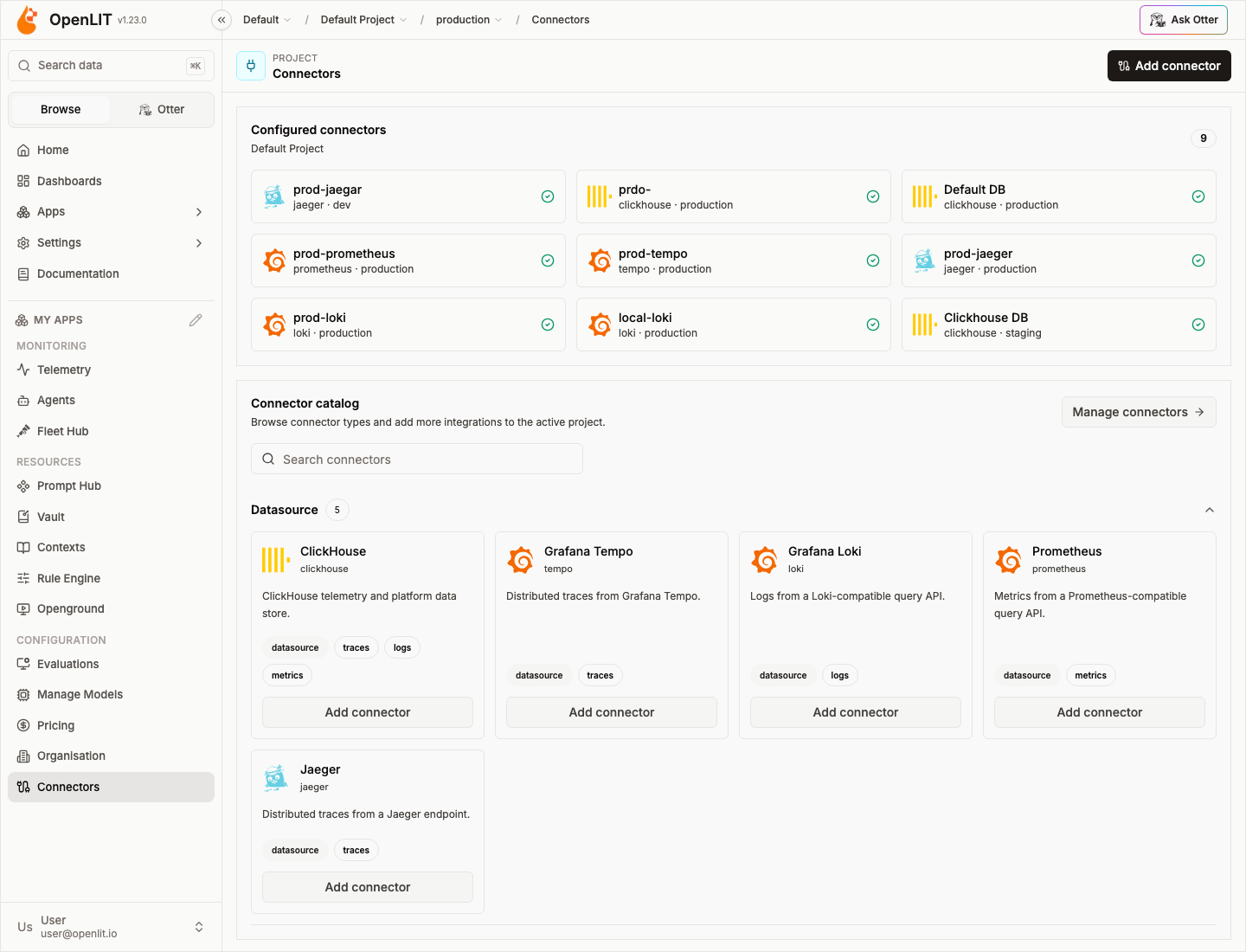
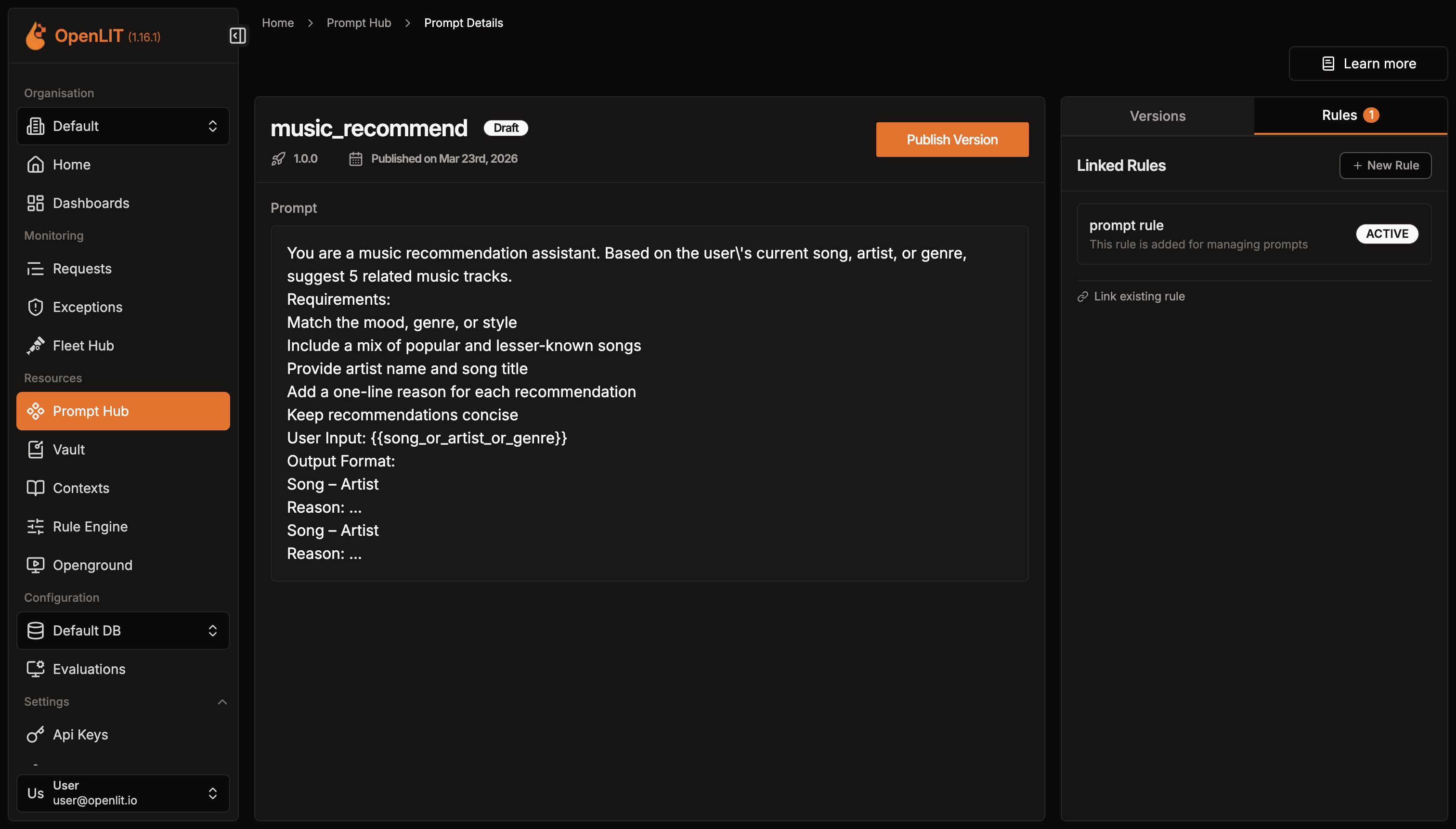
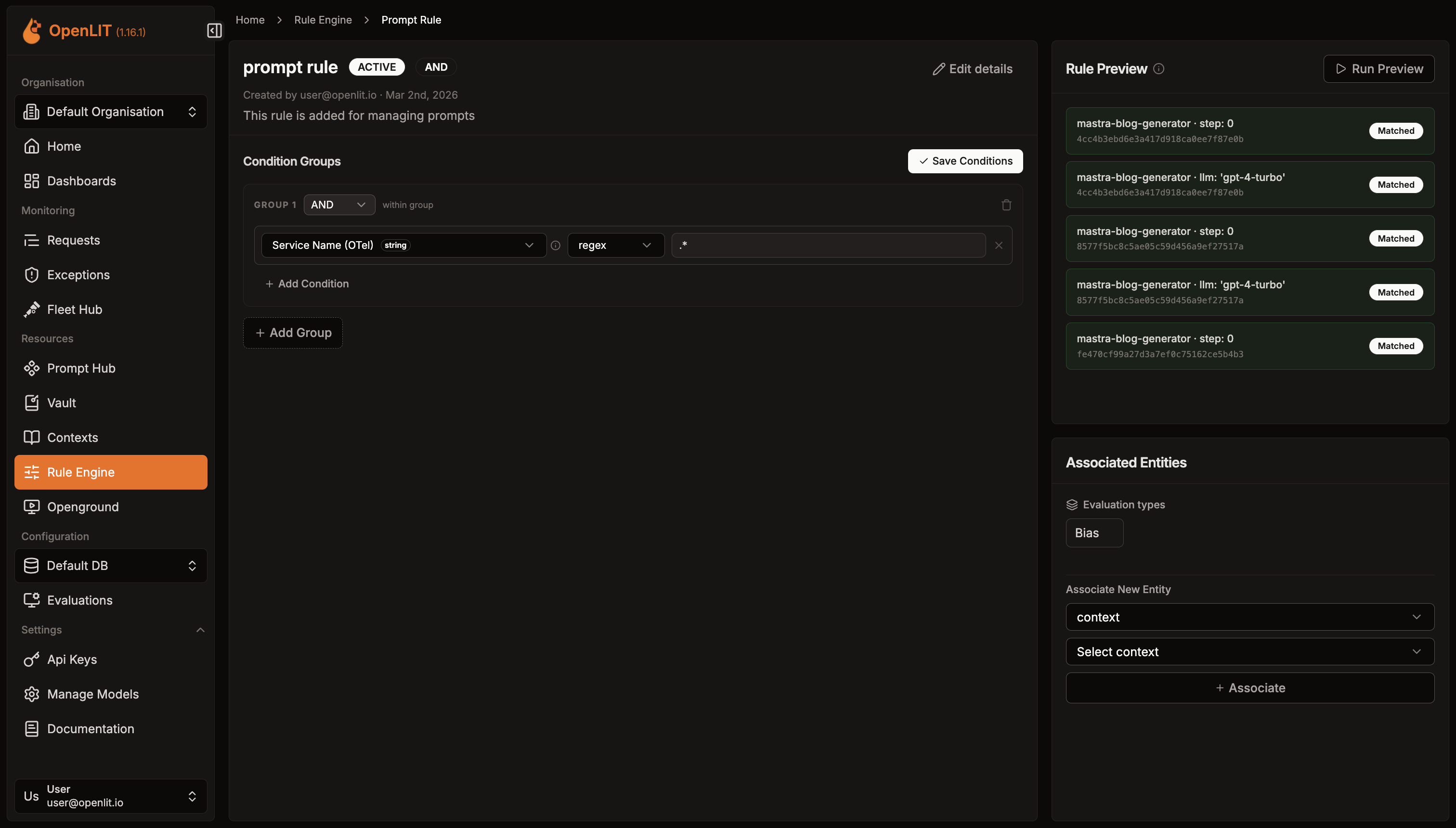
OpenLIT is an open-source platform for the parts of an AI agent that surround the model: tools, prompts, context, guardrails and feedback loops. A first-party OTLP receiver inside the OpenLIT container ingests OpenTelemetry traces, metrics and logs into ClickHouse, and the web dashboard offers agent and coding-agent session tracing, exception monitoring, custom dashboards, and spend tracking by model, provider, user, agent or environment. It also runs automated evaluations (LLM-as-a-judge on live traces, plus a programmatic API for CI regression tests), runtime guardrails against prompt injection and sensitive topics, a versioned Prompt Hub with a rule engine and context store, a multi-provider prompt/model comparison playground called OpenGround, a Vault for LLM API keys, a built-in AI copilot named Otter, and an OpenTelemetry GPU collector for NVIDIA, AMD and Intel cards; Python and TypeScript SDKs auto-instrument 70+ providers, frameworks and vector databases. Self-hosting means running the openlit image next to ClickHouse with Docker Compose or the project's Helm chart; the web interface uses the default 3000 port, the OTLP endpoints use the standard gRPC and HTTP ports, and sign-in is built-in email/password or Google/GitHub OAuth. The Apache-2.0 community edition costs nothing to run and ships without a license key or caps, while governance extras like audit logs, alerts and custom roles belong to OpenLIT Enterprise; anonymous usage telemetry is on by default and can be turned off with TELEMETRY_ENABLED=false.
openlit alternatives
 helixHelix gives each AI coding agent its own GPU desktop, orchestrating fleets on a spec-driven Kanban board with human PR review. Self-hosted on Docker, Kubernetes, Mac.Comparehelix with openlit
 open-managed-agentsSelf-hosted open-source agent platform managing sessions, execution, recovery. Supports any model, harness, sandbox via Docker, Node.js, Fly.io, Cloudflare.Compareopen-managed-agents with openlit
 litellmSelf-hosted gateway unifying 100+ LLM providers under one OpenAI-compatible API with usage tracking, safety controls, and admin console.Comparelitellm with openlit
 hearthSelf-hosted observability dashboard for home AI clusters monitoring vLLM, llama.cpp, SGLang, Ollama, LiteLLM with real metrics and training observability.Comparehearth with openlit
 openclaw-command-centerSelf-hosted, open-source dashboard for OpenClaw AI agents — real-time sessions, LLM costs, system vitals, cron jobs in a lightweight Node.js server with dark mode.Compareopenclaw-command-center with openlit
 opentraceOpenTrace is a self-hosted, open-source observability server that lets AI coding assistants query production logs, errors, and database metrics directly via MCP.Compareopentrace with openlit
 OpenBotEnterprise AI agent platform on your infrastructure. Any AG-UI agent as coworker with company knowledge and computer use. Data in PostgreSQL; models yours to choose.CompareOpenBot with openlit
 Limelit OpenOpen-source, self-hosted AI visibility tracker for seven answer engines with built-in MCP server for AI assistants.CompareLimelit Open with openlit
Should you self-host openlit?
openlit scores 67/100 on selfhost.directory (how scoring works) and ranks #2 of 2 in LLMOps. It has 3 072 GitHub stars, +235 in the last 30 days.
It shipped 26 stable releases in the past year. The latest, otel-gpu-collector-1.0.0, came out on 13 October 2026. New versions land roughly every 2 days.
Setup is moderate: expect some configuration beyond a single command. An official Docker image is available. It is Apache-2.0-licensed and written mostly in Typescript.
Its closest alternative on selfhost.directory is arize-phoenix (74/100, 12 280 stars). It scores higher overall, so compare the two before you pick. See openlit vs arize-phoenix side by side.
Features
- Built-in AI copilot
- Coding agent monitoring
- Custom dashboards
- GPU Monitoring
- Guardrails
- LLM & agent observability
- LLM-as-a-judge evaluations
- LLM Cost Tracking
- Model comparison playground
- Multi-tenancy
- OpenTelemetry-native tracing
- Prompt Management
- REST API
- Rule Engine
- Secret vault
openlit README

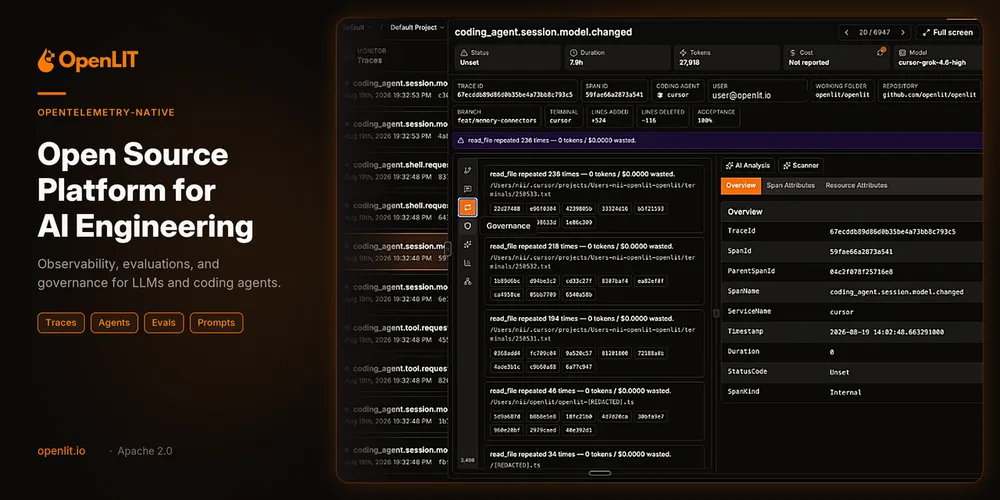
Trace, evaluate, guard, and improve AI agents and coding agents with OpenTelemetry. Agent observability · Evals · Guardrails · Prompt management · Cost & GPU monitoring · Self-host free (Apache 2.0)
Website · Documentation · Quickstart · Compare · Join Slack
OpenLIT is an open-source agent harness engineering platform. It gives teams OpenTelemetry-native tracing, evaluations, guardrails, prompt and context management, and cost and GPU monitoring for the harness around their AI agents and coding agents, so every agent failure can be traced, scored, and turned into a harness fix. OpenLIT is free to self-host under Apache 2.0 and works with any model, framework, or harness: Claude Code, Codex, Cursor, OpenAI Agents SDK, LangGraph, CrewAI, and 70+ more integrations.
FAQ
Is OpenLIT free to self-host?
Yes; the Apache-2.0 community edition is free with no license key or usage limits, though a few governance features (custom roles, audit logs, alerts) are part of OpenLIT Enterprise.
What do I need to self-host OpenLIT?
Docker with Docker Compose for the quickest path, or a Kubernetes cluster with Helm; either way it deploys OpenLIT (dashboard + OTLP receiver) plus ClickHouse.
Can OpenLIT send data to my existing observability stack?
Yes; being OpenTelemetry-native, it can export traces and metrics to Grafana, Datadog, New Relic, SigNoz or any OTLP-compatible backend.
Does OpenLIT require code changes to instrument my app?
No; the SDK auto-instruments 70+ LLMs, agent frameworks and vector databases with zero code changes, or you can call openlit.init() once for manual control.
Is OpenLIT open source?
Yes, fully open source under Apache 2.0 and self-hostable via Docker Compose or Helm, so telemetry and prompts stay on your infrastructure.
What is an agent harness?
Everything in an AI agent except the model — tools, context, prompts, memory, hooks, guardrails and feedback loops; Claude Code, Codex, LangGraph or CrewAI are harnesses OpenLIT observes and improves.
What is OpenLIT?
It is an open-source agent harness engineering platform providing OpenTelemetry-native tracing, evaluations, guardrails, prompt management and cost/GPU monitoring for AI and coding agents, free to self-host under Apache 2.0.
More in LLMOps
 SuperAGIOpen-source, self-hosted framework for building, deploying and running autonomous AI agents, with a web GUI, action console, toolkits and multiple vector databases.
 TraceloopOpen-source observability for your GenAI or LLM application, based on OpenTelemetry
 arize-phoenixSelf-hosted AI observability for LLM apps: OTLP tracing, LLM-as-judge evals, datasets, experiments, and a prompt playground, run via pip, Docker, or Kubernetes.
 bishengAn Apache-2.0, self-hosted LLM devops platform for enterprise AI: GenAI workflows, RAG knowledge bases, agents, model management, evaluation, SFT and OCR.
 FastChatSelf-hosted, open-source LLM serving platform: run open chat models behind a Gradio web UI, a CLI, or an OpenAI-compatible REST API.
0 comments