
Self-host Manifest
manifest@6.29.2Open-source LLM gateway for routing AI agent traffic
docker run -d -p 2099:2099 -e DATABASE_URL=postgresql://user:pass@host:5432/manifest -e BETTER_AUTH_SECRET=$(openssl rand -hex 32) -e BETTER_AUTH_URL=http://localhost:2099 manifestdotbuild/manifest- Stars
- 7 639
- Port
- 2099 (Web dashboard and OpenAI-compatible API (container listener; host binding defaults to 127.0.0.1))
- Requires
- PostgreSQL
manifestdotbuild/manifest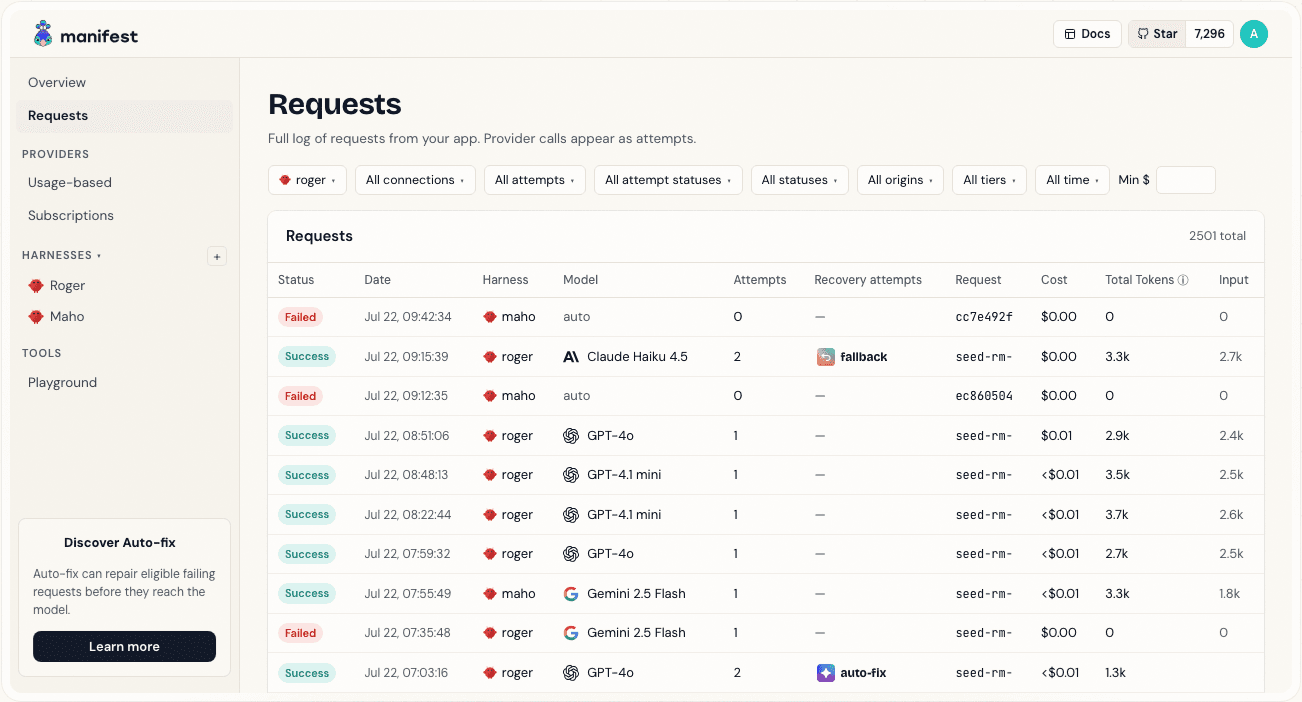
What is Manifest?
An open-source router for large-language-model traffic, Manifest sits between your AI agents and every model provider you use. It exposes one OpenAI-compatible endpoint backed by roughly 35 built-in provider connections covering 300+ models: bring-your-own API keys, existing paid subscriptions (ChatGPT, Claude, Grok and others), local servers such as Ollama, LM Studio or llama.cpp, plus custom endpoints speaking OpenAI- or Anthropic-style APIs. Requests sent with "model": "auto" are dispatched by configurable routing rules, and traffic falls over to a backup provider when one fails. An optional Autofix layer repairs malformed requests in flight; it is disabled per agent by default in self-hosted installs and calls Manifest's hosted healing service. The web dashboard records the complete body of every request and response, breaks spending down per agent, key and provider, and supports budget alerts and email notifications; a CLI and a remote MCP server endpoint are also available. Self-hosting runs through an install script or a Docker Compose stack (app container plus PostgreSQL) serving the UI on port 2099, where the first account created becomes the admin; the code carries the MIT licence. A managed cloud (free tier, then a $19/month Pro plan) and an Enterprise tier adding SSO/SAML, audit logs and support contracts exist alongside it.
Should you self-host Manifest?
Manifest scores 68/100 on selfhost.directory (how scoring works) and ranks #3 of 7 in LLM Integration. It has 7 639 GitHub stars, +62 in the last 30 days.
It shipped 61 stable releases in the past year. The latest, manifest@6.29.2, came out on 17 November 2026. New versions land roughly every 2 days.
Setup is easy: most people get it running in one sitting. An official Docker image is available. It is MIT-licensed and written mostly in Typescript.
Its closest alternative on selfhost.directory is OmniRoute (89/100, 88 213 stars). It scores higher overall, so compare the two before you pick. See Manifest vs OmniRoute side by side.
Features
- Admin Dashboard
- Autofix request self-healingOff by default per agent in self-hosted; when enabled it sends scrubbed failed request bodies to Manifest's hosted healing service.
- Automatic model fallbacks
- Bring-your-own API key
- CLI
- Cost tracking and budget alerts
- Custom provider endpoints
- Custom routing rules
- Full request/response body logs
- Local model routing
- OpenAI-compatible API endpoint
- Per-agent API keys
- Remote MCP server
- Reuse paid model subscriptions
- Visual model parameter setup
Manifest README

AI Agents that don't break
FAQ
Do you take a cut of our token spend?
No — Manifest does not charge a margin on your provider token spend.
What does Enterprise add over Pro?
Pro is a single-user cloud plan, while Enterprise targets teams with seats and roles, SSO/SAML, audit logs, custom retention and an uptime SLA.
Can you deploy and run Manifest for us?
Yes, on the Enterprise plan: the team helps with the initial deployment in your infrastructure and stays reachable on Slack for upgrades and incidents.
More in LLM Integration
 MarpUISelf-hosted, open-source web app for authoring MARP markdown slide decks: Monaco editor, live preview, speaker notes, mermaid diagrams, and HTML/PDF/PPTX export.
 mcpoA self-hosted, open-source proxy that turns any MCP server into an OpenAPI-compatible HTTP endpoint, with API-key access, generated docs and OAuth 2.1.
 mcp-searxngOpen-source MCP server that adds privacy-focused web search and URL reading to AI clients like Claude and Cursor through a self-hosted SearXNG instance.
 memory-osSelf-hosted, open-source memory stack for Hermes Agent: seven layers adding Qdrant vector search, SQLite fact storage with trust scores, and automatic context injection.
 MetorialOpen-source MCP gateway and access layer linking AI agents to 1200+ integrations with OAuth, RBAC, SAML SSO and audit logs; self-hosted via the Platform repo.
 morphicSelf-hosted, open-source AI search engine that streams cited answers as generative UI, with Docker Compose bundling PostgreSQL, Redis and SearXNG.
 next-ai-draw-ioOpen-source, self-hosted draw.io canvas where an AI turns chat prompts into diagrams you can edit, version and export, across 25 model providers.
 nexus-gatewaySelf-hosted open-source AI gateway intercepting LLM traffic at SDK, network, and OS layers with compliance, routing across 20+ providers, caching, quotas, and audit.
 NoteDiscoverySelf-hosted, open-source Markdown knowledge base: wikilinks, backlinks, graph view, tags, templates, LaTeX, Mermaid, drawing editor, MCP AI access. One Docker container.
 OllamaUIOllama UI is a self-hosted, open-source web interface for exploring, pulling, and managing Ollama models with chat, tool calling, and Telegram bridge.
 Onyx Community EditionOpen-source, self-hosted AI enterprise search and chat: connectors index 50+ apps with permissions, then RAG search, custom agents and LLM chat run on any provider.
 open-assistant-apiOpen-source, self-hosted AI assistant API compatible with OpenAI Assistants API. Supports RAG, web search, tools, multimodal, streaming — deployable via Docker Compose.
0 comments