
Self-host gitbucket
4.48.0Scala-built Git forge with GitHub API compatibility
docker run -d -p 8080:8080 ghcr.io/gitbucket/gitbucket- Stars
- 9 420
- Ports
- 8080 (Web UI / HTTP connector of the standalone server), 8443 (HTTPS connector when the https connector is enabled), 29418 (SSH access to Git repositories (opt-in in system settings))
ghcr.io/gitbucket/gitbucket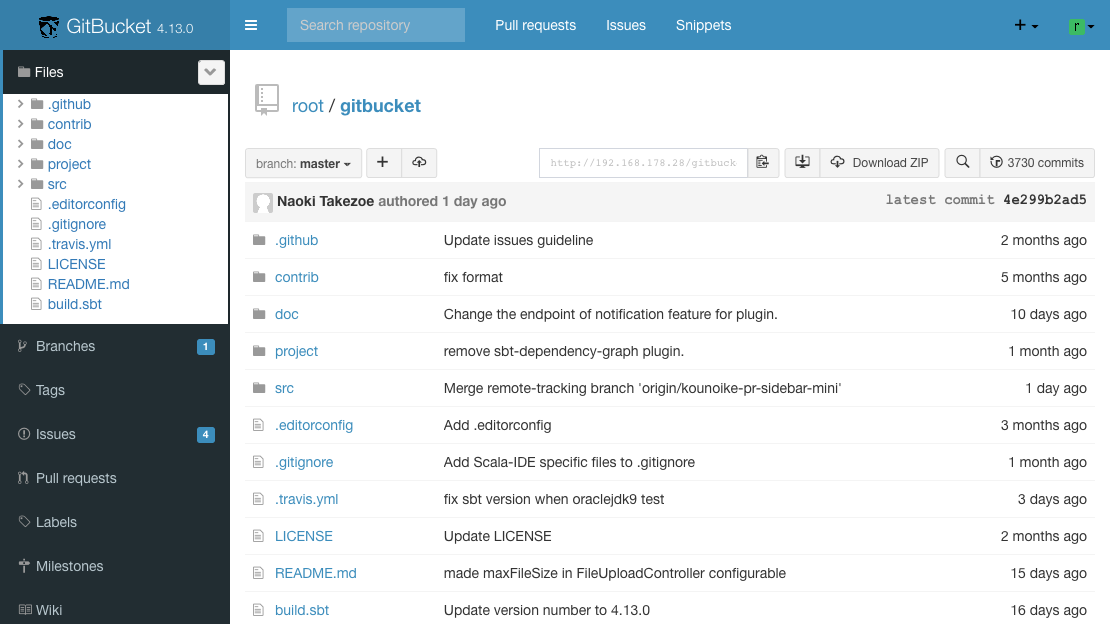

What is gitbucket?
GitBucket is an open-source, GitHub-style git forge written in Scala that runs on the JVM. It hosts public and private repositories over HTTP(S) and SSH, and wraps them with the usual collaboration layer: issues, pull requests with branch protection, wikis, an in-browser file editor, an activity timeline and email notifications. Accounts and groups are managed in the app, and the login form can be wired to LDAP directories or OpenID Connect providers. Its REST API and webhooks follow GitHub's formats, so tooling written for GitHub can often be pointed at a GitBucket instance instead, although the wiki warns that only a subset of the GitHub API and webhook payload is implemented. Extra functionality comes from a plugin system, with official plugins for gists, emoji reactions, pages sites and notifications. Running it yourself is intentionally minimal: fetch the war file and start it with Java 17 on port 8080, deploy it into a Servlet 3.0 container such as Tomcat, or use the official container image; everything (config, database, git repos, plugins) lives in one data directory that is also the backup unit. An embedded H2 database is the default, with MySQL 5.7+ and PostgreSQL 14+ as optional external backends configured in database.conf. Releases stay frequent — 4.48.0 shipped in September 2026 — but 4.47/4.48 include large migrations of core tables, so backing up before upgrading is strongly advised, and the Jakarta EE servlet stack is not supported yet.
gitbucket alternatives
 GitWitGitWit is a self-hosted, open-source AI coding platform with a browser-based IDE, live preview, AI chat, and support for Anthropic, OpenAI, and AWS Bedrock.CompareGitWit with gitbucket
 GiteaGitea is a self-hosted, open-source Git platform with code hosting, CI/CD, package registries, issues, and project management — a lightweight GitHub alternative.CompareGitea with gitbucket
 GitLab-CESelf-hosted, open-source DevOps platform for Git repositories, merge requests, CI/CD pipelines, issue boards and wikis, with free CE and paid Premium/Ultimate tiers.CompareGitLab-CE with gitbucket
 GogsA lightweight, open-source, self-hosted Git service written in Go: repos, issues, pull requests, wikis and LDAP login, run from one binary or a Docker image.CompareGogs with gitbucket
 SafebucketSafebucket is a self-hosted, open-source file sharing platform where uploads/downloads bypass the server via presigned URLs to S3-compatible storage.CompareSafebucket with gitbucket
 git-confedSelf-hosted web tool that scans folders for Git repos and applies shared config blocks (user, remotes) to multiple repos via a Bootstrap UI.Comparegit-confed with gitbucket
 folderhostA self-hosted, open-source cloud platform offering file sharing, real-time collaboration, and user management in a ~19MB binary as a lightweight Nextcloud alternativeComparefolderhost with gitbucket
 openchangelogOpenchangelog transforms Markdown changelogs into a beautiful website with search, password protection, themes, RSS, and GitHub/GitLab/Forgejo/local integrations.Compareopenchangelog with gitbucket
Should you self-host gitbucket?
gitbucket scores 67/100 on selfhost.directory (how scoring works) and ranks #6 of 15 in Code Hosting. It has 9 420 GitHub stars, +18 in the last 30 days.
It shipped 6 stable releases in the past year. The latest, 4.48.0, came out on 20 September 2026. New versions land roughly every 6 weeks.
Setup is easy: most people get it running in one sitting. An official Docker image is available. It is Apache-2.0-licensed and written mostly in Scala.
Its closest alternative on selfhost.directory is Gitea (89/100, 59 080 stars). It scores higher overall, so compare the two before you pick. See gitbucket vs Gitea side by side.
Features
- Activity timelineCan be turned off with --disable_news_feed when running several servers.
- Branch protection
- Email notifications
- GitHub-compatible REST APIA subset of the GitHub API is implemented.
- Git LFS Support
- Group accounts
- Issue Tracking
- LDAP Authentication
- Online file editor
- OpenID Connect login
- Plugin System
- Public/private Git repositories over HTTP and SSH
- Pull Requests
- WebhooksPayloads aim at GitHub compatibility; GitBucket does not fully implement the GitHub webhook.
- Wiki
gitbucket README

FAQ
How to contribute to GitBucket?
Help is wanted for documentation and wiki text, answering issues, and contributions that follow the project's contributing guidelines and issue/PR templates.
How to backup GitBucket data?
Stop GitBucket and copy the GITBUCKET_HOME directory (~/.gitbucket by default) elsewhere; the wiki has a dedicated backup page for more advanced cases.
gitbucket-gist-plugin doesn't work after upgrading to GitBucket 4.x
A gist plugin installed under GitBucket 3.x keeps an old version row; update that row in the database, restart GitBucket and the plugin migrates to a 4.x-compatible version.
What's limitation of password?
Local passwords may only use alphanumeric characters plus "-", "_" and "."; the docs point users who need stronger credentials to external authorization such as LDAP.
More in Code Hosting
- GiteaGitea is a self-hosted, open-source Git platform with code hosting, CI/CD, package registries, issues, and project management — a lightweight GitHub alternative.
- GitLabSelf-hosted, open-core DevOps platform: Git repositories, merge requests, CI/CD pipelines, issue boards, wikis and an integrated container registry in one install.
- GitLab-CESelf-hosted, open-source DevOps platform for Git repositories, merge requests, CI/CD pipelines, issue boards and wikis, with free CE and paid Premium/Ultimate tiers.
 GitnessAn open-source, self-hosted DevOps platform combining Git code hosting, CI/CD pipelines, Gitspaces dev environments and artifact registries in one Docker container.
 GitusGitus is a self-hosted, open-source Git forge in Go with no JavaScript, featuring a web installer, SSH access, issues, pull requests, and experimental webhooks.
- GogsA lightweight, open-source, self-hosted Git service written in Go: repos, issues, pull requests, wikis and LDAP login, run from one binary or a Docker image.
 harnessSelf-hosted, open-source DevOps platform: Git hosting with pull requests, CI/CD pipelines, Gitspaces dev environments, and Docker and Helm artifact registries.
 legitOpen-source, self-hosted browsing UI for Git repos, built in Go: serves bare repositories from a folder with custom templates, README rendering and HTTP cloning.
 OneDevOneDev is a powerful and simple DevOps platform that integrates Git server, Kanban, CI/CD, and package registries into a seamless experience.
- PagurePagure is a lightweight, git-centered forge for hosting projects with documentation, ticketing, and pull-request mechanisms.
 rgitSelf-hosted, open-source Git web interface in Rust using RocksDB caching and gitoxide for fast browsing with dark mode.
- RhodeCodeRhodeCode is an open-source, self-hosted platform for unified repository management, supporting Git, Mercurial, and Subversion. It provides enterprise-grade security, code review, workflow automation, and permission management for teams.
0 comments