
Self-host faas
0.27.13Serverless functions and microservices on Kubernetes
curl -SLsf https://get.arkade.dev/ | sudo sh- Stars
- 26 254
- Port
- 8080 (Gateway service: REST API, web portal and /function routes (chart default NodePort is 31112, commonly reached with kubectl port-forward 8080:8080))
- Requires
- Kubernetes
ghcr.io/openfaas/gateway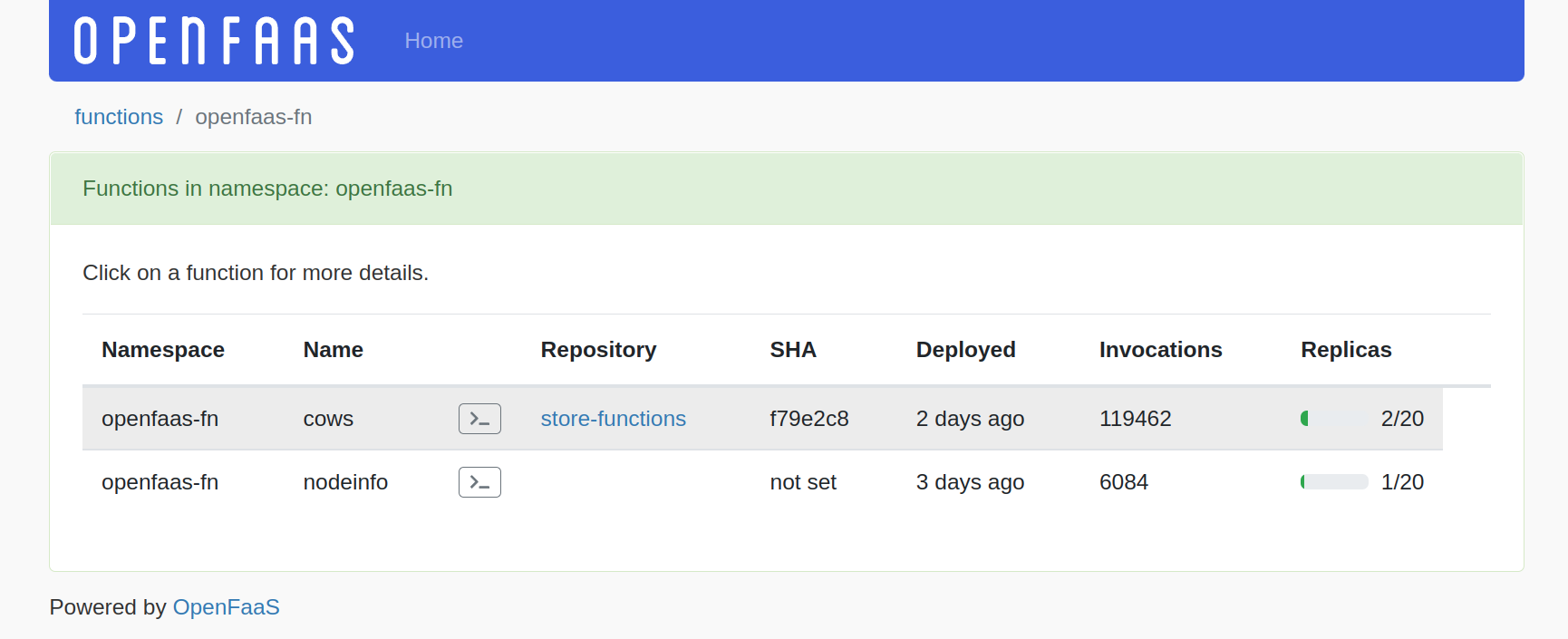
What is faas?
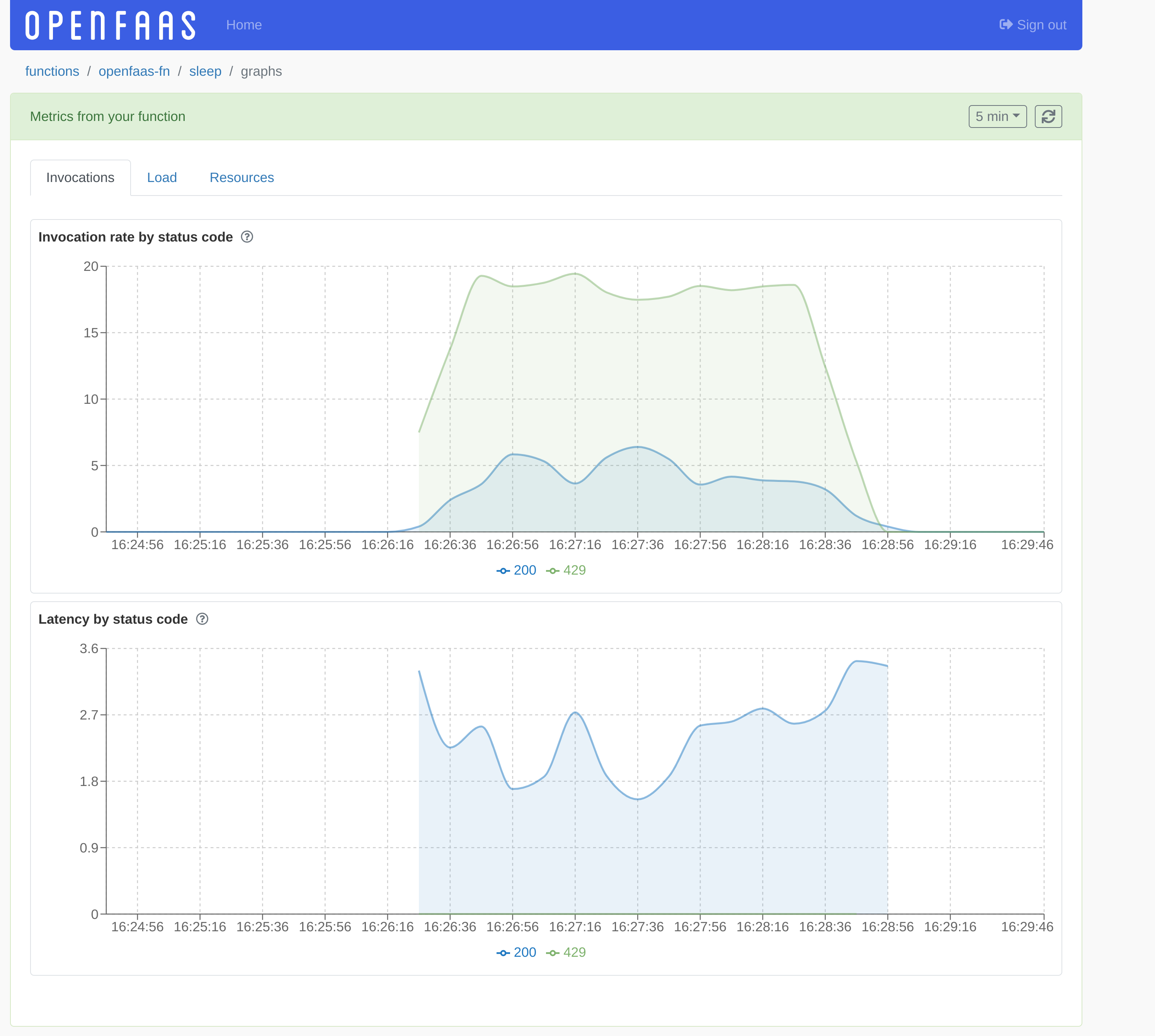
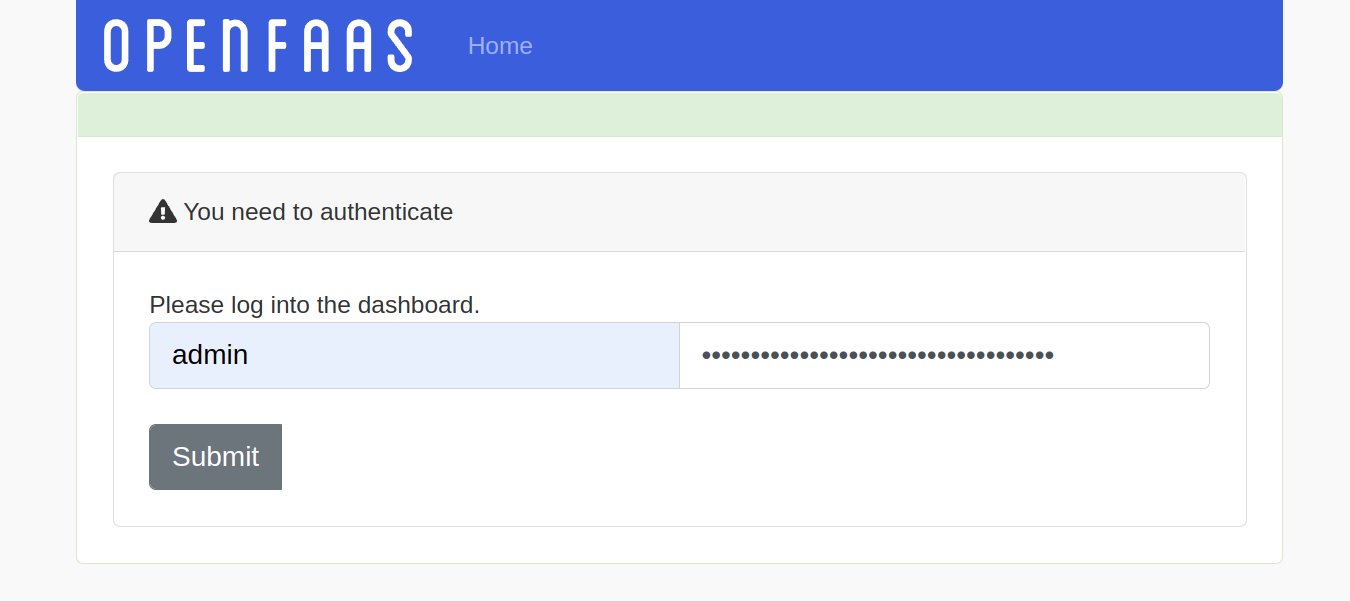
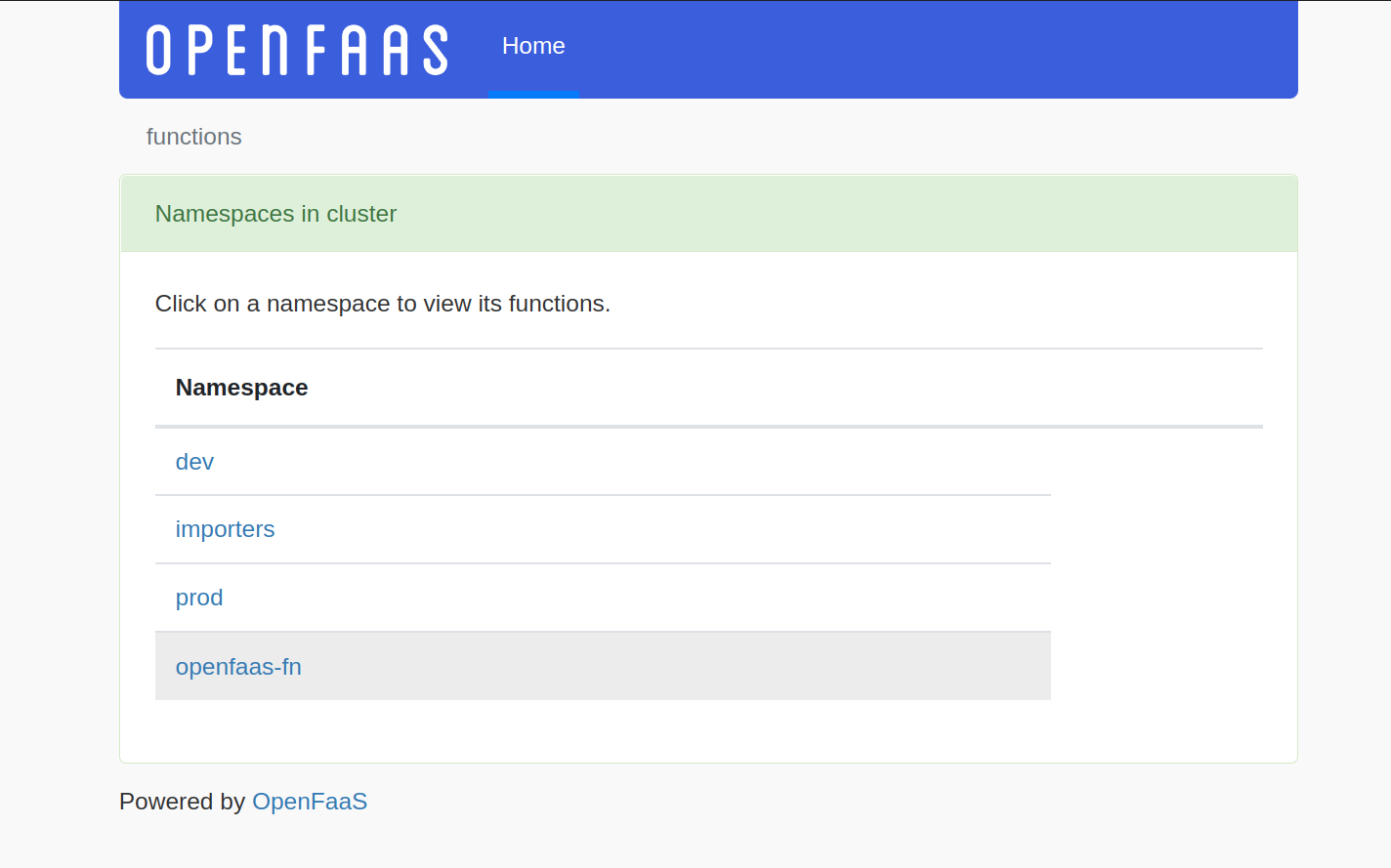
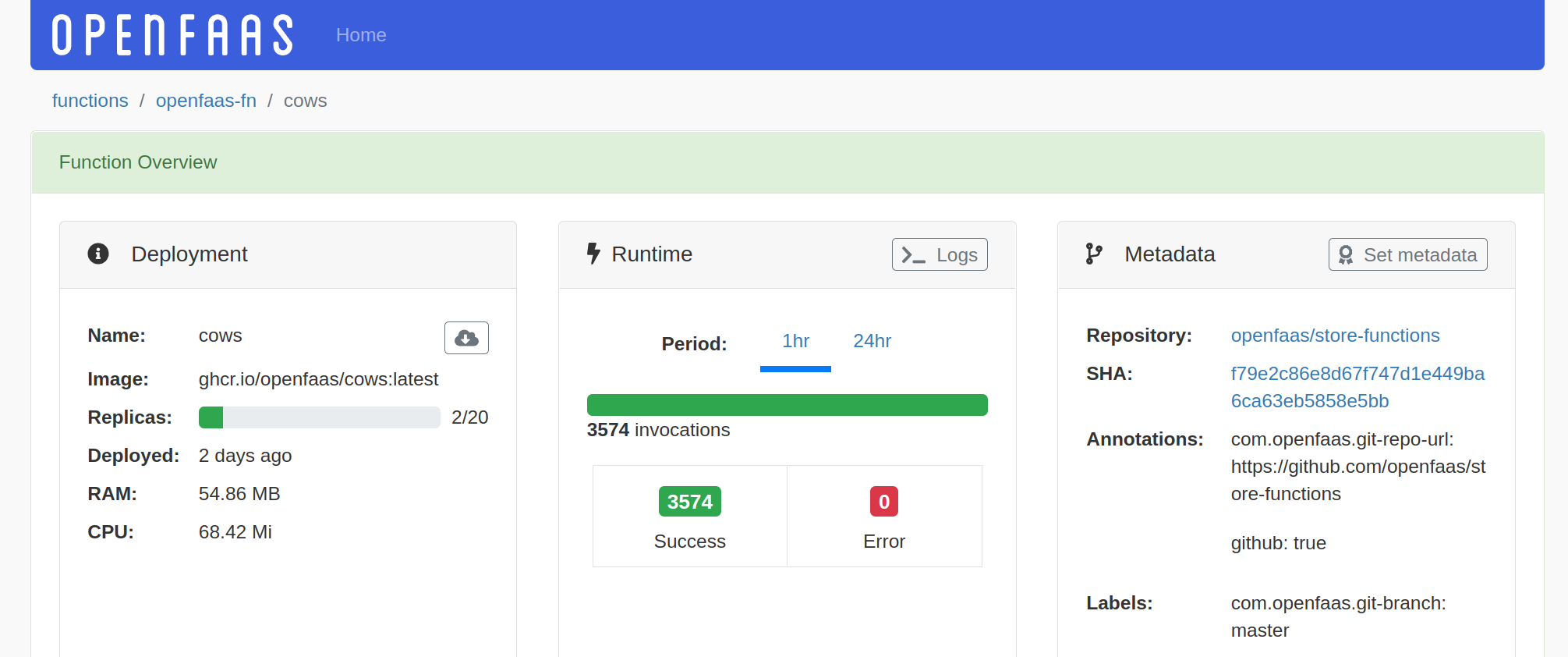
OpenFaaS is a serverless platform for developers who want to publish event-driven functions or existing microservices as containers without hand-writing Kubernetes manifests: your code, or a pre-built binary, is packaged into an OCI image and gets an endpoint with metrics and scaling. The Community Edition held in this repository is the gateway, which serves the REST API, the browser portal and the /function routes, plus queue-based async invocation with an optional callback URL. You define functions in YAML and drive them with the companion faas-cli, scaffolding from language templates (Python, Java, Go and Node.js among them, or your own Dockerfile) or deploying ready-made code from the built-in store. Metrics come from a bundled Prometheus, and a bundled NATS-based queue backs asynchronous work; both arrive with the Helm chart. Event connectors exist for Kafka, AWS SQS/SNS, Google Pub/Sub, RabbitMQ, Postgres and MQTT, but they, along with scale to zero, the modern dashboard, RBAC, OIDC single sign-on, private image registries and offline installs, are part of the paid Standard and Enterprise editions. Running it yourself means an existing Kubernetes cluster (or OpenShift, with the same chart): install with arkade install openfaas-ce or plain helm, port-forward the gateway on 8080, then log in as admin with the generated basic-auth password. Caveats worth knowing: the CE tier is capped at 15 functions in a single namespace with scaling up to five replicas, its portal is a legacy UI under code freeze, the cluster must have unrestricted Internet access, commercial use is limited to 60 days under the OpenFaaS CE EULA, and day-to-day product work happens in OpenFaaS Ltd's private repositories.
faas alternatives
 swiftwaveSwiftWave: self-hosted open source PaaS for deploying apps on any server. Alternative to Heroku/Netlify/Render with 1GB RAM min and integrated app store.Compareswiftwave with faas
 kiteSelf-hosted, open-source Kubernetes workspace for multi-cluster management: RBAC, LDAP/OAuth login, Prometheus monitoring, Helm, audit logs, and an AI assistant.Comparekite with faas
 corootSelf-hosted, open-source APM and observability platform where eBPF agents capture every telemetry signal without code changes, with service maps and SLO alerting.Comparecoroot with faas
 Versity S3 GatewayVersityGW is an open-source, Apache-2.0 S3 object-storage gateway in Go: it turns POSIX filesystems, ScoutFS or Azure Blob into an S3 API, with IAM, WebUI and Helm.CompareVersity S3 Gateway with faas
 OpenshipSelf-hosted open-source PaaS: hand it a repo, a folder or an artifact and it detects your stack, builds it, then serves it on your domain with free certificates.CompareOpenship with faas
 openrunA self-hosted GitOps platform that deploys web apps to Docker or Kubernetes using declarative config, with built-in SSO, RBAC, and database bindings.Compareopenrun with faas
 AppwriteThe open-source cloud for agents & devs. Including Auth, Databases, Storage, Functions, Messaging, Hosting, Realtime, WAF and moreCompareAppwrite with faas
 KuberoOpen-source, self-hosted PaaS for Kubernetes: deploy containers or source with 160+ app templates, CI/CD pipelines and GitOps review apps, run by a UI plus operator.CompareKubero with faas
Should you self-host faas?
faas scores 67/100 on selfhost.directory (how scoring works) and ranks #2 of 7 in Serverless. It has 26 254 GitHub stars, +4 in the last 30 days.
It shipped 1 stable release in the past year. The latest, 0.27.14, came out on 2 July 2026.
Setup is advanced: plan for several services and some ongoing maintenance. An official Docker image is available. It is MIT-licensed and written mostly in Go.
Its closest alternative on selfhost.directory is trigger (76/100, 16 730 stars). It scores higher overall, so compare the two before you pick. See faas vs trigger side by side.
Features
- Async invocation and background processing
- Auto ScalingCE: Basic autoscaling up to 5/5 replicas. RPS/Capacity/CPU/RAM/custom rules are Pro features.
- CLIProvided by the companion faas-cli project.
- Custom domains per function
- Event-driven triggersCE lists the cron trigger only; Kafka, RabbitMQ, GCP Pub/Sub, Postgres and AWS SNS/SQS connectors are Pro.
- Function store
- Language templates
- Metrics and observability
- OCI image packaging
- REST API
- Scale to ZeroCommercial editions only (Standard and above); CE does not include the autoscaler.
- Single sign-on with OIDCOpenFaaS for Enterprises tier only (the oidcAuthPlugin chart component is Pro/Enterprise).
faas README

OpenFaaS® makes it easy for developers to deploy event-driven functions and microservices to Kubernetes without repetitive, boiler-plate coding. Package your code or an existing binary in an OCI-compatible image to get a highly scalable endpoint with auto-scaling and metrics.
More in Serverless
 FaastaSelf-hosted FaaS for Rust WASIp3 components in Wasmtime with swappable SQL, KV, and blob storage backends.
 open-computeSelf-hosted platform running Cloudflare Workers apps on your hardware via a single Rust binary with 99% API compatibility.
 openwhiskSelf-hosted, open-source serverless FaaS platform: Actions run on events via Triggers, with sequences, a package catalog and the wsk CLI. Installs on Kubernetes via Helm.
 self-workerdself-workerd is an open-source, self-hosted FaaS platform on Cloudflare's workerd runtime with a publisher API and isolated worker instances, deployable via Docker.
 trusted-cgiSelf-hosted serverless functions engine via CGI. Single binary, no deps, with scheduling, queues, and token security for hobby projects.
 vorkerVorker is a self-hosted serverless platform for running Cloudflare Worker-compatible functions on your own infrastructure using workerd with a web UI.
 beamA self-hostable, open-source platform for running serverless AI workloads with GPU inference, code sandboxes, and background task queues.
0 comments