
Self-host EverShop
v2.3.0TypeScript ecommerce platform with React and GraphQL APIs
- Stars
- 10 541
- CPU
- 2 cores
- RAM
- 2 GB
- Storage
- 10 GB available disk space
- Port
- 3000 (HTTP server for storefront and admin panel)
- Requires
- PostgreSQL
evershop/evershop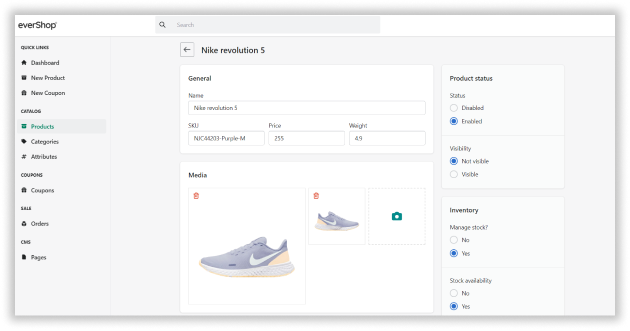

What is EverShop?
EverShop is an open-source, TypeScript-first ecommerce platform built on Node.js, pairing a server-side-rendered React storefront with both GraphQL and REST APIs. It targets developers who want a modular shop they can extend instead of a closed SaaS. Bundled core modules cover catalog (products, categories, attributes, collections, search, recommendations), cart and checkout, customer accounts, order management with multi-shipment fulfillment, promotions and coupons, shipping zones and rates, taxes, CMS pages, a visual page builder for widgets, and a blog. Gateways for Stripe, PayPal and cash on delivery ship as built-in modules, and media can live on local disk or on cloud object storage (S3, Azure blobs, Google buckets) without any extension; S3-compatible services like MinIO, Cloudflare R2 or DigitalOcean Spaces work through a custom endpoint. The React admin panel is extensible via themes and extensions, and a marketplace offers additional modules. Self-host it with npx create-evershop-app, by installing the @evershop/evershop npm package and running setup/build/start scripts, or with the provided Docker Compose file; it needs a persistent Node.js server plus PostgreSQL 13 or newer, so serverless platforms are not supported. The project states its public Docker image is meant for local use only and recommends building your own image for production. Licensed GPL-3.0 and actively released (v2.3.0, October 2026); a hosted EverShop Cloud is announced but listed as coming soon.
EverShop alternatives
 OpenCartSelf-hosted, open-source PHP ecommerce platform: run your own online store with multi-store admin, unlimited products, payment and shipping modules.CompareOpenCart with EverShop
 VendureOpen-source headless commerce platform built with TypeScript, NestJS, React, and GraphQLCompareVendure with EverShop
 Shopware Community EditionShopware is a self-hosted, open-source e-commerce platform on Symfony and Vue.js with API-first architecture and plugin ecosystem.CompareShopware Community Edition with EverShop
 yournextstoreOpen-source Next.js storefront template for Your Next Store: self-hosted commerce UI with Stripe checkout and a typed Commerce SDK, backed by the hosted YNS API.Compareyournextstore with EverShop
 SaleorSelf-hosted open-source headless commerce platform with native GraphQL API. Replaces Shopify and Magento by offering API-first extensibility.CompareSaleor with EverShop
 nopcommerceSelf-hosted, open-source ASP.NET Core shopping cart for building online stores; runs on Windows, Linux or Mac with SQL Server, MySQL or PostgreSQL.Comparenopcommerce with EverShop
 mycartmyCart is a self-hosted, open-source shopping cart in a single Go binary with SQLite/PostgreSQL, admin dashboard, and Stripe, PayPal, SpectroCoin, Coinbase payments.Comparemycart with EverShop
 Ever GauzySelf-hosted open-source ERP/CRM/HRM/ATS/PM platform with time tracking, invoicing, project management, employee monitoring, and desktop apps for Windows, Mac, and Linux.CompareEver Gauzy with EverShop
Should you self-host EverShop?
EverShop scores 70/100 on selfhost.directory (how scoring works) and ranks #8 of 27 in E-commerce. It has 10 541 GitHub stars, +41 in the last 30 days.
It shipped 6 stable releases in the past year. The latest, v2.3.0, came out on 8 October 2026. New versions land roughly every 2 months.
Setup is moderate: expect some configuration beyond a single command. An official Docker image is available. It is GPL-3.0-licensed and written mostly in Typescript.
Its closest alternative on selfhost.directory is MedusaJs (83/100, 37 126 stars). It scores higher overall, so compare the two before you pick. See EverShop vs MedusaJs side by side.
Features
- Admin Panel
- Blog
- CMS pages & widgets
- Customer Accounts
- GraphQL API
- Multi-language stores
- Order Management
- Page builder
- Payment gateway integrations
- Product catalog management
- Promotions & discounts
- REST API
- Shopping cart & checkout
- Tax Management
- Webhooks
EverShop README

How to install EverShop
Install EverShop with Docker Compose
DB_HOST, DB_PORT, DB_USER, DB_PASSWORD, DB_NAMEcurl -sSL https://raw.githubusercontent.com/evershopcommerce/evershop/main/docker-compose.yml > docker-compose.yml docker compose up -d
Starts the app plus a PostgreSQL 16 service; site at localhost:3000, admin at localhost:3000/admin. The project states the public image is for local environments only; production should build its own image.
How to configure EverShop
DB_HOSTPostgreSQL connection hostDB_PORTPostgreSQL connection portDB_USERPostgreSQL connection userDB_PASSWORDPostgreSQL connection passwordDB_NAMEPostgreSQL database name
EverShop releases & version history
AI summary Added webhooks, country-aware addresses, unified payment flow, redesigned emails, media l…
A feature release on top of v2.2.2: outbound webhooks, a country-aware address system, a unified payment capture/void/refund flow with a rebuilt PayPal integration, redesigned transactional emails, a media library, and storefront building blocks for theme authors. It includes everything in v2.2.2 (a start-up fix and several security fixes).
This release contains breaking changes and 6 new database migrations, one of which renames address columns. Please read Breaking Changes and Upgrade Notes before upgrading. If you upgrade from v2.2.1 or earlier, also read the Upgrade Notes of v2.2.2 below.
Highlights
- Webhooks — a new
webhookmodule: send signed events to up to 10 HTTPS endpoints, with retries and a delivery log. - Address Format Registry — country-aware address forms, validation, storage and display, driven by one format record per country.
- Unified payments — one capture / void / refund flow for every payment method, and a rebuilt PayPal integration (webhook, refunds, reconciliation).
- Emails — a shared email layout, plus new refund and cancellation emails, in 17 languages.
- Media library — a paginated, redesigned file browser with rename and paste-to-upload.
- Theme building blocks —
layouts.json, storefront pages split into movable blocks, shared widget typography hooks, theme assets and seed content.
Breaking Changes
Four changes that also affect you when upgrading from v2.2.1 shipped in v2.2.2 and are described there: raw SQL needs sql(), getContextValue(...) takes data literals only, Query.order(uuid) needs proven access, and API route middleware is authenticated.
- Address columns were renamed (Address Format Registry). On
customer_address,cart_addressandorder_address:full_name→recipient,address_1→address_line_1,address_2→address_line_2,city→locality,province→administrative_area,postcode→postal_code; seven nullable columns were added (organization,address_line_3,dependent_locality,sorting_code,given_name,family_name,extra).tax_rate.province/postcodebecameadministrative_area/postal_code, andshipping_zone_provincebecameshipping_zone_region. The migrations rename only (no row is rewritten), but v2.2.1 and v2.2.2 code do not work with the new schema: they still start, but every address reads back empty. The GraphQLAddresstypes and the address REST payloads changed with them, and thetypes/customerAddressandlib/locale/countriesmodules were removed (use@evershop/evershop/lib/address:getCountries,getCountryName,isKnownCountryand the address types). Custom SQL, extensions and themes that read the old names must be updated. A script that reverses the address renames only is in the repository atscripts/address-formats/rollback-schema.sql. - Payment capture and refund routes were replaced by one contract. Removed:
POST /api/stripe/paymentIntents/capture,POST /api/stripe/paymentIntents/refund,POST /api/cod/captures,POST /api/paypal/authorizations/capture,POST /api/paypal/authorizedTransactions,POST /api/paypal/captureTransactionsand the PayPal refund route, together with the per-method admin buttons. UsePOST /api/orders/:id/captureandPOST /api/orders/:id/refunds(admin only); the order page shows generic Capture and Refund buttons. Payment methods now declare optionalcapture,voidandrefundhandlers inregisterPaymentMethod. Cash on Delivery orders get their owncod_*statuses, and a migration moves existing awaiting-payment COD orders frompendingtocod_pendingand records an offlineauthorizetransaction for them. The order status no longer changes. - PayPal return page renamed:
/paypal/proccessingis now/paypal/processing(no alias). - Storefront pages are now a shell plus blocks. The product, category, cart, checkout, account, order list, blog and search pages keep only the query, the provider and the Areas; every piece is its own page component that registers into a slot at its old position, so the default markup is unchanged. A theme that forked
ProductView.tsx,CategoryView.tsx,ProductSingleForm.tsx,ShoppingCart.tsx,Checkout.tsx,MyAccount.tsx,OrderList.tsx, a blog page shell orSearchPage.tsxmust delete the inline pieces from its copy, or the page renders them twice. - Public
?limit=is capped atsystem.max_collection_size(default 200, the largest admin grid option). - Fresh installs no longer create sample data. The install migration no longer creates the Men / Women / Kids categories or the Color and Size attributes with their options. Existing stores keep what they have. Themes supply their own catalogue through
themes/<id>/seed/*.json, read only byevershop seed. sanitize-htmlwas replaced byxssfor rich text. The allow-list is the same; serialization differs cosmetically (<br>instead of<br />), andstylevalues containingurl(javascript:)orexpression()are now dropped. Code that importedsanitize-htmlthrough EverShop must declare it itself.- Prices and dates follow the active locale (the request locale, then the Store Setting language, then
shop.language). Admin pages format in the admin language.
New Features
Webhooks (new webhook core module)
- Admin → Settings → Webhooks: up to 10 webhooks, each with an HTTPS URL, a signing secret and a list of events (21 event topics, grouped in the form). Includes a test event, a delivery list with filters, a payload viewer and Retry.
- Delivery is write-first: a
webhook_deliveryrow is stored, sent, and retried from that row (after 1, 5, 30 and 120 minutes, 5 attempts). The row is both the retry queue and the admin log. Delivery is at-least-once; a 2xx response within 10 seconds counts as success. Failed deliveries are kept 30 days; completed ones up towebhookLogLimit(default 100) per webhook. - Each request is signed:
X-EverShop-Signature: t=<unix>,v1=<HMAC-SHA256>over<timestamp>.<body>;X-EverShop-Deliverystays the same across retries.passwordis removed from payloads at any depth. - Only HTTPS and public addresses are allowed, checked at connect time. Set
system.webhook.allowPrivateNetworksto allow local receivers. - Extensions can add topics with
addProcessor('webhookTopics'). Translated into all 17 languages. - Event subscribers placed in
subscribers/_all/now receive every event, and every subscriber gets{ name, uuid }as an optional second argument. Delivery of ordinary subscribers is unchanged (at-most-once).
Address Format Registry
- One country format record (Google libaddressinput shape) now drives the storefront form, server validation, display, GraphQL, emails and every integration mapping. The checkout and the account address book use one schema-driven form with country-specific fields, region lists, telephone and postal patterns.
- Admin: Settings → Customer (name format, telephone, company, address lines, required fields, default country) and Sell to countries on Settings → Shipping, with a confirmation that lists shipping zones that would be left without a country.
- Shipment emails now print the delivery address.
- Public API for extensions:
@evershop/evershop/lib/address(patchAddressFormat,registerRegionProvider,registerAddressField,resolveAddressSchema,validateAddress,formatAddress,toIntegrationAddress). Registration is locked after bootstrap, like the other registries. - The package now ships a
NOTICEfile for the bundled address data (derived from Google's libaddressinput).
Payments
- Unified operations. Capture, void and refund are owned by core (
captureOrder,refundOrder) and work the same for every payment method. The order page buttons appear fromcanCapture/canRefund. Neworder_refundedandorder_canceledevents. - PayPal was rebuilt: payment is finalized in-process on the return page (the old HTTP call to the store's own URL failed behind a bot challenge or proxy), a verified webhook at
POST /api/paypal/webhook(set the webhook ID in the PayPal settings or insystem.paypal.webhookId), admin refunds with partial-refund tracking,paypal_pendingfor pending captures, idempotent transaction recording, current Orders v2 payloads with exact-amount breakdowns (including zero-decimal currencies), and a reconciliation cron (every 30 minutes,system.paypal.abandonedOrderTtlHours, default 6) that captures approved orders and cancels and restocks abandoned ones. When a buyer cancels at PayPal, the abandoned order is now cancelled and restocked before the cart is reactivated. - Stripe: the charge amount and currency come from the order instead of the browser, the webhook verifies them, locks the order row and handles
payment_intent.payment_failedandcharge.refunded. - Cash on Delivery is wired into the same contract with its own
cod_*statuses. - Order status changes are clamped instead of throwing on terminal or reverted states; shipments can be cancelled on refunded orders and cannot be created on terminal ones.
Transactional emails
- A shared layout (header and logo, content, footer; button, divider and items-table partials; a
{{t}}translation helper) now renders the order confirmation, welcome, reset password, shipment created and shipment delivered emails. - New emails: refund and cancellation, each switchable with
notification_emails.order_refunded/order_canceled(enabled,templatePath). - The email copy is translated into all 17 languages (machine-assisted; less common languages deserve a native-speaker review).
Media library and file browser
- The file browser is paginated for every storage provider (local, S3, Azure Blob, Google Cloud Storage) with cursors, so a folder with thousands of files no longer loads at once. Folders always load completely; listings now include size and type.
- Rename files (extension is preserved, an existing name is never overwritten), paste-to-upload, a details panel with the full URL, size and dimensions, loading skeletons, and a working scrollbar. A Media library entry joins the CMS menu.
- The configured upload types (System Setting → File Uploads: PDF, video, audio) are honoured by the browser; before, only images worked.
Storefront and catalog
- All products page at
/products, editable in the page builder, with sorting, filters, pagination, a category tree facet and an attribute facet. Included in the sitemap and offered in the link picker. The category filter now matches the whole subtree. - Virtual collections ("newest", "on sale", a category's products) for widgets and the page builder, so a new store's shelves are not empty.
- Product cards decide Add to Cart themselves: simple products get the button ("Sold out" when out of stock), products with variants get Select options, a link to the product page. The featured items, recommendation, collection spotlight and rich-text product widgets gain the button.
- Contact form widget with stored submissions: submissions are saved before the email is attempted, with an admin grid (unread / read / spam) and delete. The email outcome is recorded.
- Admin → landing pages: Replace homepage with a landing page, with an automatic disabled backup and a one-click restore.
- New
featured blogsfallback (newest posts when none are picked), a slideshow placeholder in the page builder, and the page builder shows a loading skeleton while a replaced image renders.
Theme development
themes/<id>/layouts.jsonmoves any storefront page component to another Area or sort order without forking the file. Hot reload in development; admin pages are never affected.- Theme
theme.jsoncan now ship landing pages, upload assets through the store's configured storage provider (theme-asset:<path>tokens) and reference products or collections by a stable key (store-ref:<entity>/<by>/<key>). - Shared widget classes
evershop-widget__eyebrow,__heading,__subtextand__item-headinglet one rule restyle every widget; vertical spacing is consistent. The Section widget follows the page column through--page-max-widthand--page-gutterand exposesdata-padding. evershop seedis re-runnable and theme-aware: widgets (--widgets), variant groups, category images and a theme's retired categories are handled idempotently, size can drive a variant like colour, and seeded images go through the configured storage provider. The footer copyright is now live (© <year> <store name>) when none is set.
Security
The fixes released in v2.2.2 are listed under that version. This release also fixes:
- A PayPal capture action that could be called without authentication using only an order UUID; the public PayPal capture and authorize routes were removed.
- The Stripe charge amount is now derived from the order, not from client data.
?limit=on public pages could request the whole catalog in one response (denial of service).
Performance
- The product listing COUNT query drops joins it does not need (about 50.7 ms → 26.5 ms on a 300,000-product catalog) and the category facet matches a subtree with one array parameter instead of a recursive subquery (about 79 ms → 2.5 ms). The store-wide attribute facet uses an EXISTS probe (about 48 ms → 2 ms on 1.2 million index rows).
- Rich text sanitizing no longer bundles
sanitize-htmlinto the storefront: about 200 KB less minified (67 KB gzipped). - Image and static-asset requests no longer create a session or send a
Set-Cookie, so CDNs can cache product images.
Bug Fixes
- The order confirmation email no longer prefixes the base URL onto absolute (S3 and other remote) thumbnail URLs.
og:imageURLs are correct for cloud storage.- Requests no longer hang when
NODE_ENVis neitherdevelopmentnorproduction, and local extensions no longer vanish in that case. - A widget with settings its GraphQL type does not accept no longer takes the whole page down with a 500: unknown keys are dropped with a warning, an unusable widget is left out of the page, and saving such settings is refused.
- Sorting on the product listing resets the page, and the direction toggle works on the default sort.
- Display locale for prices and dates comes from the active locale, not only
shop.language. - Page components are imported in Area
sortOrder, so the CSS cascade follows it (headings no longer lose their Tailwind base styles on the cart and checkout pages). - Menu items are keyed by their stored id (no duplicate React keys); the mobile menu stays inside the viewport; the header renders its Areas in source order (correct keyboard tab order).
- Product images default to
object-fit: cover, so photos are cropped rather than stretched. - Banner and slideshow buttons and headlines are legible over photographs; the split feature's vertical alignment works; call-to-action buttons share one height; either slideshow arrows field can hide the controls.
- The Section widget lines up with the page column and no longer causes sideways scrolling on Windows and Linux.
- The gallery slider and the variant selector work with other bundlers and with relative product URLs.
- The file browser opens above the page builder, and its clicks no longer close the settings drawer.
evershop buildno longer logs a database connection error (no database exists at build time).- Seeding no longer dies on the second page, re-uploads category images, or creates a category a theme meant to retire.
Developer Experience
- New
npm run compile:devcompiles in place without deletingdist/, so a running dev server keeps working.compile:tscnow copies the same non-source files ascompile. - Jest maps
@components/*to the compiled components and stubs stylesheet imports, so page components can be unit tested. - New regression tests guard failures that compile and pass CI: a comment inside
export const layout, a Node built-in reachable from a React component, and an API route that readsrequest.bodywithout body parsing. @evershop/postgres-query-builder2.1.0 addsSelectQuery.getJoins()andpruneUnreferencedLeftJoins().
Dependencies
- Added:
xss;jsdom(dev, for DOM component tests). - Removed:
sanitize-htmland@types/sanitize-html. - The
multer,sharp,axios,undiciand@evershop/postgres-query-builderupgrades, and the removal ofcypress, shipped in v2.2.2.
Upgrade Notes
- Back up your database. This release runs 6 new migrations:
checkout1.0.12,customer1.0.5 andtax1.0.1 (address columns, renames only),cod1.0.0 (moves awaiting-payment COD orders tocod_pending),cms1.5.0 (contact_submission) andwebhook1.0.0. They apply automatically on first start. After they run, do not start v2.2.1 or v2.2.2 against the database: it starts, but every address reads back empty. To go back, restore your backup. As an alternative, runscripts/address-formats/rollback-schema.sql(psql --single-transaction -f) while you redeploy the old release: it reverses the address renames and steps thecheckout,customerandtaxmigration records back, but it does not undo thecodstatus change (orders that were awaiting payment staycod_pending) or remove the new tables. - Update
@evershop/evershop, reinstall dependencies, runnpm run build. Use Node.js 20.9 or newer (required since v2.2.2). - Stripe: enable
payment_intent.succeeded,payment_intent.amount_capturable_updated,payment_intent.payment_failed,payment_intent.canceledandcharge.refundedon your webhook endpoint. - PayPal: create a webhook in the PayPal dashboard pointing at
/api/paypal/webhookand save its ID in the PayPal settings. Until then the endpoint answers 503 and the reconciliation cron is the only fallback. The oldpaypalWebhookSecretsetting is gone. - Review your shipping zones under Settings → Shipping. Provinces became regions, and Sell to countries limits which countries checkout accepts.
- If you use custom SQL, extensions or a theme: update address column names and the removed
types/customerAddressandlib/locale/countriesimports; replace calls to the removed payment routes withPOST /api/orders/:id/captureand/refunds; delete the inline pieces from forked page shells (see Breaking Changes). - Themes that depended on
order-firstto place the header's center Area: Areas now render left, center, right in the markup. Check your header. - Rich text is sanitized by
xss; check content that relied on<br />output or onsanitize-htmlbeing installed.
A patch for v2.2.1 that fixes a start-up failure on fresh installs and several security vulnerabilities. There are no database migrations and no new features. Upgrading promptly is recommended.
Fresh installs of v2.2.1 fail to start. The upload storage imported concat-stream, which was never declared and only arrived through multer 2.3.0 or older. multer 2.4.0 dropped it, and the ^2.2.0 range now resolves to 2.4.0, so the admin GraphQL schema fails to load at bootstrap. Stores that already have a lockfile with the older multer were not affected. On v2.2.1, npm install concat-stream is a workaround.
Security
- Order data exposure through the public GraphQL API (CVE-2025-12919, CWE-639, #881):
Query.order(uuid)returned name, email, phone, addresses, items and shipment tracking to anyone who knew an order UUID. - Authorization bypass (CWE-306 / CWE-863): an API route middleware that declared its own
afterlist (for example[bodyParser]saveGroup.js) could run before authentication. - SQL injection (CWE-89) through the query builder's raw-SQL escape hatch: a request body passed as a
.where()value could set{ isSQL: true }to inline unbound SQL. Fixed in@evershop/postgres-query-builder2.1.1. - Server-side code evaluation (CWE-95): the GraphQL query builder evaluated the decoded arguments of
getContextValue(...)tokens as JavaScript. - Dependencies: 53 of the 55 open high and critical alerts, including a
multerdenial of service andsharp/ libvips / libheif fixes.
Bug Fixes
- Fixed the fresh-install start-up failure described above. The upload storage now joins the chunks with
Buffer.concat, asmulter's own memory storage does, and still enforces the per-type size limit while the file streams.
Dependencies
- Upgraded:
multer^2.4.0,sharp0.33 → 0.35 (requires Node.js 20.9 or newer),axios^1.20.0,undici^7.30.0,@evershop/postgres-query-builder^2.1.1. - Removed:
cypress(dev; the end-to-end tests use Playwright).
Upgrade Notes
- Update
@evershop/evershop, reinstall dependencies and runnpm run build. Use Node.js 20.9 or newer. - Raw SQL in the query builder needs
sql(). A hand-written{ isSQL: true, value: '...' }object is now treated as an ordinary bound value. Replace such objects in extensions withsql('...'). getContextValue(...)in a route's GraphQLqueryorvariablestakes data literals only (strings, numbers, booleans,null, arrays and objects). An expression now throws instead of running.Query.order(uuid)returnsnullunless access is proven. An order is returned only to an admin, to the customer who owns it, or to a page that calledgrantOrderAccess(request, uuid, via)(exported from@evershop/evershop/oms/services). Core's checkout success page and the order tracking page already do. A custom page, theme or extension that readsorder(uuid)on its own must call it after checking access.- Authentication is now enforced on API route middleware that declares its own
afterlist. If a route middleware is ordered ahead of a pre-auth one, you now get an explicit error message instead of an opaque cycle error.
AI summary Drag-and-drop page builder and blog module added with security fixes
The largest EverShop release since 2.0. It consolidates the previously drafted-but-unpublished 2.1.3 work (React 19) with four months of development on top of v2.1.2: a visual page builder, a blog module, entity custom fields (metafields), a multi-language storefront with a translated admin, a rebuilt shipping and fulfillment stack, built-in cloud file storage, product recommendations, and a substantial security and performance pass.
31 database migrations across 10 modules run automatically on first start. Please read Breaking Changes and Upgrade Notes before upgrading. This release also contains fixes for several security vulnerabilities — upgrading promptly is recommended.
Highlights
- Visual Page Builder — drag-and-drop storefront editing with drafts, publish, and scheduled rollouts.
- Blog — a full blog module: posts, categories, tags, comments, storefront pages and widgets.
- Metafields — typed custom fields on products, categories, collections, customers, orders, and the shop itself, with theme provisioning.
- Admin translation — runtime-translated storefront and independently-translated admin (17 locales bundled).
- Shipping providers & multi-shipment — pluggable shipping providers, first-class shipments with per-shipment status, carrier/label integration, package management.
- Cloud file storage — S3, Azure Blob, and Google Cloud Storage built in, configured from the admin.
- Product recommendations — related products, frequently-bought-together, upsell and cart cross-sell shelves.
- React 19, per-IP rate limiting, sitemap.xml + robots.txt, landing pages, automatic URL redirects, and large-catalog performance fixes.
Breaking Changes
- Upgraded to React 19 (from React 17) (#863). The framework runs on React 19, and because EverShop resolves React through a single hoisted copy (webpack alias), every extension and theme now runs on React 19 as well. Update React-17-era code:
defaultPropson function components is removed — use ES default parameters (function C({ x = 1 })).- String refs,
findDOMNode, legacyReactDOM.render/ReactDOM.hydrate, and legacy context are removed — use callback/useRefrefs,createRoot/hydrateRoot, andcreateContext. - Do not call the translation helper
_()at module scope (top-levelconstarrays/objects): it freezes the translation at import time and causes an SSR/client hydration mismatch under React 19. Call_()inside the component (render time). - Read client-only state (e.g.
window.location) in auseEffect, not in auseStateinitializer, so the first client render matches the server. - See
specifications/react-19-upgrade.mdfor the full audit and migration detail.
react-toastifyremoved — toasts now usesonner. Extensions importingreact-toastifymust switch:import { toast } from 'sonner'(thetoast.*call surface is close to drop-in) and replace<ToastContainer/>with sonner's<Toaster/>.- Shipping is now provider-based (#929). The old flat zone → method → rate model was replaced by shipping providers. Existing zones, methods, and rates are migrated automatically into the built-in Core provider (
core_shipping_method,core_shipping_method_rate,shipping_zone_providertables); the legacy tables/columns are dropped at the end of the migration chain. Custom code that queried the legacy shipping tables, or extensions that added shipping methods directly, must move to the provider registry (which also supports live-quoted rates with per-provider timeouts). - Fulfillment is now multi-shipment.
order ↔ shipmentwent from 1:1 to one-to-many: each shipment carries its own item assignments and its own status, andorder.shipment_statusis an item-based rollup over physical items. The pre-shipped state was dropped — legacypending/processingshipment rows are collapsed toshippedand order rollups are backfilled by migration. Consumers of the shipment REST/GraphQL shapes must adapt. - Widget storage refactor. The
widgettable was renamed towidget_instance, and placement moved to awidget_placementtable with one row per (widget instance, route, area). Widget instances are now scoped to the theme they were created under. Any direct SQL or custom tooling against the oldwidgettable breaks; the admin UI, REST, and GraphQL surfaces are updated. - Branding and several config keys moved from
config.jsonto admin settings. The logo, favicon, social banner, and Google Analytics 4 ID are now managed under Store Setting → Branding; currency, display timezone, weight and dimension units under Store Setting; catalog, pricing, and tax options under their own settings pages; guest checkout under checkout settings. Legacy config values are still honored as fallbacks — exceptthemeConfig.logo, which was removed entirely: re-upload your logo in the admin after upgrading. category.include_in_navdropped. Storefront navigation is built with the menu widgets now (including the new footer menu widget), not by flagging categories. Rebuild your navigation with the menu widget if you relied on this column; GraphQL no longer exposesincludeInNav.url_rewrite.languagedropped. URLs are locale-agnostic: locale is expressed as a URL prefix (/de/<slug>), and the slug is shared across locales.node-cronupgraded 3 → 4. Verify customregisterJobschedule expressions against node-cron v4 semantics.--skip-minifyremoved (and thebuild-fastnpm script). Builds are always minified; overall build time was optimized instead (see Performance).- Removed the unused CKEditor packages (
@ckeditor/ckeditor5-build-classic,@ckeditor/ckeditor5-react).
New Features
Visual Page Builder (new pageBuilder core module)
A drag-and-drop visual editor for the storefront at /admin/page-builder:
- Edit any storefront route (plus CMS pages and landing pages) by composing widgets into the theme's areas, with layout-aware drag/drop and moves.
- Draft → publish workflow: changes accumulate in a per-admin, per-theme draft changeset with per-widget auto-save; publish immediately or schedule a rollout — rollout plans remain editable and cancelable until they run.
- Inline editing on the canvas: text and images can be edited in place; the image picker supports cloud storage.
- Layers panel, a "Globals" view for site-wide areas, a session/page picker (Homepage first), per-widget styling controls, and link fields that resolve products/categories/CMS pages/blog posts through a unified link resolver.
- Widget admin redesign to match: theme-scoped widget instances and a per-(route, area) placements model.
- Hardened in a dedicated security pass and covered by an e2e test suite.
Blog (new blog core module) (#285)
- Posts, categories, and tags with per-post SEO descriptions; comments and reactions.
- Storefront blog pages plus blog widgets for the page builder; Blog Home is available in the link picker with proper thumbnails.
Entity custom fields — metafields
- Typed metafield definitions (text, long text, rich text via the block editor, number, boolean, date, select, JSON/group, and list variants) attachable to products, categories, collections, customers, orders, and the shop.
- Values stored per entity (JSONB
meta_data), validated with AJV on write; admin editing cards on the relevant edit pages; audience-gated GraphQL exposure (customer-visible vs admin-only). - Theme integration: a theme can declare metafield definitions in
theme.json— they are provisioned at theme activation and on boot (with attribution and conflict reporting) — and render values with the new storefront<Metafield>component. - The footer copyright line is now a shop metafield, editable from the page builder.
Multi-language storefront & translated admin (#311)
- Runtime translation — no rebuild needed. Per-locale CSV dictionaries live in the project's
translations/folder; English is the source language. - Enabled storefront languages and the default language are admin settings. Non-default locales get URL prefixes (
/de/...) with canonical handling; REST APIs take anX-Localeheader. - The admin panel has its own language, independent of the storefront.
- Translations are bundled for 17 locales (de, el, es, fa, fr, hu, it, mn, nb, ne, nl, pt, ru, sr, ta, vi, zh).
Landing pages, root-level CMS URLs & automatic URL redirects
- Landing pages: standalone marketing pages whose body is built entirely in the page builder, served at root-level friendly URLs, with an admin grid, duplication, status/scheduling, and SEO fields. Landing pages win URL collisions deterministically.
- CMS pages moved to root-level URLs (
/<url_key>); old/page/<url_key>URLs permanently redirect (301). Existing pages are backfilled by migration. - Automatic URL redirects: renaming a product/category/CMS/landing-page slug now captures a redirect from the old path (302 via a new
url_redirecttable), with redirect-chain collapse and periodic cleanup — old links and bookmarks keep working.
Sitemap & robots.txt (#506)
- Auto-generated
/sitemap.xml(a sitemap index plus per-content-type children) covering products, categories, CMS pages, and landing pages, with a collector registry so extensions can add their own URL sources. - Multi-language stores get one entry per enabled locale with self-referential
hreflang+x-defaultalternates. - Regenerated by a cron every 30 minutes with cheap change-detection (skips writing when nothing changed); served statically.
- Dynamic
robots.txtwith an absoluteSitemap:line — overridable via a setting or by shipping a physicalpublic/robots.txt.
Shipping providers, multi-shipment & carrier integration (#929)
- Provider abstraction: shipping rates come from registered providers; the built-in Core provider reproduces the classic zone/method/rate setup (flat, percentage, price/weight-based rates, API-calculated rates). Extension providers can quote live rates with configurable timeouts.
- Multi-shipment: ship an order in several packages — each shipment has its own items, status, tracking, and (optionally) purchased label (
label_url/format persisted). Order-level shipment status rolls up from items; digital items are excluded. - Carrier registry: register carriers that create labels, generate tracking URLs, and push status updates back into EverShop; per-method default carrier and service code pre-select in the ship dialog; carrier tracking URLs from aggregators (Shippo/EasyPost/ShipStation-style) are persisted.
- Package management: admin-managed parcel sizes, product → package assignment, and dimension/weight snapshots that flow
cart_item→order_item→ carrier requests.
Cloud file storage: S3, Azure Blob & Google Cloud Storage
- The three providers are now built into core (previously separate extensions), selected and configured at runtime from a new System Setting page — no restart needed; credentials can also come from env/config, and secrets are masked in the admin.
- Fixes doc-verified defects of the old extensions along the way: regional S3 endpoints (plus custom endpoint / path-style for R2 and MinIO), correct Content-Type on upload, listing beyond 1,000 keys, Azure public-access handling, and URL encoding.
- The storage host is automatically allowed for the
/imagesoptimizer; deletes are idempotent across providers.
Product recommendations
- Related Products: rule-based (same category / same collection / same attribute values, with price band, priority ordering, and manual picks), configurable globally, per category, and per product.
- Frequently Bought Together: powered by co-purchase statistics (association confidence + lift with configurable thresholds), rebuilt nightly and on demand from order history. Also reaches the cart page: a widget aggregates co-purchase candidates across all cart items (per-pair gating, strongest-affinity ranking, in-cart items and their variants excluded), exposed as
Cart.crossSellProducts. - Upsell shelf: derived automatically from the related-products rules restricted to pricier products, exposed as
Product.upsellProducts— nothing extra to configure. - Three new page-builder widgets render the shelves on product pages with full status/stock/visibility gating and variant-group awareness; admin cards on product and category editing (modes, manual picks, computed-candidate previews); new REST endpoints for manual links and stats recompute; new GraphQL fields
Product.relatedProducts/Product.crossSellProducts.
Checkout
- Zero-total orders (100% discounts, free products) check out through an automatic "No payment required" method instead of erroring (#996).
- Guest checkout toggle — an admin setting; when off, checkout requires login (with redirect back). Defaults to allowed; the legacy
checkout.allowGuestCheckoutconfig is honored as fallback. - Mobile checkout: the order summary now comes first as a sticky, collapsible bar; shipping/payment/billing option cards are clickable across their whole surface.
- Fixed: shipping note not showing on checkout (#955); billing country missing/restricted for virtual products (#934).
Storefront theme refresh & UX
- The default frontStore theme was re-skinned, with aligned category-page filters and product counts, a constrained footer, and grid-safe no-image placeholders.
- Accessibility pass: product-card Add-to-Cart is reachable by keyboard and touch (not hover-only), field error messages are wired to inputs via
aria-describedby. - Unavailable variant options are disabled in the storefront selector (#964); storefront images are sized from the configured aspect ratio (less layout shift); slideshow slides size to their images with real mobile dimensions.
- Live SEO snippet preview on product and category editors.
- Product duplication (#276): duplicate from the product grid into a prefilled creation form (suffixed sku/url_key/name, collections copied,
product_duplicatedevent). - New footer menu widget; refined collection/blog/mosaic widget layout settings.
Platform & operations
- Per-IP rate limiting built in (#1001): pages ~300 req/min, APIs 120 req/min, and login/registration/password-reset 8 attempts per 15 minutes; static assets exempt. Honors
TRUST_PROXY_HOPSfor correct client IPs behind proxies (default: 1 hop). EVERSHOP_HOME_URLenvironment override for the public base URL, validated at boot (#960).- Theme content tooling: new
theme:status,theme:uninstall, andtheme:export-contentcommands; themes can ship installable content (theme.json) and serve their ownpublic/assets (#830, #845 — thanks @starry-osean).
Security
Upgrading is recommended — this release fixes:
- Unauthenticated SSRF, unauthenticated IDOR on customer endpoints, and stored XSS (CWE-918, CWE-639, CWE-79) (#928).
- Unauthenticated account takeover via missing authorization on the customer update endpoint (#952).
- A page-builder security hardening pass (URL/content validation in the editor pipeline).
- Brute-force / credential-stuffing exposure on auth endpoints (covered by the new rate limiter).
- All high-severity dependency alerts cleared (#937).
Performance
- Large-catalog fixes, found by load-testing a 500k-product catalog (#1004): indexed
url_rewrite.request_path(every storefront request resolves URLs against it), fixed a keyword-search query shape that bypassed the GIN index, and removed an O(n²) id-list query-building pattern that also hit the 65,535-parameter wire limit. - Build time significantly reduced (#967–#969); minification is always on.
- SSR render errors now return a 500 instead of hanging the request; GraphQL field errors return partial data instead of failing the page.
- Session-store and boot-path cleanups; the setting cache is warmed at boot for synchronous hot paths (pricing formatter, email helpers).
Bug Fixes
- Built-in
<Form>buttons no longer double-submit (every built-in form used to POST twice). - Google Analytics now loads in production builds.
- Fresh installs no longer log a red
relation "setting" does not existerror on first boot against an empty database. - Migration runner sorts versions by semver correctly (
1.0.10no longer runs before1.0.2) (#961). - Widget types may share component files (settingComponent/previewComponent) — fixed an AreaLoader identifier bug that broke the admin bundle when two types pointed at one file.
cms:pagewidget links resolve throughurl_rewrite(they rendered dead links before).- Cloud-storage image URLs keep their scheme intact in the page-builder image picker.
- Empty settings are no longer saved as the string
"null". - Shipping zone dialog sizing fixed; province selection uses a searchable select.
- Setup no longer crashes with
ValidationError: Progress Plugin has been initialized using an options object(#932); GitHub Actions build no longer fails on the SWC native module. - Dev server boot is hardened against compile failures and file-watcher races.
- Variant option filter guards undefined values; metafield single-field setters fixed (#1006).
- Page-builder fixes: publish keeps you on the current route, the session picker no longer pops mid-session, layers show the right widgets on landing pages, draft-aware widget lookups, drops into empty areas.
Developer Experience
- New public import paths:
@evershop/evershop/lib/urn,@evershop/evershop/lib/metafield,@evershop/evershop/lib/widget/linkResolver, and@evershop/evershop/base/services/sitemap(register your own sitemap collectors). - Two new core modules (
blog,pageBuilder) demonstrate current module conventions end-to-end; the page builder ships with an e2e suite. - Runtime translation APIs and the locale context are available to extensions; admin strings are translatable.
Dependencies
- Added:
@aws-sdk/client-s3,@azure/storage-blob,@google-cloud/storage,express-rate-limit,sonner,undici,fast-json-stable-stringify,@evershop/editorjs-product-list. - Upgraded:
react/react-dom17 → 19,node-cron3 → 4,webpackbar5 → 7,axios1.18,multer2.2. - Removed:
react-toastify,@ckeditor/ckeditor5-build-classic,@ckeditor/ckeditor5-react.
Upgrade Notes
- Back up your database. This release runs 31 migrations, several of which transform data (shipping zones → Core provider, shipment status collapse, widget table rename) and drop legacy columns/tables.
- Update
@evershop/evershop, reinstall dependencies, runnpm run build. Migrations apply automatically on first start. - Re-upload your logo in admin → Store Setting → Branding (
themeConfig.logois gone). Favicon, social banner, and GA4 also live there now. - If your navigation relied on
include_in_nav, rebuild it with the menu widgets. - Review your shipping setup under the new provider-based settings UI — data is migrated automatically, but verify rates.
- For custom themes/extensions: apply the React 19 notes above, switch
react-toastifyimports tosonner, and update anything that touched thewidgettable or legacy shipping tables directly. - Custom cron jobs: verify schedules against node-cron v4.
Credits
Thanks to everyone who contributed to this release: @treoden, @starry-osean (theme public assets, #845), Sang.Tra.
v2.1.2 (2026-04-03)
Breaking Changes
-
Update payment status for PayPal orders
authorized->paypal_authorizedcaptured->paypal_captured
-
Update payment status for Stripe orders
authorized->stripe_authorizedcaptured->stripe_capturedrefunded->stripe_refundedpartial_refunded->stripe_partial_refundedfailed->stripe_failed
What's Changed
- [BUG] v2.1.1 completely breaks bold/italic/links in the CMS Editor #882 by @treoden in #885
- Feat: Add area debug feature by @treoden in #887
- fix: convert backslash paths to forward slashes for Tailwind v4 on Windows by @Sigmabrogz in #891
- Fix event management by @treoden in #896
- Add a query wrapper for better postgres query typing by @treoden in #895
- Feat: Improve typescript for better development experience by @treoden in #897
- Feat: Add sonner component by @treoden in #899
- Chore: Less strict order status update by @treoden in #900
- Chore: Update order status code for stripe by @treoden in #901
- Chore(deps): Bump handlebars from 4.7.8 to 4.7.9 by @dependabot[bot] in #902
- Chore(deps): Bump sass from 1.97 to 1.98 by @treoden in #903
- Fix: Fix listing style editor by @treoden in #904
- Fix: Fix toolbox overlapping issue by @treoden in #905
- Fix: Some warning messages from React by @treoden in #906
- Fix: fix checkoutForm area ID by @treoden in #907
- Fix: Scroll to shipping method list when it is unselected by @treoden in #909
- Fix: Improve typing by @treoden in #911
- Fix: Fix the area sort order in the registration form by @treoden in #912
- Fix: Use new data in the token payload by @treoden in #913
- Fix: Upgrade stripe packages and refactor the order status for stripe… by @treoden in #914
- Fix: Refactor the paypay payment status by @treoden in #915
- Chore(deps): Bump zero-decimal-currencies from 1.2 to 1.6 by @treoden in #917
- Fix: Can not unassign a product from a category by @treoden in #919
- Fix: Province list does not update when changing country by @treoden in #920
- Fix: Fix the missing exports by @treoden in #921
- Fix: Fix checkout error message handling by @treoden in #924
New Contributors
- @Sigmabrogz made their first contribution in #891
Full Changelog: v2.1.1...v2.1.2
v2.1.1 (2026-01-12)
New Features
- Support digital products
- Support Shadcn UI components
- Use single webpack instance (one for backend and one for frontend) in dev mode to improve the development experience
Breaking Changes
- Remove some components in favor of using shadcn/ui components
components/common/Button.jsxcomponents/common/modal/Modal.jsxcomponents/common/modal/useModal.jsxcomponents/admin/Badge.jsxcomponents/admin/Card.jsxcomponents/admin/Circle.jsxcomponents/admin/Dot.jsx
- Update Tailwind CSS from v3 to v4,
- Email service refactored to use a single email service instance. Please upgrade your sendgrid and resend extensions to the latest version.
Dependency Updates
- Upgrade tailwindcss to v4
- Upgrade axios to v1.13.2
- Replace react heroicons with lucide-react
Bug fixes
- Fix: Fix wrong summary value display in the checkout success page in c3f0a11
- Fix: Improve the login and register function to except additional data in 62242e0
- Fix: [BUG] Cannot add attribute options, crypto.randomUUID is not a function in 9757d98
- Fix: Fix can not remove all attribute options in b7ecaaa
- Fix build command failure exist code in 79defa2
- Fix: prevent xss attack in 8ad2440
- Fix: Fix security issue when building url rewrites in 5c5bdf2
- Fix: Fix security vulnerability in reset password api in 4e36463
- Fix: Backspace key does not delete text in pre-existing "Raw HTML" blocks #858
- Fix visual spacing glitch between badges. by @canmi21 in #796
- Added Tamil Language Translation by @dev-sriramp in #821
- Adding Mongolian translations by @btseee in #802
- #673 Read me document docker compose fix by @gssajith in #674
- Added skip minification command in package.json by @Belvin-04 in #650
- [BUG] Qty field shows 0 when editing a variant from admin #833 by @treoden in #838
- [BUG] Failure when adding or changing tax rate in admin: “must be str… by @treoden in #840
- Fix weight can‘t is 0.1kg #848 by @treoden in #850
- Adding the same treatment for description (formatted) field that we u… by @smartperson in #867
New Contributors
- @canmi21 made their first contribution in #796
- @dev-sriramp made their first contribution in #821
- @btseee made their first contribution in #802
- @Belvin-04 made their first contribution in #650
- @smartperson made their first contribution in #867
- ...
@ Every self-hosted release, weekly
One Monday email with the week's stable releases across the directory.
More in Online Store
 GumroadGumroad's open-source (MIT) e-commerce code for creators selling digital products and subscriptions — self-hosted from source as a Rails app with MySQL and Redis.
- nopcommerceSelf-hosted, open-source ASP.NET Core shopping cart for building online stores; runs on Windows, Linux or Mac with SQL Server, MySQL or PostgreSQL.
- OpenCartSelf-hosted, open-source PHP ecommerce platform: run your own online store with multi-store admin, unlimited products, payment and shipping modules.
 Open Food NetworkOpen-source, self-hosted marketplace software for local food: farmers and food hubs run shopfronts with order cycles, subscriptions and reports.
 PrestaShopSelf-hosted open-source e-commerce platform written in PHP with a MySQL database, offering catalog, checkout, multistore, admin back office and a REST webservice API.
 SolidusA self-hosted, open-source Ruby on Rails eCommerce platform — a fork of Spree you install into your own app, with admin dashboard, storefront and REST/GraphQL APIs.
 TheliaSelf-hosted open-source e-commerce CMS and framework on Symfony 7, with a JWT REST API, a Twig storefront and a Twig admin back office.
- yournextstoreOpen-source Next.js storefront template for Your Next Store: self-hosted commerce UI with Stripe checkout and a typed Commerce SDK, backed by the hosted YNS API.
 AimeosLaravel shop distribution for online stores, multi-vendor marketplaces and B2B sites; self-hosted and open-source, with JSON REST, GraphQL and MCP APIs.
0 comments