
Self-host DeepSeek Harness
DeepSeek agent workspace where every capability is a plugin
- Stars
- 280 572
- Ports
- 3080 (Web UI and /api served on loopback (127.0.0.1) by `dsh web`), 3081 (Dedicated GitHub review webhook listener (POST /github) added by the opt-in overlay)
What is DeepSeek Harness?
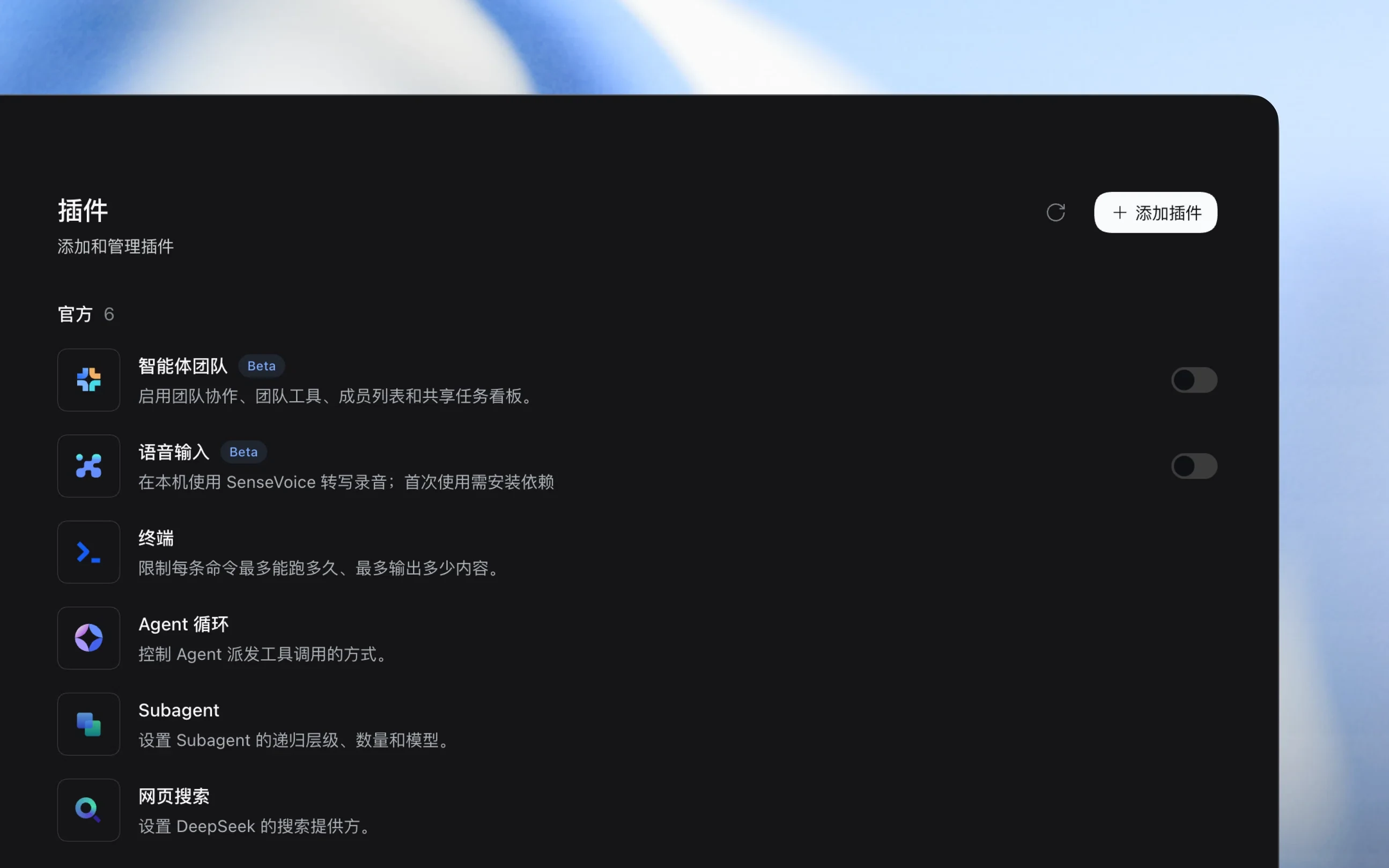
DeepSeek Harness is an agent harness from DeepSeek AI, issued as the dsh command, aimed at coding, document and spreadsheet work, sourced research, and long-running background jobs. Its design premise is that every capability ships as a plugin: the model adapter, tool registry, session log and agent loop alike, all mounted on the Cordis framework, so any of them can be swapped by editing a patch file. In the Web UI you add a workspace, choose a model, and let the agent read and edit files, run commands, delegate to subagents and keep a plan, with approval prompts where the permission policy demands them. Plugins extend it with tools, skills, voice input, automated review and scheduled tasks, and Creator mode lets the harness write a new plugin for you from a description.
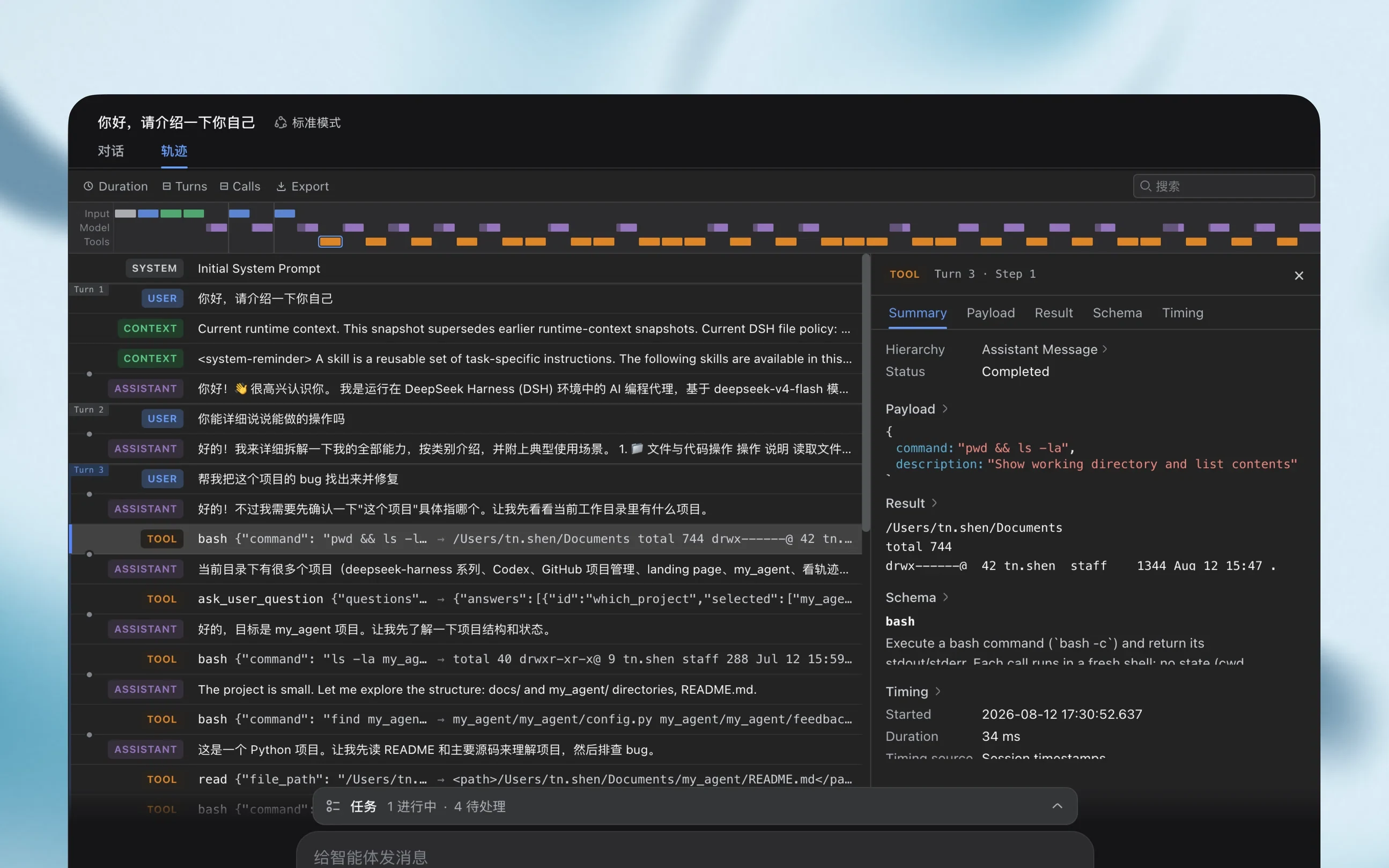
Sessions, a scheduled-reminder Automation page, an execution-trace developer view, and an opt-in GitHub webhook overlay that opens read-only review sessions cover the day-to-day workflow. Self-hosting means running Node.js: npx @deepseek-ai/dsh web serves the interface on 127.0.0.1:3080, a checkout can be built with pnpm, and macOS/Windows desktop installers plus a Python SDK wheel (no system Node.js required) are published. Each run composes a profile — web, headless, sdk, sdk-minimal or acp — from stacks of plugin bundles under $DSH_HOME, customised with cordis.patch.yml overlays and --patch files. Model access needs your own DeepSeek key, another provider key, or a custom OpenAI-compatible gateway. Behind a reverse proxy you advertise the public address with --public-url, admit the browser authority with --trusted-host, and can terminate TLS natively, while the listening port still needs network restriction. The project is in developer preview with compatibility-breaking changes expected; it has no security audit, executes model-generated code and third-party plugins, and its own safety notes suggest running it in a disposable VM or container.
DeepSeek Harness alternatives
 SandBase HarnessSelf-hosted, open-source runtime for AI agent sessions: sandboxes, MCP toolsets, credential vaults, memory, audit replay, and a built-in web Console.CompareSandBase Harness with DeepSeek Harness
 DSH MobileSelf-hosted Android app running DeepSeek Harness AI agent locally without root or Termux, with 19 built-in toolchains and accessibility automation.CompareDSH Mobile with DeepSeek Harness
 deer-flowAn open-source long-horizon SuperAgent harness that researches, codes, and creates. With the help of sandboxes, memories, tools, skill, subagents and message gateway, it handles different levels of tasks that could take minutes to hours.Comparedeer-flow with DeepSeek Harness
 MindsDBSelf-hosted, open-source agent workspace that automates recurring knowledge work, publishes artifacts to live URLs, and routes across frontier and open models.CompareMindsDB with DeepSeek Harness
 HarnessRouterSelf-hosted, open-source gateway running Codex, Claude Code and other agent harnesses behind one OpenAI Responses-compatible API with sessions, streaming and files.CompareHarnessRouter with DeepSeek Harness
 Deep Research Web UISelf-hosted AI agent generates cited reports via web searches, browsing real sources, and verifying evidence. Supports many AI providers and search APIs via Docker.CompareDeep Research Web UI with DeepSeek Harness
 OpenDesignOpen-source, local-first design workspace, self-hosted in a single Docker container; briefs become prototypes, decks and dashboards via your own coding agent.CompareOpenDesign with DeepSeek Harness
 CasibaseOpen-source personal AI assistant with RAG knowledge bases, MCP tool use and autonomous agent loops; one self-hosted binary with 30+ model providers, SSO and audit logs.CompareCasibase with DeepSeek Harness
Should you self-host DeepSeek Harness?
DeepSeek Harness scores 87/100 on selfhost.directory (how scoring works) and ranks #3 of 209 in AI Agents. It has 280 572 GitHub stars, +24 580 in the last 30 days.
There was no stable release in the past 12 months, so check the repository's recent activity before you rely on it.
Setup is moderate: expect some configuration beyond a single command. It is MIT-licensed and written mostly in Typescript.
Its closest alternative on selfhost.directory is Orca (91/100, 124 444 stars). It scores higher overall, so compare the two before you pick. See DeepSeek Harness vs Orca side by side.
Features
- Conversational plugin creation
- Custom OpenAI-compatible endpoints
- Desktop application
- Execution trace view
- Headless and one-shot mode
- Image input
- MCP SupportMemory MCP configurations are default-off reference overlays.
- Multiple model providersOAuth-based providers such as Codex are not supported yet.
- Plugin Architecture
- Scheduled TasksListed as experimental on the plugin list.
- Shell command executionSandboxing and approval prompts reduce but do not guarantee isolation.
- Subagents
- Web Search
- Workspace file editing
DeepSeek Harness README
English | 中文
DeepSeek Harness (dsh) is an open-source agent harness developed by DeepSeek AI.
It is built on an everything-is-a-plugin architecture and powered by Cordis, whose design is described in A Programming Paradigm for Spatiotemporal Composability.
Documentation: https://deepseek-harness.github.io/deepseek-harness/
DeepSeek Harness is in developer preview and iterating rapidly. THERE WILL BE COMPATIBILITY-BREAKING CHANGES.
More in AI Agents
- deer-flowAn open-source long-horizon SuperAgent harness that researches, codes, and creates. With the help of sandboxes, memories, tools, skill, subagents and message gateway, it handles different levels of tasks that could take minutes to hours.
 DeftSelf-hosted workspace unifying chat, tasks, knowledge, calendar, and AI agents. Docker Compose deploy, BYO AI providers, MCP for agent access. AGPL-3.0-only, alpha.
 DeskRPGA self-hosted 3D workspace where Hermes AI profiles become desk-dwelling coworkers that chat, meet, tackle kanban tasks, and run scheduled jobs in a shared office.
 difyDify is a self-hosted, open-source LLM app platform with visual workflows, RAG pipelines, agents, and model management for taking AI apps from prototype to production.
 disp8chSelf-hosted AI workspace turning plain English into visual workflows, multi-agent ops, cited research, and design artifacts — runs offline with local models.
 DodaiosSelf-hosted open-source AI assistant for desktop and headless servers. Coordinates coding agents, voice control with wake word, 40+ tool integrations, all data local.
 dograhSelf-hosted open-source voice AI platform: build phone agents in a visual workflow editor with BYOK LLM/STT/TTS and telephony — an alternative to Vapi and Retell.
 DormiceDormice is a self-hosted, E2B-compatible sandbox platform for AI agents. Permanent sandboxes freeze when idle (~5 MiB RAM) and wake in ~50ms. Single binary deploy.
 dotcraftDotCraft is a self-hosted, open-source AI agent runtime on .NET with desktop, CLI, Android apps sharing one workspace, plus server deployment and embeddable harness.
- DSH MobileSelf-hosted Android app running DeepSeek Harness AI agent locally without root or Termux, with 19 built-in toolchains and accessibility automation.
 duragraphDuraGraph is a self-hosted, open-source control plane for durable AI agent workflows. It uses event sourcing and CQRS to make every run replayable and crash-safe.
 e2bOpen-source sandboxes with JS and Python SDKs for running agent code in isolated Linux VMs; self-hosted via Docker Compose, Terraform, or Kubernetes on one machine.
0 comments